New Chandigarh Mullanpur Area Guide: The Complete Area & Investment Guide 2026
Royals Property Consultant is a trusted name for buying, selling, renting, and investing in residential and commercial properties in Zirakpur, Mohali, Chandigarh, and New Chandigarh.
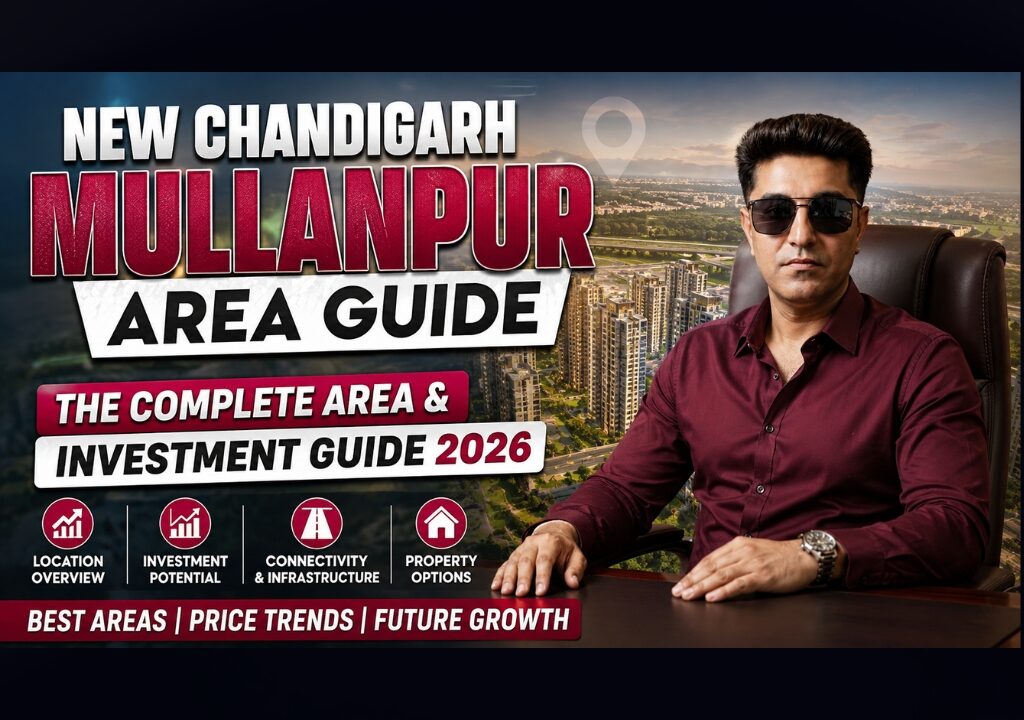
New Chandigarh Mullanpur Area Guide: The Complete Area & Investment Guide 2026
Everything about living in and investing in New Chandigarh — GMADA plots, Eco City 1 through 4, DLF and Omaxe projects, MediCity, Edu City, the Cricket Stadium, connectivity, schools, hospitals, prices, and the legal checks every buyer needs — written by someone who has sold property in this belt for 15+ years.
New Chandigarh is the single most-asked-about area in every conversation we have with buyers across the Tricity right now — and also the most misunderstood. Some buyers think of it as “the next Chandigarh.” Others dismiss it as a plotted township that’s still years from being livable. The truth sits between the two: New Chandigarh is a genuinely ambitious, government-backed greenfield city that is real and progressing, but it is not finished, and buying here requires a longer horizon and a different mindset than buying in an established Mohali sector. This guide covers every part of that picture — what’s actually built, what’s still on paper, what to buy, what to avoid, and how New Chandigarh compares to every other Tricity market.
What is New Chandigarh?
New Chandigarh, branded and popularly known as Mullanpur, is a master-planned greenfield township developed by GMADA (Greater Mohali Area Development Authority) on the northern edge of Mohali district, adjacent to the Punjab-Chandigarh border. It was conceived as Punjab’s answer to Chandigarh’s own land-supply ceiling — since Chandigarh, as a Union Territory, cannot expand its physical footprint, New Chandigarh was planned from scratch to absorb the region’s next phase of institutional, residential, and commercial growth.
History & Why New Chandigarh Was Developed
The Mullanpur master plan was first conceived in the mid-2000s as GMADA’s most ambitious greenfield project — a fully planned city rather than an organic extension of Mohali. The core motivation was straightforward: Chandigarh’s heritage and height restrictions meant it had run out of room, while Mohali’s older sectors were filling up. New Chandigarh was designed to be Punjab’s next planned urban centre, anchored by institutional catalysts — a medical city, an education city, a sports city, and GMADA’s Eco City residential phases — rather than being purely residential.
GMADA’s Vision & Master Plan
GMADA’s vision for New Chandigarh divides the township into functional zones: residential sectors (Eco City phases and GMADA-allotted sectors), an institutional MediCity zone anchored by AIIMS Mohali and private hospital campuses, an Edu City zone for universities and schools, a Sports City zone built around the Mullanpur Cricket Stadium, and private developer pockets (DLF, Omaxe, and others) layered within the overall grid. The plan follows Chandigarh’s own sector-based planning philosophy — wide roads, dedicated green belts, and segregated land-use zones — extended onto a much larger canvas.
How Big is New Chandigarh & Timeline of Development
This is a multi-decade township, not a two-year project. Buyers should mentally size the timeline in phases (Eco City 1 → 2 → 3 → future extensions) rather than expecting the entire township to mature at once.
Location Analysis
New Chandigarh sits directly north of Mohali and Chandigarh, along the Kurali-Siswan corridor, positioned to capture overflow growth from both cities while remaining within GMADA’s planning jurisdiction.
Distances are approximate road-distance estimates from central Mullanpur sectors and vary by exact address within New Chandigarh — always confirm the specific project’s distance for your daily commute needs.
Connectivity Guide
New Chandigarh’s connectivity story is built around three corridors: the link road connecting Mullanpur to Chandigarh via Sector 52/53, the PR7 Expressway system linking the wider Mohali growth belt, and the Kurali road corridor connecting toward Ropar and the Himachal border. Road widening and junction upgrades along these corridors have been an ongoing GMADA priority as the township’s population grows.
Public transport within New Chandigarh is still developing alongside the township itself — most residents currently rely on private vehicles or app-based cabs, with local bus connectivity improving as more sectors reach possession-ready population density. Peak-hour traffic on the Chandigarh-Mullanpur link road has grown noticeably over the past few years as more families move in, which is a natural pattern for a maturing township rather than a red flag specific to New Chandigarh.
Infrastructure Analysis
| Infrastructure | Status |
|---|---|
| Roads | Wide, planned sector-grid roads in developed phases (Eco City 1/2); newer phases under active construction |
| Electricity | Underground utilities in planned sectors — a structural advantage over unplanned colonies |
| Water Supply & Sewerage | Municipal supply and sewerage infrastructure developed alongside each phase; newer phases (Eco City 3) still building this out |
| Internet & 5G | Available from major telecom operators; coverage strongest in developed sectors and weaker at the township’s newer edges |
| Street Lights, Parks & Green Belts | A defining feature of the master plan — generous green belts and planned parks distinguish New Chandigarh from denser urban markets |
| Drainage | Planned stormwater drainage built into newer phase tenders (Eco City 3 infrastructure works) |
| Walkability & Cycling | Wide roads and green belts support walkability in developed pockets; cycling infrastructure is informal rather than dedicated |
Education
New Chandigarh’s Edu City zone is planned as a dedicated educational hub, envisioned to host university campuses, professional colleges, and international schools over the coming decade. Today, residents largely rely on established schools in Chandigarh, Mohali, and Kharar for the school-age population, while Edu City’s institutional build-out continues in phases. Buyers with young children should verify current school options near their specific project rather than assuming the full Edu City vision is already operational.
Healthcare
The MediCity zone is New Chandigarh’s most significant long-term demand anchor — a planned medical city anchored by AIIMS Mohali and envisioned to include private hospital campuses and medical research institutions. AIIMS Mohali itself is already operational and serves as a major regional healthcare anchor. Additional private healthcare capacity within MediCity is expected to build out over the coming years; residents currently also rely on established hospitals in Mohali and Chandigarh (including PGI) for tertiary care.
Lifestyle
Day-to-day lifestyle in New Chandigarh is still catching up to its master-plan ambition. Developed Eco City sectors have local markets, cafes, and basic retail, but the wider mall/multiplex/large-format retail ecosystem that residents associate with established cities is still emerging. The Mullanpur Cricket Stadium is New Chandigarh’s marquee lifestyle and sports landmark, already hosting major cricket fixtures and anchoring the township’s Sports City vision. For broader weekend entertainment, shopping, and dining, most residents currently travel into Chandigarh or Mohali.
Employment
New Chandigarh is not primarily an employment-driven market the way Mohali’s IT City corridor is — most residents currently commute to jobs in Chandigarh, Mohali’s IT parks, or Panchkula’s industrial areas. As MediCity and Edu City institutions come online over the coming years, they’re expected to create their own localised employment base (healthcare professionals, academic staff, and supporting services), which would meaningfully change New Chandigarh’s rental demand profile from a purely residential/appreciation play toward genuine end-use employment demand.
Complete Real Estate Guide — Current Market
New Chandigarh’s real estate market today is a mix of three buyer profiles: long-horizon investors buying GMADA plots or pre-launch branded apartments purely for appreciation; end-users buying into DLF, Omaxe, or GMADA-plotted sectors to build their long-term home; and a smaller but consistent NRI segment drawn to GMADA’s clean-title plots as a low-maintenance long-term family asset. Demand has been most active in Eco City 1 and 2 (already-developed resale markets) and in DLF/Omaxe branded launches, while Eco City 3 remains in the early infrastructure-building stage following its 2025 land acquisition milestone.
Property Types & Top Residential Projects
New Chandigarh offers a genuinely wide spread of property types: GMADA-allotted residential plots, private-developer apartments and luxury towers, independent floors and builder floors, villas, and a growing commercial layer of SCO/SCF units and retail shops within the township’s planned commercial pockets.
DLF (Hyde Park / New Chandigarh presence)
DLF’s presence in the wider Mohali/New Chandigarh corridor carries significant brand weight for buyers who prioritise builder credibility and an established resale market above all else. Pros: strong brand trust, active resale liquidity. Cons: premium pricing relative to GMADA-direct plots; appreciation more brand-driven than corridor-driven.
Omaxe New Chandigarh
Omaxe has an early and significant presence in the Mullanpur master-plan area, positioned as branded, RERA-registered exposure to the MediCity and Edu City demand story. This is a 5-10 year appreciation play rather than a short-term flip. Pros: early-mover positioning, branded RERA exposure. Cons: value realisation depends heavily on MediCity/Edu City actually building out on schedule.
GMADA Eco City (Direct Plots)
Government-backed plots with clear title and no builder execution risk — you buy land directly from GMADA and build (or hold) at your own pace. Pros: institutional credibility, no developer dependency, historically strong appreciation (Eco City 1 buyers from 2015-18 have seen consistent multi-fold growth). Cons: construction obligation and timeline in some schemes; no immediate rental income until built.
Ambika, Altus, Manohar Singh, SBP & Other Private Pockets
Beyond the largest names, a growing number of mid-size and regional developers have active or planned pockets within New Chandigarh’s private-developer zones. Evaluate each strictly on RERA registration, delivery track record on past projects, and specific location within the township — brand recognition varies far more here than in Mohali’s established sectors, so due diligence matters more, not less.
Area-Wise Guide
Eco City 1
The most mature phase — largely delivered, active resale market, original 2011-era allottees have seen the strongest long-term appreciation in the township.
Eco City 2
Significantly developed with an active resale market; slightly newer than Eco City 1 with a similar planned-sector layout.
Eco City 3
716 acres, land acquisition completed 2025, ₹3,690 crore compensation awarded. Infrastructure works (roads, sewerage, water) in progress as of 2026 — see our dedicated Eco City 3 guide for launch timeline and pricing context.
Eco City 4
As of mid-2026, GMADA has not formally notified an “Eco City 4” phase. Treat any such marketing claims as unofficial until GMADA issues a brochure or notification.
DLF & Omaxe Pockets
Branded private-developer zones within the master plan, generally commanding a premium over GMADA-direct plots for brand trust and amenities.
MediCity Zone
Institutional healthcare anchor around AIIMS Mohali — the township’s most durable long-term demand driver as private hospital campuses build out.
Edu City Zone
Planned educational hub for universities, colleges and schools — a multi-year build-out still in relatively early stages.
Sports City & Cricket Stadium
Anchored by the operational Mullanpur Cricket Stadium — the township’s most visible completed landmark and a genuine lifestyle draw.
Investment Analysis
| Factor | Assessment |
|---|---|
| Who should invest | Long-horizon investors (7-10+ years), NRIs wanting clean-title GMADA plots, end-users planning ahead of institutional build-out |
| Who should be cautious | Buyers needing immediate rental income, short-horizon flippers, buyers uncomfortable with ongoing-construction surroundings |
| Rental Yield | Lower currently than established Mohali sectors — employment base still developing |
| Capital Appreciation | Historically strong in Eco City 1/2; future phases depend on MediCity/Edu City execution pace |
| Liquidity | Good in Eco City 1/2 resale market; lower in newer, still-developing phases |
| Risk | Medium — government-backed planning reduces title risk, but execution-timeline risk remains real (Eco City 3’s own 2020 cancellation is a reminder) |
| Future Potential | Among the strongest in the Tricity on a 10-year view, contingent on MediCity, Edu City and Sports City continuing to build out as planned |
New Chandigarh is the investment I recommend most often to clients who tell me they can wait ten years and don’t need the property to pay for itself next year. It’s the wrong recommendation for someone who needs rental income to cover an EMI today. I’ve watched Eco City 1 buyers from 2015-18 do extremely well — but they were patient, and they bought government-backed plots, not speculative private-pocket promises.
Price Guide — Understanding the Trends
We deliberately don’t publish fixed price figures here, because New Chandigarh’s pricing varies significantly by exact phase, project, and current market conditions — a number accurate in one quarter can be stale within months. As a general pattern: GMADA-direct plots in developed Eco City phases command a premium over undeveloped zones; branded private-developer projects (DLF, Omaxe) typically price above GMADA-direct plots for the same broad area; and commercial SCO/SCF units in planned commercial pockets carry their own separate pricing logic tied to expected footfall once the township matures. For current, accurate pricing on any specific plot or project, please contact our team directly — we don’t publish fixed prices because they change too quickly to stay reliable in writing.
Pros, Cons & Common Buyer Mistakes
| Advantages | Disadvantages |
|---|---|
| Government-backed master planning and clear GMADA titles | Infrastructure and social ecosystem still maturing vs. established Mohali/Chandigarh |
| Generous green belts, wide roads, planned sector grid | Lower immediate rental income than established employment corridors |
| Strong long-term demand anchors — MediCity, Edu City, Sports City | Execution-timeline risk — phases have historically slipped (Eco City 3’s 2020 cancellation) |
| Historically strong appreciation in developed phases (Eco City 1/2) | Newer phases require patience — not a quick-flip market |
Legal Guide
| Check | Why It Matters |
|---|---|
| GMADA-Approved Status | Confirms the plot or sector is part of the official master plan, not an unauthorised colony |
| RERA Registration | Mandatory for private-developer projects; verify directly on the Punjab RERA portal (rera.punjab.gov.in) |
| Registry & Mutation | Confirms updated, undisputed ownership records for resale purchases |
| CLU (Change of Land Use) | Relevant for any private land parcels adjacent to the notified township that haven’t completed formal land-use conversion |
| Bank Loan Availability | Most established GMADA plots and RERA-registered private projects are bank-approved; always confirm for the specific unit |
For the full step-by-step legal due diligence process — documents to verify, red flags to watch for, and how to check builder track records — see our complete legal knowledge resource.
Read the GMADA & Mohali Complete Guide →Cost of Living
Cost of living in New Chandigarh sits close to Mohali’s, with maintenance charges in GMADA-plotted sectors generally lower than in fully-amenitised private societies. Groceries, transportation, and internet costs mirror the broader Tricity, though residents should budget for slightly longer commute costs (time and fuel) until MediCity/Edu City employment reduces the need to travel into Chandigarh or Mohali for daily needs.
New Chandigarh vs Other Tricity Markets
| Comparison | Key Takeaway |
|---|---|
| New Chandigarh vs Mohali | Mohali offers deeper institutional confidence, established IT City employment, and a more liquid resale market today. New Chandigarh offers a longer-horizon appreciation play tied to MediCity/Edu City build-out. See our GMADA & Mohali guide. |
| New Chandigarh vs Zirakpur | Zirakpur offers better near-term rental yield and end-user demand; New Chandigarh is the longer-horizon, more institutionally-anchored bet. See our Zirakpur vs Mohali comparison for the wider context. |
| New Chandigarh vs Chandigarh | Chandigarh has zero new land supply and the highest prestige/scarcity premium; New Chandigarh is the only way to get a “Chandigarh-adjacent” planned address at a lower entry point. |
| New Chandigarh vs Panchkula | Panchkula offers established civic infrastructure on the Haryana side; New Chandigarh offers newer, more spacious planning but a less mature social ecosystem. |
| New Chandigarh vs Kharar | Kharar is a more affordable, faster-churn rental market; New Chandigarh is a planned, institutionally-anchored, longer-horizon investment. |
Who Should Buy in New Chandigarh?
🏡 First-Time Buyer
Wants a planned, spacious environment and can wait for the ecosystem to mature.
Consider: Eco City 1/2 resale apartment or GMADA plot
📈 Investor
Chasing long-horizon appreciation over immediate income.
Consider: GMADA plot or early-phase branded project
🌍 NRI
Wants clean title and low-maintenance long-term family asset.
Consider: GMADA-direct plot
👴 Retired Couple
Values green, spacious surroundings and future healthcare access via MediCity.
Consider: Ready villa or independent floor in Eco City 1/2
💎 Luxury Buyer
Wants prestige and space at a lower entry point than Chandigarh proper.
Consider: DLF or Omaxe branded luxury project
💼 Business Owner
Considering future commercial opportunity as the township matures.
Consider: Wait for MediCity/Edu City commercial pockets to mature further, or an early SCO plot for long-term positioning
🩺 Doctor
May benefit directly from MediCity’s healthcare ecosystem build-out.
Consider: Residential unit near the MediCity zone
🏛️ Government Employee
Values institutional credibility and long-term security.
Consider: GMADA-allotted plot
👨👩👧 Young Family
Should weigh current school/hospital access carefully against future Edu City/MediCity promises.
Consider: Eco City 1/2 for closer-to-ready infrastructure
Future Development
The following are officially announced or publicly reported plans — distinguished here from mere expectation:
| Development | Status |
|---|---|
| Eco City 3 infrastructure (roads, sewerage, water) | Confirmed — land acquisition complete, tenders progressing as of 2026 |
| MediCity expansion (private hospital campuses) | Publicly reported plan, phased execution ongoing |
| Edu City institutional build-out | Publicly reported plan, early-to-mid stage execution |
| Sports City / Cricket Stadium ecosystem | Confirmed — stadium operational, surrounding sports infrastructure developing |
| “Eco City 4” | Not officially notified as of mid-2026 — treat as unconfirmed expectation only |
| Chandigarh-Mohali Metro corridor | Discussed at proposal stage — not yet formally notified for construction |
Frequently Asked Questions — New Chandigarh
Is New Chandigarh a good place to live?
Yes, for buyers who value green, spacious, master-planned surroundings and don’t need a fully mature retail/social ecosystem immediately — that continues to build out in phases.
Is New Chandigarh good for investment?
Yes, particularly for long-horizon investors (7-10+ years); it’s a weaker fit for anyone needing immediate rental income or a quick exit.
Should I buy property in New Chandigarh?
Depends on your goal — strong fit for long-term appreciation, NRI clean-title plots, and future MediCity/Edu City-linked demand; weaker fit for immediate income needs.
What are the best sectors in New Chandigarh?
Eco City 1 and 2 are the most developed and liquid today; Eco City 3 offers earlier-stage entry pricing with more execution-timeline risk.
New Chandigarh vs Mohali — which is better?
Mohali offers more mature infrastructure and employment-driven rental demand; New Chandigarh offers a longer-horizon, more spacious, institutionally-anchored appreciation play.
New Chandigarh vs Zirakpur — which is better?
Zirakpur suits buyers wanting near-term rental yield and established connectivity; New Chandigarh suits patient, long-horizon buyers.
Who is the best builder in New Chandigarh?
DLF and Omaxe carry the strongest brand recognition; GMADA-direct plots offer the strongest government-backed title security. Verify RERA and delivery track record for any specific project.
What is Eco City in New Chandigarh?
Eco City is GMADA’s flagship residential development within New Chandigarh, developed in phases (1, 2, and 3 so far) — see our dedicated Eco City 3 guide for the latest phase.
Is there an Eco City 4?
Not officially, as of mid-2026 — GMADA has not notified a fourth phase. Verify any such marketing directly with GMADA before paying anything.
What is MediCity in New Chandigarh?
A planned institutional healthcare zone anchored by AIIMS Mohali, envisioned to include additional private hospital campuses over time.
What is Edu City in New Chandigarh?
A planned educational hub intended to host university campuses, colleges, and schools — still in a relatively early build-out stage.
How far is New Chandigarh from Chandigarh?
Approximately 12-15 km, depending on the exact sector and route.
How far is New Chandigarh from the airport?
Approximately 25-30 km to Chandigarh International Airport.
Is there a metro planned for New Chandigarh?
A Chandigarh-Mohali metro corridor has been discussed at proposal stage but is not yet formally notified for construction as of mid-2026.
What is the rental yield in New Chandigarh?
Generally lower than established Mohali sectors today, since the local employment base is still developing around MediCity and Edu City.
Is New Chandigarh good for NRI investment?
Yes — GMADA-direct plots offer clean title and low ongoing management burden, which suits NRI buyers well.
What is the ideal holding period for New Chandigarh property?
Most buyers should plan for a 7-10+ year horizon to see the township’s institutional anchors mature fully.
Is New Chandigarh GMADA-approved?
Yes — New Chandigarh (Mullanpur) falls squarely within GMADA’s planning jurisdiction and master plan.
What is the cricket stadium in New Chandigarh?
The Mullanpur Cricket Stadium anchors the township’s Sports City zone and is already operational, hosting major cricket fixtures.
Are there commercial properties available in New Chandigarh?
Yes — SCO, SCF, and retail shop options exist within planned commercial pockets, though the commercial ecosystem is still maturing alongside residential phases.
What mistakes should I avoid when buying in New Chandigarh?
Avoid unofficial “Eco City 4”-style schemes, don’t expect immediate rental income, verify RERA for any private-developer project, and match your holding period to the phase’s actual maturity stage.
Considering New Chandigarh? Talk to the team that knows it phase by phase.
Manindar Verma and Royals Property Consultant specialise in GMADA plots, DLF & Omaxe projects, Eco City resale, and New Chandigarh investment strategy — with zero brokerage and honest, phase-by-phase guidance.
Get a New Chandigarh Project Shortlist
Fill in your details — Manindar Verma personally responds on WhatsApp.
Related Guides
This page is the pillar for New Chandigarh. For deeper dives and the wider buying journey, see:
- The Ultimate Tricity Property Buying Guide — the full 9-step buying process this page belongs to
- Eco City 3 New Chandigarh 2026 — Complete Investment Guide — launch timeline, pricing context, land pooling
- GMADA & Mohali Complete Guide — the wider GMADA jurisdiction and infrastructure story
- GMADA 2026 E-Auction Guide — recent auction results across GMADA corridors
- Best Property Investment Chandigarh Tricity 2026
- Zirakpur vs Mohali: Which Is Better to Buy in 2026?
- Property Type Comparison Guide — plots vs apartments vs villas explained
- Home Loan Hub Tricity — eligibility, EMI, CIBIL and bank comparison
Distances, timelines, and project details reflect publicly available information as of July 2026 and may change. This is educational content, not financial or legal advice — verify current GMADA notifications, RERA status, and pricing directly before making any purchase decision.