
GMADA in 2026: Major Projects Transforming Mohali — Complete Guide
Royals Property Consultant is a trusted name for buying, selling, renting, and investing in residential and commercial properties in Zirakpur, Mohali, Chandigarh, and New Chandigarh.
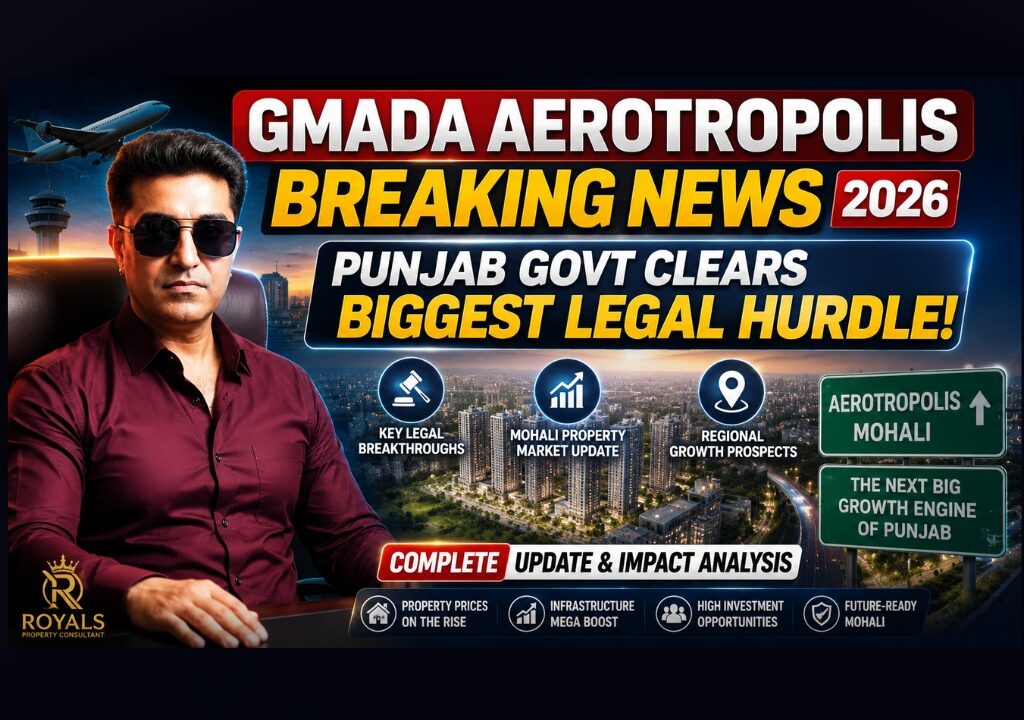
GMADA in 2026: Major Projects Transforming Mohali — Complete Guide
Everything you need to know about GMADA’s active projects — Aerotropolis, Eco City 1 through 4, IT City, New Chandigarh and the infrastructure corridors linking them. Fact-checked, status-verified, and written for buyers, NRIs, investors, and developers who want clarity, not hype.
📋 Table of Contents
📲 Real estate mein aage rehna hai? Latest GMADA & property updates seedha apne WhatsApp par paayein — abhi join karein.
✅ Follow Our WhatsApp ChannelWhat is GMADA — and Why Does it Matter in 2026?
The Greater Mohali Area Development Authority, or GMADA, is a statutory planning body established by the Government of Punjab in 2006 under the Punjab Regional and Town Planning and Development Act, 1995. Its mandate: plan, develop, and regulate the entire Greater Mohali region — covering SAS Nagar (Mohali), Banur, Zirakpur, Derabassi, Kharar, Mullanpur, Fatehgarh Sahib, Mandi Gobindgarh, and Roopnagar.
Think of GMADA as the urban planning engine that is converting a satellite town next to Chandigarh into a self-sufficient metropolitan region. Chandigarh itself cannot expand — it is a Union Territory with fixed boundaries. GMADA fills that gap by methodically developing land in Punjab that surrounds the capital. This makes GMADA-planned sectors some of the most strategically located real estate in North India.
In 2026, GMADA is simultaneously developing or planning over 11,000 acres across seven major township projects. Each project has a distinct purpose — and together they are creating an interconnected urban corridor stretching from the airport in the south to the Shivalik foothills in the north.
🏛️ GMADA Legal Backing
GMADA plots come with government backing, RERA registration, and transparent allotment through draw of lots or auction. This distinguishes them from private developer projects and makes them considerably safer — though timelines remain subject to government processes and, in some cases, court proceedings.
Evolution of GMADA — Key Milestones
GMADA Constituted
Statutory authority formed under Punjab Act, covering 8 districts including Mohali, Kharar, Mullanpur and Zirakpur.
Eco City 1 Launched
GMADA’s first residential plot scheme in New Chandigarh received ~1,60,000 applications for 836 plots — setting a precedent for government township demand.
Aerotropolis Concept Introduced
GMADA unveiled the airport-centric township concept — a 5,500-acre integrated city planned adjacent to Shaheed Bhagat Singh International Airport.
IT City & New Chandigarh Expansion
IT City sectors gain traction; New Chandigarh master plan formalized with institutional, medical, and educational corridors.
Eco City 2 Possession & Eco City 3 Initiated
Eco City 2 plots see possession; GMADA restarts Eco City 3 acquisition across 716 acres. Market prices in New Chandigarh begin sharp upward cycle.
Aerotropolis Infrastructure Begins; Eco City 3 Award Declared
Environmental clearances secured; grid road contracts awarded for Aerotropolis. Section 19 compensation award for Eco City 3 declared in December 2025 — 716 acres, ₹3,690 crore in compensation, touching ₹6.46 crore per acre in some villages.
Eco City 4 Notified; Aerotropolis Roads Progress
Section 4(1) notification issued for Eco City 4 (526 acres) in June 2026. Aerotropolis Pocket B, C, D infrastructure underway. Eco City 3 launch expected by end 2026.
GMADA Master Plan — The Vision Behind Modern Mohali
GMADA’s Master Plan is not just a map. It is a blueprint for a metropolitan region designed to absorb Chandigarh’s overflow, generate new employment, and provide planned housing at scale for the next three decades. The current plan encompasses seven new townships, seven new sectors, three additional Aerotropolis pockets, and a new commercial city centre in Sector 87.
What makes planned development valuable for buyers — and verifiable — is the presence of trunk infrastructure before residential occupation. GMADA-developed sectors typically include a 150–200-ft road grid, underground utilities, sewerage, water supply, and parks before plots are handed over. Private colonies rarely match this standard.
| Planning Objective | Current Status (2026) | Vision Target |
|---|---|---|
| Residential Sectors | Eco City 1 & 2 delivered; Eco City 3 acquiring; Eco City 4 notified | Contiguous planned township corridor from Mullanpur to Kharar |
| Airport Township | Aerotropolis Phase 1 (1,650 acres) infrastructure underway | 5,500-acre integrated city by 2032+ |
| Technology Corridor | IT City sectors operational; companies present | Regional IT hub anchoring 50,000+ jobs |
| Industrial Zones | Sector 101, 103 industrial parks in acquisition/development | Warehousing, manufacturing, MSME clusters |
| Institutional Belt | Universities, medical colleges operational in New Chandigarh | Knowledge economy anchoring residential demand |
| Commercial Centres | Aerocity commercial pockets under SCO draw | Sector 87 city centre + Aerotropolis commercial spine |
| Green Belts | MDR-B greenbelt protected; foothills buffer | Ecological corridors connecting Shivalik range to urban core |
| Road Network | PR-7 operational; 200-ft roads in progress | Integrated ring road + airport expressway system |
GMADA Aerotropolis — Complete Pocket-Wise Guide
What is the Aerotropolis Concept?
An aerotropolis is a city planned around an airport as its economic core — not merely near it. Land use zones radiate outward from the airport: aviation commerce, logistics, hotels and hospitality, office parks, residential, and institutional. The airport drives employment, which drives housing demand, which drives commercial activity. GMADA Aerotropolis is Punjab’s first project built on this principle.
The project spans 5,500 acres adjacent to Shaheed Bhagat Singh International Airport in SAS Nagar (Mohali). It is divided into 10 pockets (A through J), each with distinct land use and development status. Plots in this project are not sold — they are allotted by GMADA through a government scheme. Buyers and investors trade LOI (Letter of Intent) documents in the secondary market. An LOI is GMADA’s official confirmation of your plot allotment.
📍 Location Advantage
- 2–5 km from Shaheed Bhagat Singh International Airport
- Direct connectivity via Airport Road and PR-7 (Zirakpur–Parwanoo Highway)
- NH-7 access within 10 minutes
- Adjacent to IT City and Aerocity sectors
- Shaheed Bhagat Singh Airport handled a record 2.8 million passengers in 2025–26 with direct international routes to Canada, UAE, and UK
Pocket-Wise Status — 2026
Under court case (Guava Scam litigation). LOIs exist but cannot be registered until resolved. Avoid buying without legal verification.
Grid road work underway. Residential and institutional use planned. Closer to operational readiness than later pockets.
M/s SBEIPL-HRG (JV) awarded infrastructure contract. Development underway alongside Pocket B and D.
Active development. Commercial and mixed-use zones planned with airport-facing frontage advantage.
Part of more recent acquisition processes. Infrastructure planned but not yet active. Medium-term horizon for buyers.
Institutional and residential mix proposed. Dependent on Phase 1 progress before active development begins.
Planned greenfield residential sector. Long-term play — likely 5+ years from possession.
Industrial and warehousing zones proposed, given proximity to airport cargo facilities.
Aerotropolis extension belt. Banur corridor — 2,489 acres notified for expansion. Very long-term.
Outermost planned pocket. Conceptual stage. Suited for visionary investors with 7–10 year horizon only.
| Status (2026) | Primary Land Use | Key Risk | Investment Horizon | |
|---|---|---|---|---|
| Pocket A | Court Dispute | Residential + Institutional | LOIs cannot be registered; litigation ongoing | Speculative only |
| Pocket B | Infra Underway | Residential + Commercial | Possession expected 2027–28 | 2–3 years |
| Pocket C | Infra Underway | Mixed Use | Possession expected 2027–28 | 2–3 years |
| Pocket D | Infra Underway | Commercial + Residential | Possession expected 2027–28 | 2–3 years |
| Pockets E–J | Planning/Acquisition | Mixed — varies by pocket | High timeline uncertainty | 5–10+ years |
⚠️ NRI Investor Note
NRI buyers account for approximately 40% of Aerotropolis enquiries, driven by direct flights to Canada, UAE, and the UK. LOI secondary market prices have appreciated roughly 20% year-on-year over the past three years. However, this is a capital appreciation play — no rental income from a bare LOI. Liquidity in the secondary market is good but not instant. Always verify LOI authenticity with GMADA directly before any transaction.
GMADA Eco City Projects — Phases 1 to 4 Explained
The Eco City series is GMADA’s flagship residential township programme in New Chandigarh, Mullanpur. Each phase builds on the previous — geographically and in planning maturity. Understanding where each phase stands in 2026 is critical before investing.
Eco City 1 — The Benchmark
Launched in 2011, Eco City 1 was GMADA’s debut residential scheme in New Chandigarh — and it set the benchmark for demand. Approximately 1,60,000 applications arrived for just 836 residential plots, a ratio that reflected how starved the Chandigarh region was for planned, affordable government housing. The scheme was developed across roughly 419 acres around Mullanpur Garibdas village through 100% land pooling — farmers received developed plots in exchange for their agricultural land, making them stakeholders rather than displaced residents.
Today, Eco City 1 is the most mature township in the New Chandigarh corridor. Infrastructure is in place — roads, parks, water supply, sewerage, and schools. Resale market in Eco City 1 is active, with plot values significantly above original allotment prices. If you want a near-ready-to-build plot in a government township near Chandigarh, this is the reference point.
Eco City 2 — Delivered and Growing
Eco City 2 covers roughly 387 acres across Hoshiarpur and Takipur villages. Possession has been handed over to allottees in most sectors. Infrastructure is substantially complete. A 96-acre Eco City 2 Extension was announced in late 2025, adding 153 residential plots (135 of 1 Kanal and 18 of 2 Kanal) plus 68 commercial plots. The draw-based allotment price for the extension was approximately ₹60,000 per square yard — meaning a 1 Kanal (500 sq. yd.) plot comes to roughly ₹3 crore through the draw. Open market auction prices for similar plots touched ₹9 crore — demonstrating the significant premium buyers willingly pay for direct GMADA allotment versus secondary market entry.
💡 Eco City 2 Extension — Key Facts
- 96 acres in Hoshiarpur village, New Chandigarh
- 153 residential plots (135 × 1 Kanal, 18 × 2 Kanal)
- 68 commercial plots via open auction
- Draw-based allotment price: ~₹60,000/sq. yd.
- Also includes group housing and institutional sites
Eco City 3 — Acquisition Complete, Launch Approaching
Eco City 3 is the project that crystallises GMADA’s ambitions for scale. The acquisition covers 716 acres from nine villages — Kansala, Kartarpur, Rajgarh, Takipur, Hoshiarpur, Rasulpur, Dhodemajra, Majra, and Salamatpur. The compensation announced was ₹3,690 crore, with rates touching ₹6.46 crore per acre in certain villages — among the highest ever paid for agricultural land in Punjab’s urban fringe.
The Section 19 compensation award under the LARR Act, 2013 was declared in December 2025, legally clearing the path for GMADA to take possession and begin infrastructure. The GMADA Chief Administrator has indicated a township launch could happen by end of 2026, though infrastructure development is still in the early tendering and execution phase. This is not a ready product — it is an early-stage government township with a clear legal and funding foundation.
Eco City 4 — Early Acquisition Stage (June 2026)
Eco City 4 is the freshest chapter in GMADA’s New Chandigarh story — and the most important development to understand clearly. On June 2, 2026, the Punjab government issued a Section 4(1) notification under the LARR Act, 2013 to compulsorily acquire 526.03 acres across four villages in the Kharar tehsil of Mohali district: Kartarpur, Kansala, Rajgarh, and Boothgarh.
The notification followed the resolution of a significant three-week Pucca Morcha farmer protest. The state revised its land acquisition approach in November 2025 — making the Land Pooling Policy optional rather than compulsory, offering farmers a genuine choice between cash compensation and developed plots. A majority of affected village panchayats passed resolutions endorsing the revised process.
🚨 Critical Buyer Warning — Eco City 4
Eco City 4 is at the very beginning of its legal acquisition journey. No public launch is possible for several years, and no authorised pre-booking or advance booking of any kind exists. Anyone approaching you for an advance or booking amount for Eco City 4 plots in 2026 is operating outside any GMADA-sanctioned framework. Do not pay anyone without an official GMADA allotment letter. The government has itself committed to a three-year development timeline as a concession to affected farmers.
| Project | Area | Status (2026) | Plot Types | Infrastructure | Buyer Action |
|---|---|---|---|---|---|
| Eco City 1 | ~419 acres | Developed | Residential; 836 plots allotted | Complete — roads, parks, utilities | Buy resale with clear title |
| Eco City 2 | ~387 acres + 96-acre ext. | Possession Given | Residential + commercial | Substantially complete | Draw or resale; Extension draw open |
| Eco City 3 | 716 acres | Land Acquired; Infra Pending | Residential + commercial (to be announced) | Tendering stage | Watch for official launch; avoid premiums now |
| Eco City 4 | 526 acres | Section 4(1) Only | Not yet defined | None | Do NOT pre-book; wait for official scheme |
🔗 Related Guides on Royals Property Consultant
IT City Mohali — Technology Hub Driving Residential Demand
IT City is GMADA’s dedicated technology and knowledge corridor in SAS Nagar. It occupies sectors along the Chandigarh–Kharar corridor and was conceived to give Punjab a competitive IT destination that could attract software companies, BPOs, data centres, and tech startups that might otherwise gravitate toward Delhi NCR or Bengaluru.
What’s Inside IT City
IT & Tech Companies
Multiple IT parks and office buildings operational. Companies have set up offices, though the corridor is still developing density comparable to mature IT hubs.
Residential Sectors
Planned residential zones within and adjacent to IT City provide housing for the knowledge workforce. GMADA plot schemes have been launched in connected sectors.
Educational Ecosystem
Universities, engineering colleges, and management institutes cluster around IT City, feeding a pipeline of technical talent to local employers.
Connectivity
Direct access via airport road and Chandigarh–Kharar NH. The Aerotropolis, when developed, will sit 10–15 minutes away — creating an employment corridor.
IT City’s Role in the Mohali Real Estate Equation
IT City influences residential demand in surrounding sectors in a straightforward way: employment centres attract workers, and workers need housing within commuting distance. This creates organic demand for plots, floors, and flats in sectors between IT City and Chandigarh. It does not guarantee price appreciation — that depends on supply, sentiment, and economic cycles — but it does provide a structural foundation for long-term residential demand that purely residential areas without employment anchors lack.
GMADA has also notified an Industrial Plot Scheme for IT City (Sector 101), with notices for Hearing of Objections under Section 15 appearing as recently as 2026. This suggests ongoing expansion of the industrial and technology production footprint in the area.
New Chandigarh — Planned City at the Foothills
New Chandigarh is not a single project — it is a geographic corridor. It refers to the planned urban expansion in Mullanpur tehsil and the adjoining sectors of Kharar, stretching north from Chandigarh toward the Shivalik foothills. GMADA is the primary development authority shaping this corridor, with Eco City 1–4, educational institutions, a medicity, sports infrastructure, and commercial zones all mapped within its master plan boundaries.
Why New Chandigarh Commands Attention in 2026
Three factors make New Chandigarh India’s most watched planned city corridor in the mid-2020s. First, Chandigarh proper has essentially no buildable land left for new residential or commercial development. Second, GMADA’s methodical township approach — unlike the chaotic private colony sprawl around many Indian cities — creates environments with real infrastructure and legal clarity. Third, the combination of Eco City townships, institutional anchors (universities, medical colleges, hospitals), and a natural backdrop against the Shivaliks creates a quality-of-life proposition that is genuinely rare.
| Feature | New Chandigarh (GMADA) | Chandigarh (Union Territory) |
|---|---|---|
| Land availability | Large — actively developing | Minimal — near-zero buildable supply |
| Plot entry price | Starting ~₹3 Cr (draw); ₹6–9 Cr market | ₹15–30 Cr+ for government plots |
| Planning authority | GMADA (Punjab Government) | Chandigarh Administration |
| Infrastructure quality | Government-grade; improving rapidly | Benchmark — mature city infrastructure |
| Green cover | Shivalik proximity; planned green belts | Le Corbusier’s green city framework |
| Hospital access | Private hospitals + GMADA Medicity planned | PGI, GMCH — tier-1 medical facilities |
| Future growth potential | High — multiple upcoming phases | Limited — constrained supply |
Infrastructure Highlights
New Chandigarh benefits from MDR-B (the main boulevard-style road running through the corridor), plus internal sector roads, parks, and a growing base of schools and healthcare. The Sports Complex in Mullanpur is a landmark facility. The corridor also has proximity to three national highways, making connectivity to Chandigarh, Panchkula, Ambala, and Delhi manageable.
Industrial Development — The Employment Engine
Residential real estate does not function in isolation. Long-term residential demand in any planned zone depends significantly on nearby employment. GMADA has recognised this and incorporated industrial and logistics zones into its master plan.
Sector 101 Industrial Park
Land acquisition hearings completed in 2026. A ₹270 crore mega industrial hub has been announced for this sector — positioned as a game-changer for Tricity’s industrial landscape.
Sector 103 Industrial Park
Section 15 hearing of objections completed. Warehousing and light manufacturing zones planned. Airport proximity makes this ideal for logistics operations.
MSME Clusters
Small and medium enterprise units planned within industrial zones, supporting local manufacturing and creating accessible employment for the region’s growing workforce.
Industrial development matters to residential buyers for a reason often overlooked: it expands the catchment of genuine end-users for housing. When workers and entrepreneurs relocate for employment, they become homebuyers — creating genuine demand rather than purely investment-driven buying. The Aerotropolis industrial component, aligned with the airport’s cargo capability, adds a logistics dimension that is particularly relevant as e-commerce supply chains reshape warehousing requirements across North India.
Institutional Development — Knowledge Economy Anchor
Institutional zones — universities, medical colleges, research centres, government offices — are typically the most durable anchor for residential demand in planned townships. They employ educated professionals who prefer to live near work, generate student housing demand, and bring with them the commercial ecosystem of cafes, pharmacies, retail, and services.
| Institution Type | Status in New Chandigarh / Mohali | Impact on Residential Demand |
|---|---|---|
| Universities & Engineering Colleges | Multiple operational — IIT Ropar nearby, private universities in Kharar-Mullanpur corridor | Faculty + student housing demand; commercial spin-off |
| Medical Colleges & Hospitals | Several private hospitals operational; GMADA Medicity planned | Medical professionals prefer proximity; creates stable long-term demand |
| Government Institutions | Punjab government offices relocating to Mohali | Government employee quota housing demand |
| Research Centres | Science and technology parks in IT City corridor | High-income knowledge workers; premium residential demand |
| Sports Infrastructure | Mullanpur Sports Complex operational | Draws investment and footfall; supports hospitality sector |
The single most important thing to understand about institutional development and property values: institutions typically take 5–10 years to reach operational maturity and generate meaningful residential demand. Buyers who enter the surrounding residential market early often see the biggest benefit — but they must have the patience and holding capacity to wait for that demand to materialise.
Road Connectivity — The Infrastructure That Moves Value
In real estate, infrastructure is not decoration — it is valuation. A plot that takes 45 minutes to reach from Chandigarh is worth less than an identical plot 15 minutes away, regardless of GMADA approvals. Understanding Mohali’s road network helps you assess realistic travel times, not theoretical ones.
| Road / Corridor | Current Status | Key Connections | Relevance |
|---|---|---|---|
| PR-7 (Zirakpur–Parwanoo Highway) | Operational; 6-lane bypass complete | Zirakpur → Mohali → Kharar → Himachal | Spine of the entire western Mohali corridor; Aerotropolis gateway |
| Airport Road | Operational; widening works ongoing | Chandigarh Airport ↔ IT City ↔ Mohali sectors | Direct Aerotropolis access; commercial corridor |
| MDR-B (Main District Road) | Operational | New Chandigarh north-south spine | Eco City corridor backbone |
| 200-ft Sector Roads | Partially complete; under construction in newer sectors | Internal grid of Aerotropolis and New Chandigarh | Plot accessibility; infrastructure quality marker |
| Chandigarh–Kharar NH | Operational 4-lane | Chandigarh ↔ IT City ↔ Kharar ↔ New Chandigarh | Primary commuter artery for IT City residents |
| Sector Dividing Road (92/92A) | Acquisition notified | Internal Mohali sectors | Sewerage and internal connectivity |
| Ring Road Proposals | Planned — not confirmed | Outer Mohali bypass | Would reduce congestion on PR-7; long-term project |
🛣️ 31 km 6-Lane Bypass Impact
A 31 km 6-lane bypass connecting Chandigarh and Delhi has recently opened, significantly cutting travel time. This improves Delhi NCR ↔ Chandigarh travel and adds strategic value to Mohali’s position as a hub between the capital and the hills.
Future Infrastructure Projects — Confirmed vs Proposed
A common buyer mistake is treating proposals as completed facts. Below is an honest breakdown of what is confirmed and what remains at the planning or proposal stage.
Confirmed — Infrastructure Contracts Awarded
Aerotropolis Pockets B, C, D grid roads (M/s SBEIPL-HRG JV). Eco City 3 Section 19 award (compensation paid). Sector 101 Industrial Park acquisition process active.
Active Acquisition — Legal Process Ongoing
Eco City 4 (Section 4(1) issued June 2026). Sector 87 commercial centre acquisition. Sector 103 Industrial Park objections heard.
Proposed — Master Plan Stage
Ring road bypass around Mohali. Public transport systems (metro extension proposals). Aerotropolis Pockets I and J expansion (Banur belt). Future sector roads in New Chandigarh phases.
Smart Utilities and Environmental Planning
GMADA’s newer schemes include underground utilities (electricity, water, sewerage) rather than overhead wiring — a quality marker that distinguishes planned townships from private colonies. Eco City 1 demonstrates this approach at scale. Eco City 3 and 4, when developed, are expected to follow similar standards. Environmental clearances from SEIAA (State Environment Impact Assessment Authority) have been secured for Aerotropolis — a key milestone that removed a major institutional hurdle in 2025.
Investment Analysis — Balanced View for 2026 Buyers
No investment analysis is complete without acknowledging risk alongside opportunity. The Mohali real estate market is genuinely in an expansion cycle — but different GMADA projects offer very different risk-return profiles depending on where they are in the development journey.
Low risk, stable, moderate upside. Best for end-users.
Near-ready. Extension draw opportunity. Good balance.
Medium risk. 2–3 year horizon. High upside if airport grows.
Early stage. High upside. 3–5 year patience needed.
Employment-backed demand. Good for mid-term hold.
| Project | Current Maturity | Risk Level | Long-Term Outlook | Best Suited For |
|---|---|---|---|---|
| Eco City 1 | Fully developed | Low | Stable appreciation | End-users; NRIs wanting ready possession |
| Eco City 2 (incl. Extension) | Developed + new draw | Low–Medium | Moderate-strong appreciation | Buyers with 1–3 year horizon |
| Aerotropolis B/C/D | Infra underway | Medium | High — airport-linked | Investors with 2–4 year horizon; NRI capital appreciation |
| Aerotropolis A | Stalled — court case | High | Unknown — litigation dependent | Speculative buyers only; legal due diligence mandatory |
| Eco City 3 | Land acquired; no infra | Medium | Very high if timeline holds | Patient investors; 3–5 year horizon |
| Eco City 4 | Section 4(1) only | High — early stage | Very long-term (5–7+ years) | NOT for current buyers; monitor for official scheme |
| IT City | Operational | Low–Medium | Steady employment-backed demand | Professionals; buy-and-hold investors |
| New Chandigarh (Mullanpur) | Mixed — varies by sector | Low–Medium | Strong — scarcity near Chandigarh | End-users; NRIs; long-term investors |
Not Sure Which GMADA Project Fits Your Budget & Goals?
Our team analyses your requirements and matches you with verified, legally clear GMADA properties. Free consultation, no hidden fees.
💬 WhatsApp Manindar 📞 Call: 98787 59508Common Buyer Mistakes in GMADA Properties
Buying in Pocket A Without Legal Check
Pocket A LOIs cannot be registered due to ongoing court proceedings (Guava Scam case). Buyers who purchased without verification are stuck until litigation resolves.
Pre-Booking Eco City 3 or 4
No authorised agent can accept advance bookings for Eco City 3 or 4 plots. Infrastructure doesn’t exist. Anyone collecting money is operating without GMADA sanction.
Buying Unauthorised Colonies Near GMADA Land
Private colonies that claim GMADA “adjacency” but have no RERA registration or CLU approval carry significant legal and resale risk. Always verify approval status.
Assuming Infrastructure Timelines
GMADA projects operate on government timelines, which can change due to court orders, farmer protests, budget cycles, or political decisions. Budget for a longer hold than brochures suggest.
Ignoring Registry and Transfer Charges
LOI transfers typically cost 2.5% of circle rate plus processing fees (~₹6,970 for residential). These are real costs that affect your total investment calculation.
Not Checking Collector Rate vs Market Rate Gap
Registry values in Mohali often sit 30–50% below actual transaction prices. This creates a capital gains tax complexity on resale. Consult a CA before purchasing expensive plots.
📩 Get Expert Advice — Directly on WhatsApp
Fill this form and your enquiry goes straight to Manindar Verma on WhatsApp. No call centre. No waiting.
Frequently Asked Questions — GMADA Projects 2026
GMADA in 2026 — What’s Operational, What’s Coming, What to Watch
GMADA’s footprint across Greater Mohali in 2026 represents the most ambitious planned urban expansion in Punjab’s history. The authority is simultaneously delivering mature residential townships, constructing airport-centric infrastructure, acquiring land for future phases, and planning an industrial ecosystem that could anchor long-term employment for hundreds of thousands of people.
The honest picture, project by project:
| Project | Status | What Buyers Should Do Now |
|---|---|---|
| Eco City 1 | Operational | Buy resale with clear title; ready to build |
| Eco City 2 | Operational + Extension | Monitor draw results; resale available |
| Eco City 3 | Acquired; Pre-Launch | Watch for official GMADA scheme; avoid premiums |
| Eco City 4 | Early Acquisition | Do NOT pre-book; monitor gmada.gov.in |
| Aerotropolis B/C/D | Infra Underway | LOI secondary market opportunity; verify before buying |
| Aerotropolis A | Court Case | Wait for litigation resolution; high risk |
| IT City | Operational | Plot scheme active; good for professionals |
| New Chandigarh | Growing | Best for long-term end-users; buy in mature sectors |
| Sector 87 Commercial | Acquisition Active | Watch for commercial auction; investor opportunity |
| Industrial Sectors 101, 103 | Acquisition Stage | Industrial plot investors monitor GMADA notices |
Over the next decade, if GMADA’s current trajectory continues, the Mohali-New Chandigarh-Aerotropolis corridor has the potential to become a genuinely self-sufficient metropolitan region rather than a Chandigarh satellite. That outcome is not guaranteed — it depends on government consistency, court clearances, airport growth, and the broader economy. But the structural foundations — land acquisition, legal frameworks, trunk infrastructure, institutional anchors — are being laid with more seriousness than at any previous point in GMADA’s history.
For buyers: the best entry points in mature projects (Eco City 1 and 2, operational IT City sectors) are gone — but they were the lowest risk. The next generation of entry points is in Eco City 3 (when officially launched), Aerotropolis Pockets B–D (LOI secondary market), and eventually Eco City 4. Each comes with commensurate risk and time horizons. Invest with clear eyes, verified documents, and realistic timelines.
🎯 Final Expert Recommendation
If you are buying to build and live in the next 2–3 years: Eco City 1 or 2 resale, or operational IT City sectors. If you are investing with a 3–5 year horizon and can handle uncertainty: watch for Eco City 3 official launch. If you want airport-linked capital appreciation with a 3–4 year hold: Aerotropolis Pockets B, C, D LOIs after proper legal verification. If someone is promising you Eco City 4 plots today — walk away.
Need Expert Guidance for Buying, Selling, or Investing?
Contact Royals Property Consultant for professional assistance and verified market insights across Mohali, Zirakpur, Chandigarh, Panchkula, and New Chandigarh.
💬 WhatsApp: 98787 59508 🌐 Visit Website