
Mohali-Kurali Growth Corridor: Why Developers Are Investing Before the Next Growth Wave
Royals Property Consultant is a trusted name for buying, selling, renting, and investing in residential and commercial properties in Zirakpur, Mohali, Chandigarh, and New Chandigarh.
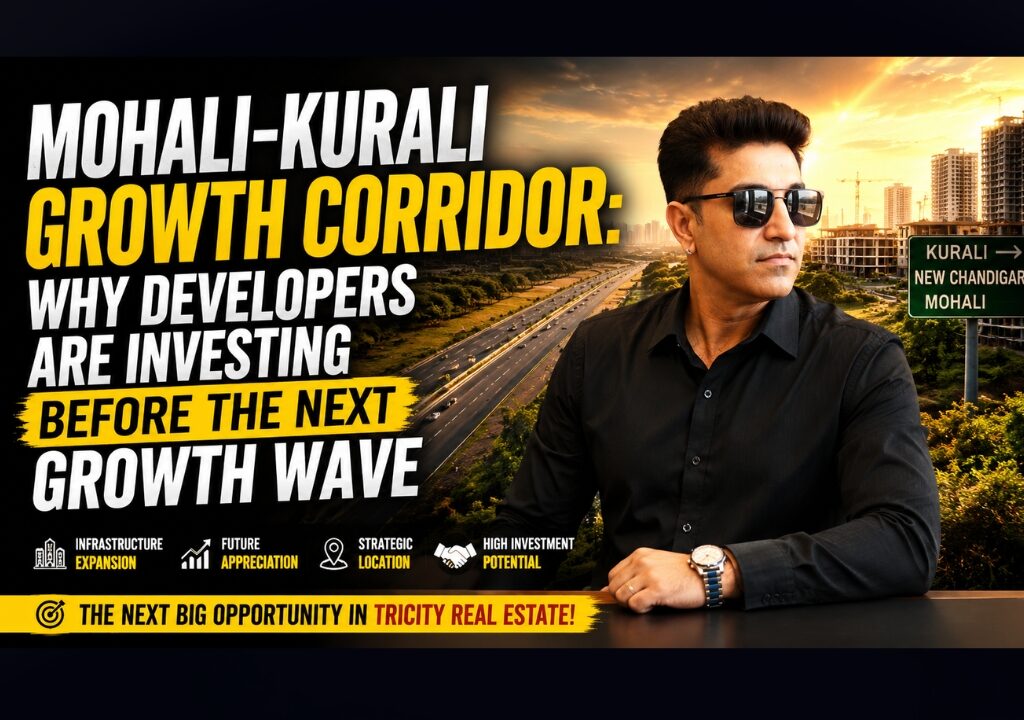
Mohali-Kurali Growth Corridor: Why Developers Are Investing Before the Next Growth Wave
Royals Property Consultant is a trusted name for buying, selling, renting, and investing in residential and commercial properties in Zirakpur, Mohali, Chandigarh, and New Chandigarh.
📞 Call +91 98787 59508 💬 WhatsApp — Free Consultation 📋 Get My Free Corridor Report
⚡ Quick Answer — Google AI & Search Overview
The Mohali-Kurali growth corridor is emerging as Punjab’s next real estate frontier because two forces are moving together: private developers acquiring large land parcels in Mohali for residential, commercial, and mixed-use projects, and GMADA’s draft master plan formally bringing Kurali Municipal Council and 78 surrounding villages under organised urban planning for the first time. Historically, this combination — private capital plus government planning — has preceded sustained, multi-year appreciation in corridors like Mohali and New Chandigarh. The corridor runs roughly from established Mohali sectors through New Chandigarh and Kharar into Kurali along the NH-21/greenfield connectivity belt.
📋 Table of Contents
- Why Punjab Real Estate Is Entering a New Phase
- Mapping the Mohali-Kurali Growth Corridor
- Why Private Developers Are Buying Land Here
- GMADA’s Kurali Expansion, Explained
- How Infrastructure Creates Appreciation
- Lessons From Other Growth Corridors
- Risks Investors Must Understand
- Expert Investment Framework
- Future Outlook: 2026–2035
- FAQs
Why Punjab Real Estate Is Entering a New Phase
Developers rarely commit large capital to a location on a hunch. When acquisitions worth crores happen in the same window that a government authority redraws its planning boundary, it usually reflects several macro trends converging at once: steady urbanisation pressure spilling out of Chandigarh’s constrained core, sustained migration of professionals into the IT and services economy around Mohali, and a state government keen to formalise growth before it turns into unplanned sprawl.
Punjab’s Tricity market has already been through one such transition — from a Chandigarh-centric market to a Mohali-and-Zirakpur-centric one. The Mohali-Kurali growth corridor looks like the next iteration of that same pattern, just earlier in its cycle.
Mapping the Mohali-Kurali Growth Corridor
Understanding this corridor geographically helps explain why developers are positioning here rather than elsewhere. The stretch runs from Mohali’s established sectors and Aerocity, through New Chandigarh (Mullanpur), along the NH-21/Kharar belt, and terminates at Kurali — a town that has, until this year, existed largely outside any dedicated master plan.
- Mohali core sectors: Mature, high-priced, limited fresh land supply.
- New Chandigarh: GMADA’s flagship planned township — institutional anchors maturing steadily.
- Kharar (NH-21 corridor): IT City spillover market, infrastructure-sensitive.
- Kurali: Newly brought into formal planning via the 78-village draft master plan — the corridor’s current frontier.
Connectivity is the thread linking all four: the national highway network, improving road links, and the greenfield corridor connecting this belt to Mohali’s employment centres. As each segment along this line gets absorbed into formal planning, the next one typically becomes the focus of early-mover capital.
Why Private Developers Are Buying Land Here
Separate from GMADA’s own auctions, private developers have been acquiring land parcels across Mohali worth well over ₹1,000 crore for residential, commercial, and mixed-use projects. This is a distinct signal from government auction data — it reflects developers betting their own capital on future demand rather than the government setting a reserve price.
Developers typically buy ahead of a wave for a few structural reasons:
- Land banking: securing large parcels while per-acre cost is still low relative to where planning certainty will eventually push it.
- Mixed-use flexibility: parcels large enough to combine residential, retail, and commercial components capture more of a corridor’s future demand.
- Population and employment forecasting: developers model where Mohali’s workforce will need housing five to ten years out, not just today.
- Construction cycle timing: a 3–5 year construction and approval cycle means today’s land purchase is really a bet on demand in 2029–2031.
Notably, this buying hasn’t slowed despite tighter regulatory scrutiny on developer compliance — if anything, serious players are treating stricter oversight as a filter that weeds out under-capitalised competitors rather than a reason to hold back.
GMADA’s Kurali Expansion, Explained
On 3 July 2026, GMADA released a draft master plan dedicated specifically to Kurali Municipal Council and 78 surrounding villages — the first time Kurali has been treated as a planning area in its own right rather than folded into a wider regional exercise. A 30-day public objection window was opened before the plan moves toward finalisation.
Why does a government authority expand its planning boundary? Master plans exist to sequence infrastructure — roads, drainage, power, water — ahead of construction, and to prevent unauthorised colonies from forming in a legal grey zone. When a village is brought inside a formal residential or commercial zone, three things typically follow over time: clearer legal standing for transactions on that land, a stronger case for infrastructure investment to follow, and reduced risk of the area being reclassified as an unauthorised colony later.
Impact on landowners: if you hold ancestral or investment property in any of the 78 villages, it likely now falls within a formally zoned urban area — worth checking directly with GMADA or the Kurali Municipal Council before the objection window closes.
Impact on buyers: early-stage planning zones carry more uncertainty than a finalised, infrastructure-delivered sector — but they also carry meaningfully lower entry prices. This is the trade-off every buyer along this corridor needs to weigh deliberately, not assume away.
How Infrastructure Creates Property Appreciation
Land value rarely moves on announcements alone — it moves when infrastructure sequencing becomes credible and, later, visible on the ground. The typical sequence looks like this: planning notification → road and utility tendering → visible construction progress → institutional anchors (schools, hospitals, commercial hubs) committing → sustained price re-rating.
Along this corridor, the relevant infrastructure threads to track are national highway connectivity, the greenfield corridor linking Kurali to Mohali’s employment zones, and whatever institutional anchors (educational, healthcare, commercial) eventually locate within the newly zoned villages. Each of these, as it moves from proposal to funded contract to visible construction, typically corresponds to a distinct step-change in land value — not a smooth curve.
Lessons From Other Growth Corridors
This pattern — private capital plus formal planning arriving together — isn’t unique to Punjab. Gurugram’s growth beyond its original core, Noida’s extension corridors, and closer to home, New Chandigarh’s own transition from farmland to a planned township all followed a similar arc: early informal interest, formal master planning, infrastructure delivery, then sustained appreciation. The common thread across all of these is that the earliest, cheapest entry points were available before infrastructure was visible on the ground — and the biggest gains accrued to those willing to hold through the uncertain middle phase, not just the ones who bought first.
| Corridor | Planning Trigger | Typical Pattern |
|---|---|---|
| New Chandigarh (Mullanpur) | GMADA township notification | Steady, planning-anchored appreciation over a decade |
| Gurugram Extension Belts | Master plan boundary expansion | Sharp re-rating once connectivity roads opened |
| Mohali-Kurali (current) | 78-village draft master plan, 2026 | Early stage — corridor thesis still forming |
Risks Investors Must Understand
- Draft ≠ final: the Kurali master plan is still in its objection window — zoning classifications can shift before finalisation.
- Unauthorised colonies: land outside the eventually approved zones carries real regulatory risk.
- Developer compliance: GMADA’s recent action against developers with pending dues is a reminder that not every project riding this corridor’s momentum is financially sound.
- Title verification: agricultural-to-residential conversion status (CLU) must be independently confirmed, not assumed from a broker’s word.
- Holding period and liquidity: early-stage corridor land is a 5–10 year thesis, not a quick-flip asset.
Expert Investment Framework
| Buyer Profile | Recommendation |
|---|---|
| End-user wanting near-term possession | Look at established sectors closer to Mohali/New Chandigarh, not raw Kurali land |
| Long-horizon investor (7–10 yrs) | Corridor entry points in Kurali/Kharar worth evaluating now, with full title diligence |
| Existing landowner in the 78 villages | Verify zoning classification and documentation before the objection window closes |
| NRI investor | Prioritise GMADA-backed or clearly-titled parcels; avoid pre-notification land pending formal zoning |
Future Outlook: 2026–2035
Base case: Kurali’s master plan finalises broadly as drafted, infrastructure sequencing begins within 2–3 years, and the corridor sees steady, planning-anchored appreciation similar to New Chandigarh’s trajectory.
Bull case: faster-than-expected infrastructure delivery and an institutional anchor (education, healthcare, or commercial hub) commits early, pulling forward appreciation timelines.
Bear case: plan finalisation delays, objection-period disputes push the timeline out, and infrastructure funding gets deprioritised relative to other GMADA zones — appreciation stays muted for longer than the base case assumes.
Frequently Asked Questions
Is Kurali going to become the next Mohali?
It has the ingredients — formal planning, connectivity, and developer interest — but the comparison is premature. Kurali is at the stage Mohali was decades ago, not where Mohali is today.
Why are developers buying land in Mohali right now?
Private acquisitions worth over ₹1,000 crore reflect developers positioning for demand 3–5 years out, ahead of the construction and approval cycle completing.
Is GMADA actually expanding its boundary?
Yes — the July 2026 draft master plan formally brings Kurali Municipal Council and 78 villages under dedicated planning for the first time.
Should I invest before infrastructure arrives?
Early entry offers lower prices but carries more uncertainty. It suits long-horizon investors with independent title verification, not buyers needing near-term certainty.
What happens to my land if it falls inside the new residential zone?
It gains clearer legal standing and a stronger case for future infrastructure investment — verify your village’s exact classification directly with GMADA.
Where can I check exact GMADA plot pricing and auction benchmarks?
See our detailed GMADA 2026 E-Auction breakdown and Tricity Property Price Trends 2026 guide.
How does this compare to GMADA’s overall structure?
Our GMADA Mohali Complete Guide covers sectors and zones in full.
Related Guides
- GMADA 2026 E-Auction — The Numbers That Moved the Market
- GMADA Mohali Complete Guide
- Tricity Property Price Trends 2026
- Eco City 3 New Chandigarh 2026 Guide
- Best Places to Invest in Mohali for NRIs
- GMADA Property Verification Guide
External References
Get Your Free Mohali-Kurali Corridor Report
Fill this in — it opens directly in WhatsApp, pre-filled and ready to send to Manindar Verma.
🔒 Goes straight to Manindar Verma’s WhatsApp · Zero brokerage · Reply within 2 hours
Need expert guidance for buying, selling, or investing in property across Mohali, Zirakpur, Chandigarh, Panchkula, and New Chandigarh?
Contact Royals Property Consultant for professional assistance and market insights.
📞 Call +91 98787 59508 💬 WhatsApp Now 📥 Free Investment Guide PDF
GMADA Expansion, Kurali Master Plan, Punjab Real Estate Investment, New Chandigarh Investment, Mohali Growth Corridor, Mixed Use Development Mohali, Punjab Property Market, Real Estate Investment Punjab, Mohali Infrastructure, GMADA Kurali 78 Villages, Best Upcoming Investment Location Mohali, Future Growth Areas Tricity