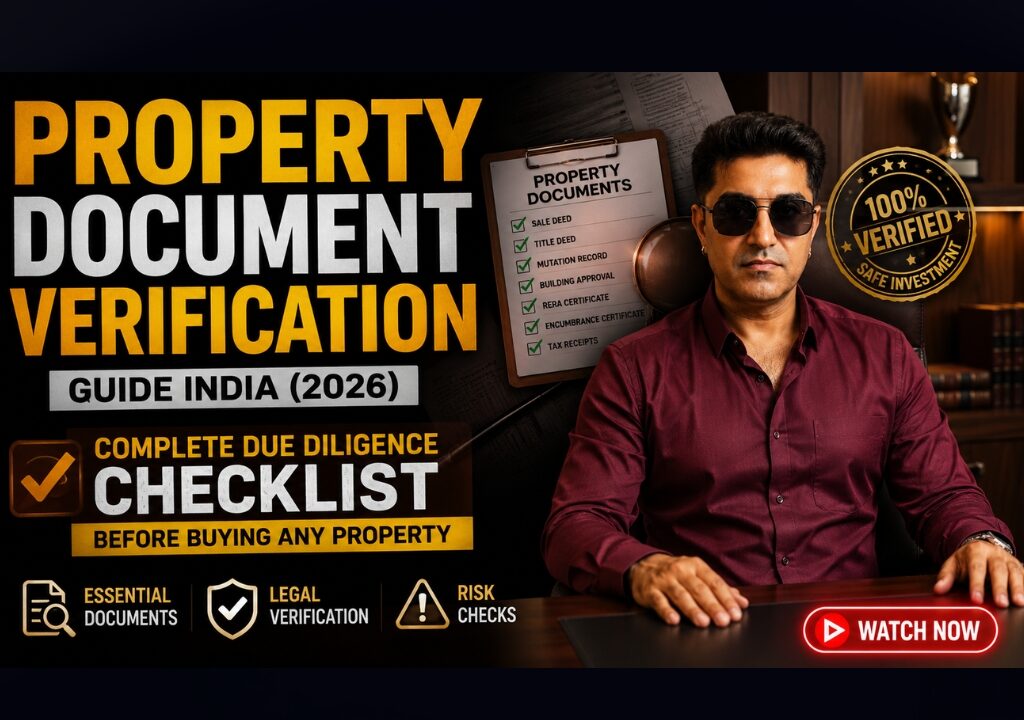
Property Document Verification Guide India (2026): Complete Due Diligence Checklist Before Buying Any Property
Royals Property Consultant is a trusted name for buying, selling, renting, and investing in residential and commercial properties in Zirakpur, Mohali, Chandigarh, and New Chandigarh.
Home > Real Estate Blog > Legal Guides > Property Document Verification Guide India
Property Document Verification Guide India (2026): Complete Due Diligence Checklist Before Buying Any Property
Every year, buyers lose their life savings to properties that looked perfectly fine on paper. Here’s the document-by-document verification process that actually protects you — plus where to check each record online, state by state.
⚡ Quick Answer
Property document verification means confirming five things before you pay anything: (1) an unbroken chain of title back to the Mother Deed, (2) current revenue records (Jamabandi/Bhulekh/7-12) matching the seller’s name after mutation, (3) an Encumbrance Certificate showing no pending loans, mortgages, or court disputes, (4) valid planning approvals (CLU, layout, building plan, RERA registration where applicable), and (5) cleared property tax, electricity and water dues. No single document is enough on its own — verification means cross-checking all of these against each other, not just collecting a stack of paperwork.
📋 Table of Contents
- Why Buyers Lose Crores by Skipping This
- The Due Diligence Roadmap
- The Master Verification Checklist
- Every Property Document, Explained
- Official Government Portals — State by State
- Common Property Frauds & Red Flags
- Builder & Developer Due Diligence
- Land-Specific Verification (Agri, CLU, Green Belt)
- NRI Verification Checklist
- High-Value / Luxury Property Checklist
- Illustrative Scenarios
- Myths vs Facts
- Royals Property Consultant’s Approach
- Glossary
- Frequently Asked Questions
- Get Your Property Verified
Why Buyers Lose Crores by Skipping This
The pattern repeats across almost every property fraud case: a buyer sees a good price, likes the location, and rushes to pay a token amount before doing the paperwork properly — because “the deal will slip away otherwise.” Common ways this goes wrong: the seller isn’t actually the current legal owner (an old, unmutated record); the property has an undisclosed mortgage still active; the land is agricultural and was never legally converted for construction; or the “sale deed” being shown is one link in a broken ownership chain with a gap nobody can explain.
Every one of these is catchable with proper document verification, before money changes hands — which is the entire point of this guide.
The Due Diligence Roadmap
- Confirm the seller’s identity and title — match ID proof to the name on the Sale Deed/Mother Deed.
- Trace the chain of title — every transfer from the Mother Deed to the current seller, with no unexplained gaps.
- Cross-check revenue records — Jamabandi/Bhulekh/7-12 extract must match the seller’s name post-mutation.
- Get the Encumbrance Certificate — 13-30 years depending on financing and risk tolerance.
- Verify planning/zoning status — CLU, layout approval, building plan sanction as applicable.
- Check RERA registration — for any project still under construction.
- Clear dues check — property tax, electricity, water, and society maintenance if applicable.
- Litigation search — check for pending civil/criminal cases tied to the property or seller.
- Draft and review the Agreement to Sell — ideally with an independent lawyer, before any substantial payment.
- Register the Sale Deed — at the Sub-Registrar’s office with correct stamp duty.
- Complete mutation — update revenue records to reflect your ownership post-registration.
- Take physical possession — with a documented possession letter/handover note.
The Master Verification Checklist
📜 Legal
Mother Deed, chain of title, Sale Deed, Will/Gift/Partition Deed (if applicable), POA validity, court order search
🏛️ Government/Revenue
Jamabandi/Bhulekh/7-12, Khasra, Khewat, Khatoni, mutation status, Aks Shajra/village map
🗺️ Planning
CLU, zoning classification, master plan status, road-widening/acquisition check
🏗️ Construction
Approved building plan, layout approval, Occupation Certificate, Completion Certificate
💰 Financial
Encumbrance Certificate, mortgage release (if any prior loan), bank loan approval status for the project
🧾 Taxes & Dues
Property tax receipts (latest), electricity dues, water dues, society/maintenance dues
🏢 Developer (if applicable)
RERA registration, past project delivery record, any consumer/RERA complaints filed
🔑 Possession
Possession/allotment letter, physical inspection matching approved plan, utility connection transfer
Every Property Document, Explained
Sale Deed / Conveyance Deed
The legal instrument that actually transfers ownership, executed and registered at the Sub-Registrar’s office under the Registration Act, 1908. This is the document — not any revenue record — that establishes title. Verify: registration number, stamp duty paid matches property value, and that it’s registered (not just notarised — a notarised-only “sale agreement” does not transfer title).
Mother Deed & Chain of Title
The Mother Deed is the earliest traceable document establishing how the property first came into private/individual ownership (often the original grant, partition, or first sale). The chain of title is every subsequent registered transfer since then. Verify: every link in the chain — a missing or unexplained gap of even one transfer is a serious red flag.
Jamabandi / Bhulekh / 7-12 Extract (varies by state)
The Record of Rights — a revenue department register showing current ownership, possession, and land classification. Called Jamabandi in Punjab/Haryana/Himachal, Bhulekh in UP/Bihar/MP, and the 7/12 extract (Satbara) in Maharashtra. Critical: courts have repeatedly held this reflects possession/revenue status, not legal title by itself — always cross-check against the registered deed.
Khasra, Khewat & Khatoni
Khasra is the unique survey/plot number for a specific piece of land. Khewat is the ownership-share record where multiple owners hold undivided land. Khatoni (or Khata) is the consolidated register of all land a person holds in a village. Verify: the Khasra number on your documents matches what the government portal shows for that exact plot.
Mutation (Intkal / Dakhil Kharij)
The process of updating revenue records to reflect a new owner after a registered transaction. Critical: a completed registration without mutation leaves the revenue record showing the previous owner — always confirm mutation is done, not just applied for.
Encumbrance Certificate (EC)
Issued by the Registration Department, this certifies whether a property has any registered mortgages, liens, or transactions during a chosen period (Form 15 if transactions exist, Form 16 if “nil”). Limitation: it only shows registered transactions — unregistered/informal loans or family disputes won’t appear. Get 13-15 years minimum for a loan; 30 years for outright purchase peace of mind.
CLU (Change of Land Use)
Government approval permitting agricultural land to be used for residential, commercial, or industrial purposes. Red flag: any construction or plotting on agricultural land without CLU is illegal, regardless of what a seller or broker claims about “upcoming approval.”
Building Plan & Layout Approval
Sanctioned by the local municipal/development authority before construction begins. Verify: the actual built structure matches the sanctioned plan — unauthorised extra floors or deviations can mean the excess is not legally recognised.
Occupation Certificate (OC) & Completion Certificate (CC)
CC confirms construction matches the sanctioned plan; OC confirms the building is fit for occupation and utility connections can be granted. Without OC: you may legally not be permitted to occupy the unit, regardless of possession being handed over.
RERA Registration
Mandatory for most under-construction projects above a threshold size. Confirms the project is registered, escrow-compliant (70% collections ring-fenced), and subject to disclosure requirements. Verify directly on the state RERA portal — never rely solely on a certificate shown by the builder.
Power of Attorney (POA)
Authorises a representative to act on an owner’s behalf. Verify: it is specific (not an overly broad general POA), still valid (not revoked), and properly registered/notarised — apostilled if executed abroad.
Will, Gift Deed & Partition Deed
Relevant when a property came to the seller through inheritance, gift, or family division rather than direct purchase. Verify: the Will’s probate status (where required), that a Gift Deed is registered, and that a Partition Deed clearly defines the seller’s specific share.
Property Tax, Electricity & Water Dues
Outstanding dues can sometimes attach to the property itself, not just the previous owner. Verify: latest paid receipts, and get written confirmation of “no dues” from the relevant municipal/utility department where possible.
Official Government Portals — State by State
Portal branding varies by state, and exact URLs occasionally change — always search the official portal name directly rather than following an old link. Here’s what each state calls its system:
| State | Land Records Portal | What It’s Called |
|---|---|---|
| Punjab | Jamabandi Punjab (jamabandi.punjab.gov.in) | Jamabandi / Fard |
| Haryana | Jamabandi Haryana (jamabandi.nic.in) | Jamabandi / Khasra / Khatauni |
| Uttar Pradesh | UP Bhulekh | Khatauni / Khasra extract |
| Rajasthan | Apna Khata Rajasthan | Jamabandi |
| Maharashtra | Mahabhulekh / Mahabhumi (bhulekh.mahabhumi.gov.in) | 7/12 Extract (Satbara) |
| Karnataka | Bhoomi Karnataka | RTC (Record of Tenancy and Crops) |
| Tamil Nadu | eServices TN / TNREGINET | Patta & Chitta / FMB Extract |
| Telangana | Dharani / Bhu Bharati | Pahani / ROR |
| Gujarat | AnyROR Gujarat | 7/12 & 8-A Extract |
| Madhya Pradesh | MP Bhulekh | Khatauni Extract |
| Bihar | Bihar Bhumi | Jamabandi / Khata-Khasra |
| Himachal Pradesh | HimBhoomi | Jamabandi |
| Chandigarh (UT) | Chandigarh Estate Office / Punjab-linked records | Allotment & lease records |
| Delhi | Delhi Revenue Department portal | Khasra/Khatauni (rural), DORIS for registration |
For the Encumbrance Certificate specifically, use your state’s Registration Department / IGRS portal (not the land records portal) — the EC is a registration-department document, issued for the property’s location regardless of where you live.
For Mohali, Zirakpur, and New Chandigarh specifically: our GMADA Property Verification Guide covers the exact Punjab process step-by-step — jamabandi checks, GMADA Estate Office verification, and CLU status for GMADA-notified land.
Common Property Frauds & Red Flags
| Fraud Pattern | How to Detect It |
|---|---|
| Selling agricultural land as “residential plots” without CLU | Check CLU approval directly with the planning authority — never accept a broker’s verbal assurance |
| Multiple sales of the same property to different buyers | Encumbrance Certificate and current mutation status will reveal conflicting registered claims |
| Forged or fabricated Sale Deed | Verify the registration number and details directly on the Sub-Registrar’s record, not just the physical paper |
| Property still under an active bank mortgage | EC will show the existing charge; get a mortgage release/NOC before paying |
| Seller is not the actual legal owner (unmutated inheritance) | Cross-check current revenue record name against ID and the registered deed |
| General/broad Power of Attorney misused to “sell” property | Verify the POA’s specific scope and current validity directly with the issuing authority |
| Unauthorised construction beyond sanctioned plan | Compare the approved building plan against actual construction, and check for OC |
| Fake or unregistered RERA number | Verify directly on the official state RERA portal, never via a screenshot from the builder |
Builder & Developer Due Diligence
- RERA registration: verify directly on the state portal, including the promoter’s other registered projects.
- Delivery track record: check how many of the builder’s past projects were delivered on time versus significantly delayed.
- Litigation history: search for consumer court, RERA, or civil cases against the promoter entity.
- Financial health signals: stalled sites, unpaid contractor disputes, or repeated project-name changes are warning signs.
- Construction quality: visit a completed project by the same builder, not just the marketing office of the new one.
Land-Specific Verification: Agricultural, CLU, Green Belt & Zoning
Land carries risks that built property doesn’t. Before buying any plot: confirm current zoning classification (agricultural/residential/commercial/green-recreational) directly with the planning authority; check whether the land falls within any notified master plan’s green belt, forest, or no-construction zone; verify it isn’t under active government acquisition or road-widening alignment; and confirm CLU status if any construction is planned. Land in an active acquisition corridor can look perfectly saleable on paper while carrying serious future risk — this is precisely the kind of check our GMADA Land Acquisition Explained guide and Punjab Land Pooling Policy guide walk through in detail for Punjab specifically.
NRI Verification Checklist
- Appoint a specific (not general) Power of Attorney, properly apostilled if executed abroad.
- Insist on a live video walkthrough of the property/site, not just photographs or renders.
- Independently verify title and EC — don’t rely solely on a relative’s assurance.
- Confirm payments route through your own NRE/NRO/FCNR account, never a direct foreign transfer to the seller/builder.
- Verify RERA registration directly, since remote buyers are the most common target for fake project claims.
For the full FEMA, tax, and remote-buying process, see our NRI Property Investment Mohali guide and RERA Approved Property for NRIs guide.
High-Value / Luxury Property Checklist
Higher transaction values justify extra diligence: a longer Encumbrance Certificate window (25-30 years), independent structural/quality audit for ready properties, verification of every amenity claimed in marketing material against actual sanctioned plans, and confirmation of society/maintenance corpus fund status for larger developments. See our Luxury Property Mohali, Zirakpur & New Chandigarh Guide for how we vet premium projects specifically.
Illustrative Scenarios
Composite, illustrative scenarios based on common patterns — not real individual clients.
A buyer found the seller’s name didn’t match the current Jamabandi entry — the property was inherited but never mutated. Resolution: mutation was completed before registration proceeded, closing the gap.
An Encumbrance Certificate revealed an active bank charge the seller hadn’t mentioned. Resolution: buyer required a mortgage release/NOC before any further payment.
A broker marketed unconverted agricultural land as ready residential plots. Resolution: buyer checked CLU status directly with the planning authority and found no approval existed, and walked away.
Myths vs Facts
Royals Property Consultant’s Approach
For every property we recommend in Tricity, we follow the same sequence this guide describes — chain of title, current revenue record match, Encumbrance Certificate, planning/CLU/RERA status, and dues clearance — before it goes on our shortlist. We don’t skip steps to close deals faster, and we tell clients plainly when a specific document can’t be verified rather than smoothing over the gap.
Glossary
| Term | Meaning |
|---|---|
| Mutation (Intkal) | Updating revenue records to reflect a new owner after a transaction |
| Khasra | Unique survey number for a specific plot of land |
| Khewat | Ownership-share record for jointly-held land |
| Khatoni/Khata | Consolidated register of all land held by a person in a village |
| CLU | Change of Land Use — approval converting agricultural land to another use |
| Encumbrance Certificate | Registration-department document showing registered charges/transactions on a property |
| OC / CC | Occupation Certificate / Completion Certificate — construction and occupancy sign-off |
| RERA | Real Estate (Regulation and Development) Act, 2016 — project registration and buyer-protection law |
Frequently Asked Questions
What is the single most important property document?
The registered Sale Deed — but it must be cross-checked against the Mother Deed chain, current revenue records, and an Encumbrance Certificate.
Can Jamabandi or 7/12 extract prove ownership alone?
No — it reflects possession/revenue status; title comes from the registered deed.
How do I verify mutation has been done?
Check the current land record entry shows the buyer as owner, referencing the registered deed number.
What does an Encumbrance Certificate show?
All registered transactions on a property over a chosen period — not unregistered/informal claims.
What is CLU and why does it matter?
Change of Land Use approval; without it, construction on agricultural land is illegal.
Is RERA registration enough to trust a builder?
Necessary but not sufficient — verify delivery track record and litigation history too.
How many years should an EC cover?
13-15 years minimum for a loan; 30 years for outright purchase peace of mind.
How do I verify a khasra number?
Cross-check it against your state’s official land records portal for that exact village/plot.
What’s the difference between OC and CC?
CC confirms construction matches the sanctioned plan; OC confirms the building is fit for occupation.
Where do I check Punjab-specific property verification steps?
See our dedicated GMADA Property Verification Guide for the full Punjab/GMADA process.
Before You Pay a Single Rupee, Get It Verified
Share your property details — we’ll check title, records, and dues before you commit further.
Disclaimer: This guide is for general educational information only and is not legal advice. Property laws and portal names/URLs may change; always verify current requirements with a qualified property lawyer and the relevant government department before any transaction.
Service area note: Royals Property Consultant provides real estate advisory exclusively within the Tricity region — Mohali, Zirakpur, Chandigarh, New Chandigarh, Panchkula and surrounding Punjab micro-markets.