Royals Property Consultant is a trusted name for buying, selling, renting, and investing in residential and commercial properties in Zirakpur, Mohali, Chandigarh, and New Chandigarh.
The Delhi Development Authority has surprised the Indian property market yet again — this time with the DDA Karmajeevi Awaas Yojana 2026, a scheme offering a flat 25% discount on more than 1,200 ready-to-move flats in Narela. Unlike earlier DDA housing offers restricted purely to government staff, this one widens the door to private-sector professionals, business owners, and entrepreneurs too — and that single change is why property circles from Delhi to the Tricity are talking about it.
If you’re a first-time buyer priced out of Delhi’s resale market, a government employee eyeing a freehold flat, or an investor scanning for the next affordable-housing wave before it spreads to other cities, this guide breaks down everything: eligibility, pricing logic, locations, risks, and what it genuinely means for buyers in Punjab, Mohali, and Zirakpur watching from the sidelines.
📌 Editorial note: This article is published purely for buyer awareness and market-education purposes. Royals Property Consultant operates exclusively in the Tricity region — Mohali, Zirakpur, Chandigarh, Panchkula, and New Chandigarh — and does not facilitate, broker, or assist with DDA/Delhi property transactions. No booking, brokerage, or sale service is being offered here.
The DDA Karmajeevi Awaas Yojana 2026 is a First-Come-First-Serve (FCFS) housing scheme launched by the Delhi Development Authority, offering a flat 25% discount on ready-to-move-in freehold flats built in Narela’s Pocket-11, Sector A1-A4. It was launched ahead of Independence Day under the guidance of Delhi’s Lieutenant Governor and DDA Chairman, and is positioned as DDA’s next step after the earlier Karmayogi Awaas Yojana, which was restricted only to government employees.
What makes the Karmajeevi scheme genuinely different is eligibility — it now welcomes serving and retired government employees as well as working professionals from the corporate, business, and entrepreneurial sectors. In effect, DDA has opened its affordable-housing doors to a much larger slice of Delhi-NCR’s working population.
Quick Highlights
Parameter
Detail
Scheme Name
DDA Karmajeevi Awaas Yojana 2026
Launched By
Delhi Development Authority (DDA)
Discount Offered
Flat 25% on disposal price
Total Flats
1,200+ ready-to-move units
Location
Pocket-11, Sector A1-A4, Narela
Flat Types
1 BHK, 2 BHK, 3 BHK
Ownership
Freehold
Allotment Mode
First-Come-First-Serve (FCFS)
Registration Opens
24 July 2026
Booking Opens
15 August 2026 (DDA Awaas Portal)
Eligibility
Govt employees (serving/retired) + corporate, business & entrepreneurial professionals
Why Has DDA Launched This Scheme?
Three forces are converging here, and buyers benefit from understanding all three. First, unsold inventory — DDA has a substantial number of constructed flats in Narela that have taken time to find buyers despite Delhi’s chronic housing shortage, largely because Narela sits at the city’s northern edge, away from established job hubs. A discount scheme is the fastest lever to move that inventory.
Second, genuine affordable housing demand — Delhi’s resale and builder-floor markets have pushed ownership out of reach for a large section of salaried professionals. A freehold flat at a discounted rate, even on the city’s outskirts, answers a real need.
Third, urban planning strategy — DDA has been positioning Narela as a satellite growth corridor for over a decade, and filling it with owner-occupiers rather than leaving flats vacant is central to making that sub-city function as intended, with schools, markets, and civic infrastructure following the rooftops.
Locations Covered — Why Narela Matters
Every flat under this scheme sits in Narela Sub-City, in Pocket-11 across Sectors A1 to A4. On paper, Narela is roughly 1.2 km from an upcoming Metro station and about 1.9 km from a proposed RRTS station — both still in the pipeline rather than operational today, which buyers should weigh carefully. The site is close to Urban Extension Road-I and GT Karnal Road, giving reasonable road connectivity to central and north Delhi even before the metro arrives.
Narela already hosts several educational institutions and sports infrastructure, and DDA has highlighted community centres, open green spaces, and enhanced security as part of the township design. The bigger story, though, is trajectory: Narela is one of the few pockets in Delhi where large-scale planned residential supply is still being added, which is exactly why long-term appreciation potential here looks different from an already-saturated inner-Delhi micro-market.
Reality check: Metro and RRTS connectivity are announced/proposed, not yet running. Buyers prioritising immediate daily-commute convenience should factor in today’s road-only connectivity, not the future map.
Types of Flats Available
1 BHK — compact ready-to-move units, best suited to young professionals, single government employees, or as a rental-yield asset.
2 BHK — the volume category for nuclear families, the most competitive segment historically in DDA’s Narela launches.
3 BHK — larger freehold units aimed at bigger families or buyers wanting future amalgamation of adjoining flats.
Ready to Move — every unit under this scheme is already constructed; there is no under-construction wait, and buyers can inspect sample flats before booking.
Pricing Explained
After the 25% discount, DDA’s disposal prices under this scheme start at roughly ₹33.40 lakh for a 1 BHK, ₹75.55 lakh for a 2 BHK, and ₹1.065 crore for a 3 BHK — figures officially disclosed at launch. These are starting/base figures; the final payable amount depends on the specific pocket, floor, and facing of the unit allotted, plus one-time corpus fund and maintenance charges collected separately at allotment.
Flat Type
Indicative Starting Price (Post-Discount)
What Buyers Should Know
1 BHK
From ~₹33.40 lakh
Fastest-selling category historically; corpus + maintenance charged separately
2 BHK
From ~₹75.55 lakh
Best balance of size vs affordability for families
3 BHK
From ~₹1.065 crore
Amalgamation with adjoining units possible, subject to DDA norms
On EMI affordability: at current home-loan rates, a 2 BHK priced near ₹75-76 lakh with a 20% down payment and a 20-year tenure typically works out to an EMI in the range most double-income households in government or mid-level corporate jobs can service — but this varies bank to bank and with your credit profile. Because on-ground charges (corpus, stamp duty, registration, maintenance) can meaningfully change your actual outflow, always get a written, itemised cost sheet directly from DDA and run your specific EMI numbers with your bank or loan officer before booking.
Who Can Apply? Eligibility, Documents & Process
Eligibility
Serving and retired employees of Central Government, State Governments, PSUs, Public Sector Banks, universities, and autonomous bodies.
Working professionals from the corporate, business, entrepreneurial, and professional sectors (the scheme’s key expansion versus earlier DDA housing rounds).
No restriction on applicants who already own residential property elsewhere.
Documents Typically Required
PAN card and Aadhaar card
Proof of current/retired government employment or business/professional registration, as applicable
Passport-size photograph and valid bank account details
Address proof and income documents (for home loan processing)
Booking & Payment Process
Registration opens 24 July 2026 on the DDA Awaas Portal.
Bookings open 15 August 2026 strictly on FCFS basis — earlier applicants get first choice of pocket, floor, and facing.
Booking amount is paid online at the time of application.
Balance payment is due per DDA’s payment schedule, either as full payment or through a sanctioned home loan.
Registration and possession follow once payment formalities are complete; sample flats are open for physical inspection before booking.
Pros
Genuine 25% discount on disclosed disposal price — a real, upfront saving rather than a marketing discount on an inflated base rate.
Ready-to-move freehold flats — zero construction-delay risk, which is the single biggest complaint buyers have with private under-construction projects.
Wider eligibility than previous DDA schemes, opening access to private-sector and self-employed buyers.
Government-backed title and construction — meaningfully lower fraud and litigation risk than an unregistered private project.
No restriction on owning other residential property, unlike some subsidy-linked housing schemes.
Cons
Narela remains peripheral to Delhi’s core job centres; daily commute is a genuine consideration until metro/RRTS connectivity actually goes live.
FCFS allotment means the best-facing, best-floor units in Pocket-6/9/13 under the earlier phase sold out fast — expect similar competition here.
Corpus fund and annual maintenance are additional costs on top of the discounted price, and buyers sometimes underestimate these at booking stage.
Resale liquidity in Narela, while improving, is still thinner than established central-Delhi micro-markets.
Social and civic infrastructure (markets, hospitals, entertainment) is still catching up to the pace of housing construction in parts of the sub-city.
Should You Buy? — A Segment-Wise View
First-time buyers: This is one of the more genuine affordability windows in Delhi right now. If your job or family ties don’t demand a central-Delhi address, a 1 BHK or 2 BHK here can be a sound entry into homeownership without the debt burden of a resale flat.
Families: The 2 BHK and 3 BHK categories, with community infrastructure and open spaces DDA has built in, suit families prioritising space and a planned layout over a shorter commute.
Investors: Rental yields in Narela today are modest simply because the working population nearby is still growing. The stronger investment thesis here is medium-term capital appreciation as connectivity infrastructure matures — not immediate rental income.
NRIs: Freehold DDA flats are purchasable by NRIs under standard FEMA rules through an NRE/NRO account, the same framework covered in our NRI Property Investment Guide 2026. The FCFS timeline, though, makes remote participation harder — you’ll likely need a trusted representative physically present at registration to move fast.
Government employees: This scheme was effectively built for you first — the discount, freehold status, and no-restriction clause on existing property make it one of the more straightforward buy decisions in this list.
Private employees: You’re now eligible where you weren’t before. Evaluate purely on commute realism and long-term plans, since the discount and freehold title are equally available to you.
Investment Analysis
Future appreciation: Narela’s appreciation curve has historically been slow-and-steady rather than explosive, tracking the pace of metro, RRTS, and road infrastructure completion rather than speculative demand. A 5-10 year horizon is the realistic lens for meaningful capital gains here.
Rental demand: Currently modest, tied closely to nearby employment generation. Expect this to strengthen as government offices, educational campuses, and commercial development around the sub-city mature.
Infrastructure growth: The upcoming metro extension and proposed RRTS corridor are the two triggers that could meaningfully re-rate property values here — but “proposed” and “under construction” carry execution risk, as with most Indian infrastructure timelines.
Government ownership: A genuine plus for title certainty and construction quality assurance, though it does not eliminate the need for buyers to do their own due diligence on possession-readiness and civic services.
Risk factors: Peripheral location, FCFS competition for the better units, and infrastructure timelines that could slip. Long-term potential: Reasonable for patient capital, weaker for buyers seeking a quick flip.
DDA vs Private Builders — Head to Head
Parameter
DDA (Government)
Private Builders
Price
Discounted, fixed disposal rate
Market-driven, often negotiable
Quality
Standardised, functional finishes
Varies widely — budget to premium
Possession
Ready to move (this scheme)
Often under-construction with delay risk
Trust/Title
Government-backed, low litigation risk
Requires independent RERA/title verification
Construction Speed
Already built
Depends on builder track record
Maintenance
Corpus fund + RWA-managed
Builder-managed initially, then RWA
Home Loan Ease
Straightforward, government project
Depends on project’s bank approval status
Appreciation Potential
Steady, infra-linked
Can be higher in prime private micro-markets
How This Could Impact India’s Real Estate Market
Schemes like this put quiet pressure on private developers in adjacent price bands to sharpen their own affordable-housing offerings, since a government-backed, freehold, ready-to-move flat at a real discount is hard to compete with on trust alone. Expect more state and city development authorities to study DDA’s FCFS-plus-discount model closely.
It also reinforces a broader policy direction — using existing unsold government inventory more aggressively rather than only launching fresh under-construction projects — which could shape how authorities like GMADA, HUDA, and others approach their own unsold stock going forward. For buyers nationally, it’s a reminder that affordable government housing is becoming a genuine parallel track to private real estate, not just a subsidy-linked side scheme.
How This Affects Punjab, Mohali & Zirakpur Buyers
Even though DDA Karmajeevi Awaas Yojana is a Delhi-specific scheme, it carries real lessons for buyers watching the Tricity market. Punjab buyers should track this because it shows what happens when a development authority uses discounting and wider eligibility to move genuine ready-to-move inventory — a playbook GMADA could adapt for its own unsold stock in sectors like Eco City and New Chandigarh.
The core difference between Delhi and Punjab affordable housing lies in scale and land economics: DDA operates within a mega-city with acute land scarcity, so even peripheral Narela commands crore-plus pricing for 3 BHKs; GMADA-region affordable housing in Mohali, Zirakpur, and New Chandigarh still offers meaningfully lower entry prices for comparable unit sizes, because Tricity land and construction costs remain lower than Delhi-NCR.
Investment lesson for Tricity buyers: Government-backed, freehold, discounted inventory — wherever it appears — tends to sell fast and offers lower title risk than an unverified private project. If GMADA launches a similar FCFS discount scheme on its own unsold plots or flats, as it recently has with the GMADA Plot Scheme 2026, the same urgency and due-diligence principles from this DDA scheme apply directly.
Opportunity: Buyers who can’t access or don’t want a Delhi property but like the government-housing logic should look closely at GMADA’s own approved layouts and properties in Mohali and Zirakpur, where similar freehold, planned-development dynamics are increasingly common.
“Every time a large development authority discounts unsold government inventory, it resets buyer expectations everywhere else. Tricity buyers who understand why DDA is doing this in Narela are better placed to spot the same opportunity when GMADA does it in Mohali or New Chandigarh.” — Manindar Verma, Managing Director, Royals Property Consultant
Expert Tips, Common Mistakes, Warning Signs & Checklist
Buyer Tips
Physically inspect the sample flat before booking — floor, facing, and pocket matter more than the brochure suggests.
Get an itemised cost sheet covering corpus fund, maintenance, stamp duty, and registration before you commit.
Register early on the portal — under FCFS, minutes can decide which pocket and floor you get.
Investment Tips
Treat this as a 5-10 year hold, not a quick-flip investment, given Narela’s infrastructure-linked appreciation curve.
Compare rental yield expectations honestly against established Delhi micro-markets before assuming quick returns.
Common Mistakes
Booking without visiting the actual site and sample flat.
Ignoring maintenance and corpus charges when calculating total cost.
Assuming metro/RRTS connectivity is operational when it is still proposed/under construction.
Warning Signs to Avoid
Anyone other than the official DDA Awaas Portal asking for booking payments.
Agents guaranteeing “confirmed allotment” outside the FCFS process — no one can guarantee FCFS outcomes.
Quick Checklist Before You Book
☑ PAN, Aadhaar, and employment/business proof ready
☑ Home loan pre-approval or funds arranged in advance
☑ Sample flat visited and pocket/floor preference decided
☑ Itemised cost sheet reviewed, including corpus and maintenance
☑ Registration done early on the official DDA Awaas Portal
Frequently Asked Questions
What is DDA Karmajeevi Awaas Yojana 2026?
It’s a DDA housing scheme offering a flat 25% discount on 1,200+ ready-to-move freehold flats in Narela’s Pocket-11, open to government employees and corporate/business professionals under an FCFS allotment system.
Who is eligible to apply for this scheme?
Serving and retired government employees (Central, State, PSU, PSB, university, autonomous bodies), plus corporate, business, entrepreneurial, and professional-sector individuals.
What is the starting price of flats under this scheme?
Post-discount, prices start around ₹33.40 lakh for 1 BHK, ₹75.55 lakh for 2 BHK, and ₹1.065 crore for 3 BHK, per DDA’s disclosed figures at launch.
When does registration and booking open?
Registration opens 24 July 2026; booking opens 15 August 2026 on the official DDA Awaas Portal, on a First-Come-First-Serve basis.
Are these flats freehold or leasehold?
All flats under this scheme are offered on a freehold basis.
Can I apply if I already own a house elsewhere?
Yes. DDA has clarified there is no restriction on applicants who already own residential property.
Is metro connectivity available near these flats today?
Not yet. A metro station and an RRTS station are proposed/upcoming near the site; current connectivity relies on Urban Extension Road-I and GT Karnal Road.
Can NRIs buy a flat under this scheme?
Yes, freehold DDA flats can be purchased by NRIs under standard FEMA rules via an NRE/NRO account, though the FCFS timeline may require a trusted representative on the ground.
How is this different from the earlier DDA Karmayogi Awaas Yojana?
The Karmayogi scheme was limited strictly to government employees; the Karmajeevi Awaas Yojana 2026 widens eligibility to include corporate, business, and entrepreneurial professionals as well.
Should Punjab or Tricity buyers consider this scheme?
Only if a Delhi-based property genuinely fits their needs. Otherwise, the same government-discount logic is worth tracking for future GMADA-region affordable housing launches in Mohali, Zirakpur, and New Chandigarh.
Final Verdict — Should You Buy?
For eligible buyers who are comfortable with Narela’s current peripheral positioning and a 5-10 year investment horizon, the DDA Karmajeevi Awaas Yojana 2026 is a genuinely good opportunity — a real 25% discount, freehold title, and zero construction-delay risk are not something private resale or under-construction options in Delhi can easily match today. It is not a fit for buyers who need immediate central-Delhi connectivity or a quick-flip investment.
The bigger lesson for India’s real estate market, and for Tricity buyers specifically, is that government-backed discounted inventory — wherever it surfaces — deserves serious buyer attention and equally serious due diligence, not blind rush. Explore more property insights and city-specific guides on Royals Property Consultant before making your next move.
MV
Manindar Verma Managing Director, Royals Property Consultant · 15+ years guiding buyers and investors across Mohali, Zirakpur, Chandigarh, Panchkula, and New Chandigarh · RERA: PBRERA-CHD04-REA0390
📌 This DDA guide is shared for informational purposes only. Royals Property Consultant does not deal in Delhi or DDA properties — our services are exclusively for Mohali, Zirakpur, Chandigarh, Panchkula, and New Chandigarh.
Looking to Buy, Sell, or Invest in Tricity Property?
Contact Royals Property Consultant for professional assistance and honest market insights — buying, selling, or investing across Mohali, Zirakpur, Chandigarh, Panchkula, and New Chandigarh.
Royals Property Consultant is a trusted name for buying, selling, renting, and investing in residential and commercial properties in Zirakpur, Mohali, Chandigarh, and New Chandigarh.
MV
Manindar Verma
Managing Director · Royals Property Consultant
| 📅 Updated June 2026 | ⏱ 18 min read
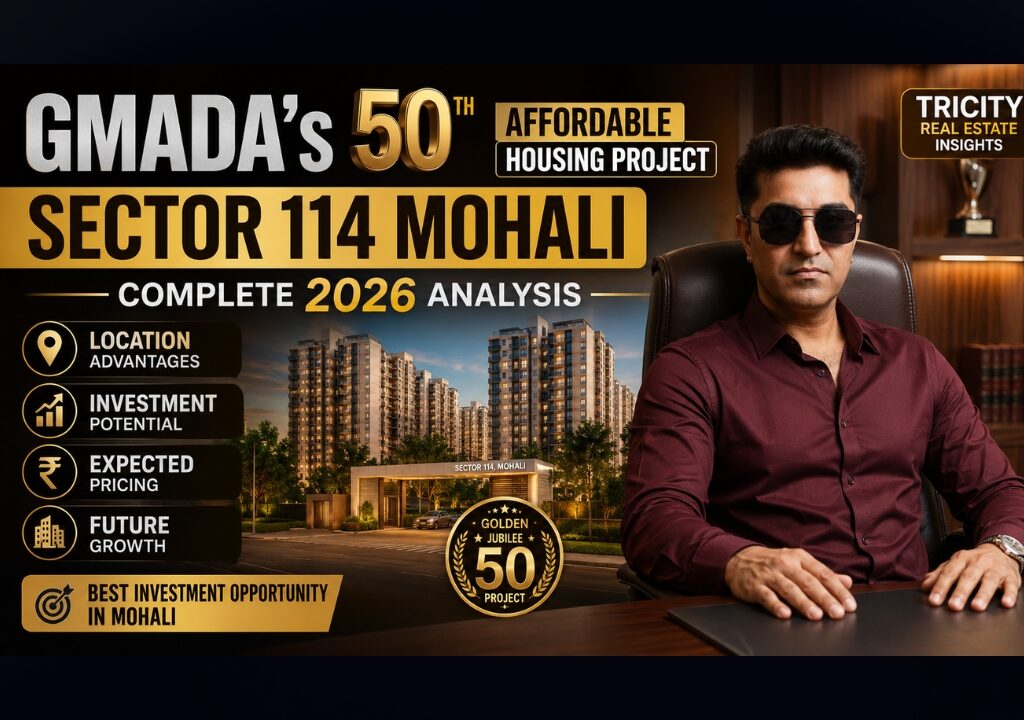
GMADA’s 50th affordable housing project in Sector 114 Mohali (White City) spans 25 acres on Kharar-Landran Road. It targets EWS and LIG buyers under Punjab’s Affordable Housing Policy. The sector sits within 8–12 km of Chandigarh International Airport and connects to PR-7, making it one of the fastest-appreciating corridors in Greater Mohali. Entry prices for government-backed affordable units are expected to be significantly below the open market, with strong long-term upside for patient investors.
There are real estate announcements, and then there are milestones that actually reshape how a city grows. GMADA’s 50th affordable housing project — placed in Sector 114 Mohali — belongs firmly in the second category. For a city that has grown faster than its own planning in many ways, this is the government’s clearest signal yet: Mohali’s next decade of growth will be structured, inclusive, and anchored in policy rather than speculation.
The White City project in Sector 114 covers approximately 25 acres on Kharar-Landran Road, an area that has quietly become one of the most discussed addresses in Greater Mohali real estate circles. Whether you are a first-time buyer trying to understand what this announcement actually means for you, an investor calculating appreciation potential, or an NRI assessing whether this is the right Mohali bet — this guide is built for you.
We have spoken to urban planners, studied connectivity maps, analysed GMADA’s track record across Aerocity, IT City, Eco City, and New Chandigarh, and pulled together everything a serious buyer needs to make an informed decision. No builder language. No speculation dressed as fact. Just a professional, honest breakdown of what Sector 114 is, what GMADA’s 50th project means, and what it could become.
Section 1: What GMADA Has Announced — The 50th Milestone Explained
The Greater Mohali Area Development Authority (GMADA) has officially launched its 50th affordable housing project under the White City brand in Sector 114 Mohali. The development covers 25 acres along Kharar-Landran Road and represents the largest single affordable housing push GMADA has undertaken in the Kharar-Landran belt to date.
Reaching the 50th project is not a ceremonial number. It reflects the scale at which GMADA has been operating across Greater Mohali — collectively covering tens of thousands of housing units across income groups, geographies, and formats. Each project adds to the legal, planned fabric of the city, and this one carries particular significance because Sector 114 represents the kind of emerging location where government entry can genuinely anchor long-term value.
What “White City” Means
White City is GMADA’s sub-brand for affordable and mid-income housing. The name signals a development that is planned, legal, RERA-registered, and built to policy specifications — not a private builder’s branding exercise. White City projects are developed under Punjab’s state affordable housing policy, which defines eligible income groups, unit sizes, pricing caps, and allotment processes. This is important because it means the project operates under government pricing discipline rather than open-market speculation during the initial allotment phase.
The 25-Acre Development at a Glance
Parameter
Details
Project Name
White City, Sector 114 Mohali
Developing Authority
GMADA (Greater Mohali Area Development Authority)
Project Number
50th Affordable Housing Project
Location
Sector 114, Kharar-Landran Road, Mohali
Total Area
Approx. 25 Acres
Housing Type
Affordable Housing (EWS / LIG / MIG)
Policy Framework
Punjab Affordable Housing Policy
Legal Status
Government Authority Project (No separate RERA required; exempt under state policy)
Allotment Process
Draw / Lottery-based (standard GMADA process)
Why does this announcement matter beyond the housing units themselves? Because GMADA entry into a sector is historically one of the strongest signals of planned infrastructure investment to follow. Aerocity was once peripheral — GMADA built it. IT City was farmland — GMADA gave it roads, sewage, and legal identity. Sector 114 is now receiving the same signal.
Section 2: Understanding GMADA — History, Role & Track Record
GMADA was constituted under the Punjab Regional and Town Planning and Development Act, 1995, as the primary development authority for the Greater Mohali region. Its mandate covers land acquisition, sector development, road building, housing delivery, and commercial zone planning across an area that now stretches from Zirakpur to Kharar and from the airport road to the boundaries of New Chandigarh.
The authority operates differently from a private developer in one critical way: it is not primarily motivated by profit. Its mandate is to enable planned urban growth. This means GMADA projects, while not always the fastest in delivery, carry a level of legal security that no private project can match. The land is government-acquired, the approvals are in-house, and the allotment process is regulated.
GMADA’s Major Projects and What They Prove
GMADA Project
Location
What It Achieved
Current Status
Aerocity
Near Airport, Mohali
Created premium commercial & residential zone adjacent to airport
Established, high-value
IT City
Sector 66-A, Mohali
Anchored Mohali’s IT sector; brought Infosys, NABET & major campuses
Active employment hub
Eco City
New Chandigarh belt
Planned green township with sector roads & utility infrastructure
Ongoing development
New Chandigarh
Mullanpur
Satellite township; already home to PGI Satellite, sports institutions
Active growth phase
Airport Road Sectors
Sectors 65–90 belt
Created residential sectors with legal identity on Airport Road corridor
Mature market
White City Projects (1–49)
Various sectors
Delivered affordable housing across income groups
Ongoing delivery
The pattern across every major GMADA project is consistent: entry precedes value appreciation. Sectors that GMADA formally developed are now among Mohali’s most liquid, most financeable, and most trusted addresses. Sector 114’s inclusion in this list is a forward-looking indicator, not just a housing announcement.
Section 3: Why Sector 114 Is Mohali’s Next Big Address
Sector 114 sits on Kharar-Landran Road, which is one of the most strategically placed corridors in the entire Greater Mohali region. It connects the rapidly growing Kharar township to Landran, where several educational institutions including I.K. Gujral Punjab Technical University (IKGPTU) have established significant campuses. The road is not peripheral — it is a functional spine of the northern expansion of Mohali.
Road Connectivity
Road / Highway
Distance from Sector 114
Significance
Kharar-Landran Road
Direct access
Primary arterial road; connects Kharar to Landran and Mohali bypass
PR-7 (Peripheral Road)
~4–6 km
High-speed arterial connecting airport, IT City, and Zirakpur
PR-4
~5–7 km
Links New Chandigarh corridor to northern Mohali sectors
Chandigarh-Kharar Highway (NH-05)
~3–5 km
National highway; direct Chandigarh access
Chandigarh International Airport
~10–14 km
30–40 min drive depending on traffic
Chandigarh City Centre (Sector 17)
~20–22 km
40–50 min drive
Educational Institutions in the Sector 114 Belt
Institution
Approximate Distance
Type
IK Gujral Punjab Technical University (Landran)
~3–5 km
State University
Chitkara University (Rajpura Road belt)
~15 km
Private University
Lovely Professional University (via highway)
~60 km
Major Private University
Multiple CBSE Schools (Kharar)
~4–8 km
K-12 Schools
GD Goenka, Ryan International (Mohali)
~10–12 km
Premium K-12
Healthcare Infrastructure
Hospital
Approximate Distance
Specialty
Fortis Hospital Mohali
~12–15 km
Multi-specialty
Max Hospital Mohali
~12–15 km
Multi-specialty
GMCH-32 Chandigarh
~20 km
Government Medical
Alchemist Hospital Panchkula
~22 km
Multi-specialty
Local Nursing Homes (Kharar)
~4–6 km
Primary care
Commercial Growth and Employment Corridors
The Kharar-Landran belt has seen consistent growth in commercial activity driven by student population, daily commuters, and the gradual shift of residential demand northward from core Mohali. The area hosts neighbourhood markets, emerging retail formats, and is within the influence zone of IT City Mohali — one of Punjab’s most significant technology employment hubs. Workers in IT City who cannot afford airport-road pricing are increasingly looking at the Kharar-Landran corridor as a commutable alternative, and Sector 114 falls directly in that demand pocket.
Metro Connectivity (Proposed — Label Important)
Important note: Any metro connectivity for the Kharar-Landran belt remains at the proposal/feasibility study stage as of June 2026. The Chandigarh Metro project has been in discussion for several years but has not received final Central government funding approval or definitive alignment confirmation for routes extending to Kharar. Buyers should not factor metro connectivity into their immediate decision-making but should be aware that long-term metro extension to this corridor is part of the broader regional planning discourse.
Section 4: Location Analysis — Who Should Buy in Sector 114 Mohali?
Buyer Profile Analysis
👨👩👧
Families (End Users)
Fit: Strong. Sector 114 offers the space, quieter environment, and planned development character that families with children value. Schools in Kharar are within commutable distance, and the sector’s planned nature means fewer encroachment and illegal colony risks compared to surrounding unplanned areas.
📈
Investors
Fit: Good with a 5–10 year horizon. Sector 114 is not a flip-it-in-18-months market. But for investors who understand that GMADA entry drives long-term value creation, the risk-reward ratio is favourable. The affordable housing allotment price, when available, typically comes at a discount to the open market, which builds in immediate paper upside.
🌍
NRI Buyers
Fit: Moderate to Strong. NRIs looking to buy government-backed property for family use or as a safe long-term store of value will find GMADA’s track record reassuring. The legal security, no-encumbrance land, and policy pricing make this a credible NRI option — particularly for those who cannot monitor a project closely and need a trustworthy developer.
💼
Working Professionals
Fit: Moderate. Professionals working in IT City, Chandigarh, or Mohali industrial areas can commute from Sector 114 — but travel times will be 30–45 minutes in normal traffic. For those who value space over commute time, this is workable. For those in core city jobs, it may feel distant.
🏡
Retirees
Fit: Good. The lower density, planned character, and relatively affordable entry price make Sector 114 a reasonable retirement address — particularly for those who want to be near Chandigarh without paying Chandigarh prices. Proximity to good hospitals via car is adequate, though not walkable.
🏘️
Rental Investors
Fit: Moderate. Rental demand exists from students near IKGPTU Landran and IT City employees, but yields in emerging sectors are typically 2–3.5% in early stages. As the sector matures and commercial activity grows, yields will improve. Do not buy here purely for immediate rental income — buy for appreciation with rental as a secondary benefit.
Sector 114 — Honest Pros & Cons
✅ Pros
⚠️ Cons / Risks
Government-backed project with full legal security
Possession timelines on government projects can stretch beyond initial estimates
Entry at policy-controlled, sub-market price
Sector still emerging — limited immediate social infrastructure
GMADA’s 50th project = institutional confidence in the sector
Punjab’s Affordable Housing Policy defines who can apply, what they can buy, and at what price. Understanding this policy is essential before applying for the GMADA Sector 114 project because eligibility is strictly verified and applications that do not meet criteria are rejected at the draw stage.
Income Group Definitions
Category
Annual Household Income
Unit Type
Typical Unit Size
EWS (Economically Weaker Section)
Up to ₹3 Lakh/year
Apartment
Up to 300 sq ft carpet area
LIG (Lower Income Group)
₹3 Lakh – ₹6 Lakh/year
Apartment
300–600 sq ft carpet area
MIG-I (Middle Income Group)
₹6 Lakh – ₹12 Lakh/year
Apartment / Plot
600–900 sq ft
MIG-II (Middle Income Group)
₹12 Lakh – ₹18 Lakh/year
Apartment / Plot
900–1200 sq ft
Eligibility Conditions (Standard GMADA Criteria)
The applicant or any family member should not own a pucca house in the urban area of Punjab
Only one application per family is permitted
Applicant must be a resident of Punjab (or NRI of Punjab origin for specific categories)
Income certificate must be issued by a competent government authority
Age: typically 18 years and above at the time of application
Allotment is done by lucky draw in case of oversubscription (which is common for GMADA projects)
Legal Security — Why GMADA Beats Private Builders
The difference between a GMADA affordable housing unit and a private builder’s “affordable” project is not subtle — it is foundational. GMADA projects involve government-acquired land, which eliminates title disputes at the source. The allotment letter is a legal document. Registry is done through the standard sub-registrar process with no ambiguity. Banks routinely approve home loans on GMADA properties because the legal chain is clean.
Private builders’ affordable projects, particularly those not registered with HRERA or RERA Punjab, carry title risks, builder default risks, and encumbrance risks that GMADA projects do not. This is one of the strongest arguments for GMADA Sector 114 regardless of the sector’s stage of development.
Key Distinction for Buyers: An “RERA-registered” private project and a “GMADA government project” are not the same level of security. GMADA operates at the sovereign authority level — it is the planning authority itself. This is categorically different from a private builder’s RERA registration.
We will not give you exact rupee-per-square-yard figures because property prices in emerging sectors move quickly, and any number we print today could be stale in 90 days. What we will give you is the relative pricing framework — how Sector 114 sits relative to surrounding markets, what determines its trajectory, and what the appreciation story looks like on a 10-year view.
Why No Fixed Prices Here? Real estate pricing changes with market conditions, GMADA’s allotment announcements, and sector development milestones. For current, accurate pricing, call our team at +91 98787 59508 — we track this market daily.
Relative Price Positioning (Index-Based)
Location
Price Index (vs Sector 114 = 100)
Maturity Level
Appreciation Stage
Sector 114 Mohali (GMADA)
100 (Base)
Emerging
Early growth
Sector 115 Mohali
110–125
Emerging-Developing
Mid growth
Sector 116 Mohali
115–130
Developing
Mid-late growth
Kharar (Near NH-05)
90–110
Mixed — some mature pockets
Variable
IT City (Sectors 66–67)
200–280
Established
Mature
Aerocity (Mohali)
280–380
Premium / Established
Mature-late
Airport Road (Sectors 65–82)
200–350
Established
Mature
What Drives Appreciation in Emerging Sectors — The Factors to Watch
Infrastructure delivery: Every road widening, sector road completion, and utility connection directly impacts land values. Track GMADA’s road development programme for Sector 114.
GMADA follow-on projects: After the 50th project, will a 51st and 52nd follow in the same sector? Commercial plot auctions? These are key catalysts.
Private developer entry: When private builders launch projects in a sector after GMADA entry, it signals demand validation and typically lifts land prices in the surrounding area.
Employment growth: IT City expansion, new industrial clusters, and any large employer establishing in the belt will drive residential demand and push prices.
Metro alignment: If and when a metro route is finalised passing near Sector 114, expect a 20–35% value jump in that belt within 12–18 months of the announcement.
10-Year Price Appreciation Framework
Timeline
Likely Scenario
Appreciation vs Today (Indicative)
Key Driver
Year 1–2
Steady; limited liquidity
5–10% (low activity)
Sector development activity
Year 3–4
Infrastructure milestone delivery
15–25% cumulative
Road completion, utility delivery
Year 5–6
Private builder entry phase
35–55% cumulative
Demand validation by private sector
Year 7–8
Commercial activation
60–90% cumulative
Commercial zones, employment
Year 9–10
Established sector
90–140%+ cumulative
Full infrastructure, metro (if confirmed)
Note: These are indicative ranges based on GMADA’s historical appreciation patterns in comparable sectors. They are not guarantees. Real estate is inherently cyclical and subject to macroeconomic factors.
Strong for Kharar belt; not yet airport-road level
Legal Security
10/10
GMADA government project — maximum legal safety
Appreciation Potential (10-yr)
8/10
Strong fundamentals; good long-term story
Near-Term Liquidity
5/10
Low immediate resale market; not for short-term flippers
Infrastructure Score
6.5/10
Roads good; social infrastructure developing
Government Support
9.5/10
This IS the government project
Demand-Supply Balance
8/10
Affordable housing demand far exceeds supply in Mohali
Rental Yield Potential
6/10
Modest now; will improve as sector matures
Overall Investment Score
7.6/10
Strong for patient, long-term investors
Section 8: Sector 114 vs Aerocity, IT City, Kharar & Others — Full Comparison
Parameter
Sector 114 (GMADA)
Aerocity
IT City
Sector 88
Kharar
New Chandigarh
Price Level
Low–Affordable
Premium
High
Mid-High
Low–Mid
Mid–High
Legal Security
★★★★★
★★★★★
★★★★★
★★★★
★★★
★★★★★
Current Infrastructure
★★★
★★★★★
★★★★★
★★★★
★★★
★★★★
10-Year Appreciation
★★★★★
★★★
★★★
★★★★
★★★★
★★★★
Entry Affordability
★★★★★
★★
★★
★★★
★★★★★
★★★
Airport Access
★★★
★★★★★
★★★★
★★★★
★★★
★★★
Rental Demand
★★★
★★★★★
★★★★★
★★★★
★★★
★★★★
NRI Appeal
★★★★
★★★★★
★★★★
★★★★
★★★
★★★★
Who Wins?
Best for affordable entry + long horizon
Best for premium + immediate use
Best for IT professionals
Good all-rounder
Budget play
Planned township buyers
The honest verdict: Sector 114 is not competing with Aerocity or IT City in the same time frame. It is competing with Kharar for affordable buyers today, and with Sectors 88/115 for medium-term appreciation. On legal security, it beats every private developer project in those comparable areas outright.
Section 9: Hidden Things Buyers Must Know Before Registering
1. Understand the Allotment Process Completely
GMADA affordable housing allotments are done via lottery draw when oversubscribed — which they always are for well-located projects. Applying does not guarantee allotment. Have a backup plan. Also, understand the payment schedule post-allotment: missing instalments on GMADA schemes can result in cancellation with penalty deductions.
2. Infrastructure Charges Are Extra
The allotment price in GMADA schemes often does not include External Development Charges (EDC) and Infrastructure Development Charges (IDC). These can add a meaningful percentage to your total cost. Always ask for the final cost inclusive of all charges before comparing with open-market options.
3. Possession Timelines and Realistic Expectations
Government projects in Punjab have historically faced delays of 12–48 months beyond initial possession estimates. This is not unique to GMADA — it is a structural feature of government construction delivery. Budget for it in your financial planning and do not depend on possession for immediate occupancy.
4. Home Loan Eligibility
Banks and HFCs (Housing Finance Companies) actively finance GMADA allotted properties. Approval is generally straightforward because the legal title is clean. However, loan disbursement is often stage-linked to construction progress. For affordable housing schemes, you can also check if the project qualifies under PMAY (Pradhan Mantri Awas Yojana) for additional interest subsidy benefits under CLSS (Credit Linked Subsidy Scheme).
5. Resale Before Possession — Understand the Rules
GMADA has specific rules around resale of allotted units before possession and registry. There are typically lock-in periods and NOC requirements. Buying an “on-paper” allotment in the secondary market requires due diligence on whether the transfer is properly documented with GMADA’s records.
6. Legal Check Before Any Secondary Market Purchase
If you are buying from a current allottee (secondary market) rather than directly from GMADA, verify: allotment letter authenticity, no outstanding dues with GMADA, confirmed transfer NOC, and no court cases or encumbrances on the allotment. Use a registered lawyer, not just a broker’s verbal assurance.
After 15 years of tracking Mohali real estate, here is my honest take on GMADA Sector 114 White City in June 2026.
Apply if you are an eligible affordable housing buyer. If you meet the income criteria and do not own property in Punjab’s urban areas, applying for GMADA Sector 114 is a straightforward decision. The allotment price will be below market, the legal security is maximum, and the long-term appreciation story is intact. The downside is possession timing uncertainty — but for a first home purchase, that is manageable.
Invest in the open market around Sector 114 if you have a 7–10 year horizon. The GMADA project’s announcement is a trigger for surrounding land values. Open-market plots and floors in the Kharar-Landran belt will benefit from the sector’s formalisation. If you are an investor who cannot get a GMADA allotment directly, look at adjacent legal colonies with clean title in the Landran-Sector 114 belt.
Do not buy here if you need liquidity in under 5 years. This is not a Zirakpur airport-road investment where you can exit in 18 months at a profit. Sector 114 is a long game. If you are parking money with a short exit strategy, this is the wrong address.
NRIs: This is one of Mohali’s safest affordable entry points. The combination of government authority, legal title clarity, and policy pricing makes GMADA Sector 114 one of the most reliable NRI investment options in the Tricity market. You do not need to worry about builder default, encumbrance, or title disputes.
Compare with Kharar open market before deciding. Some Kharar sectors offer similar price points with more immediate social infrastructure. The trade-off is legal certainty: GMADA wins that comparison comprehensively. But if the infrastructure timeline matters more than legal certainty for your use case, a Kharar RERA-registered private project might serve you better in the short term.
Q1. What is GMADA’s 50th Affordable Housing Project in Sector 114?
GMADA’s 50th affordable housing project is a 25-acre development in Sector 114 Mohali on Kharar-Landran Road, launched under the White City brand. It represents the authority’s milestone entry into this part of the Kharar-Landran corridor with government-backed, policy-priced housing for EWS, LIG, and potentially MIG income groups. The project brings legal, planned residential development to a sector that has been on investors’ radar due to its strategic connectivity and proximity to educational institutions.
Q2. Where exactly is Sector 114 Mohali located?
Sector 114 Mohali is located along Kharar-Landran Road in the northern expansion zone of Greater Mohali. It lies in the Kharar tehsil area under SAS Nagar (Mohali) district and connects to the PR-7 peripheral road to the south, Kharar town to the north, and Landran — home to several educational institutions — further along the same road. The approximate driving distance from Chandigarh’s city centre is 20–22 km and from Chandigarh International Airport is 10–14 km depending on route taken.
Q3. Who is eligible for GMADA Affordable Housing Sector 114?
Eligibility is governed by Punjab’s Affordable Housing Policy. General criteria include: the applicant (and no immediate family member) must not own a pucca house in any urban area in Punjab; only one application per family is permitted; income must fall within the specified category (EWS: up to ₹3 lakh/year; LIG: ₹3–6 lakh/year; MIG: ₹6–18 lakh/year depending on sub-category); applicant must be an adult resident of Punjab. NRIs of Punjab origin may be eligible for specific categories — consult the official GMADA notification when it is released for this project.
Q4. Is GMADA Sector 114 a good investment in 2026?
For long-term investors with a 7–10 year horizon, GMADA Sector 114 offers a compelling entry: government-backed legal security, policy pricing that is typically below open-market rates, and a sector that is in the early growth stage of Mohali’s northward expansion. For short-term investors needing liquidity in under 5 years, it is not the right fit. The strongest case for investment is the combination of GMADA’s historical track record in transforming emerging sectors and the sustained demand for affordable housing across Greater Mohali that far exceeds current supply.
Q5. What is White City Mohali?
White City is GMADA’s sub-brand for affordable and mid-income housing projects. It is not a standalone location but a naming convention applied to GMADA’s affordable housing scheme developments across various sectors. The White City brand signals that the project is a government-developed, policy-priced, legally secure housing scheme rather than a private builder’s branding. The Sector 114 project is the 50th project to be launched under this framework, making it part of a well-established delivery programme with documented track records across the city.
Q6. What types of units will be available in Sector 114 GMADA project?
The specific unit configuration for Sector 114 will be confirmed in the official GMADA scheme notification. Based on the pattern of prior White City projects and the 25-acre scale of this development, the project is likely to offer a mix of apartment units across EWS (studio-type or 1 BHK), LIG (1–2 BHK), and possibly MIG (2 BHK) categories. Plot allotments under affordable housing schemes are less common but have been offered in some GMADA projects historically. Watch for the official notification for exact unit types, sizes, and pricing.
Q7. How does the GMADA lottery allotment process work?
When the scheme is oversubscribed — which is the norm for GMADA affordable housing — GMADA conducts a public lucky draw to allocate units. Eligible applicants submit applications with required documents and the application fee within the specified window. Applications are verified for eligibility. In the event of oversubscription in any category, GMADA conducts a computer-assisted draw in the presence of officials, and results are published publicly. Successful allottees receive allotment letters and must complete the first instalment payment within the stipulated period or risk cancellation.
Q8. Can NRIs apply for GMADA Affordable Housing Sector 114?
NRIs of Punjab origin may be eligible for specific categories within GMADA’s affordable housing scheme, subject to meeting the income and property ownership criteria. NRIs must not own a pucca residential property in Punjab’s urban areas, and their global income is typically considered for income group classification. Given that many NRIs, particularly from Canada, the UK, and the Gulf, are actively seeking safe, government-backed Mohali real estate, GMADA projects have seen growing NRI participation. The exact NRI eligibility conditions will be specified in the official scheme brochure when released.
Q9. What are the risks of buying in Sector 114 Mohali?
The primary risks specific to Sector 114 are: possession delay (common in government projects), limited near-term social infrastructure and commercial development, lower resale liquidity in the first 3–5 years, and the fact that the metro connectivity discussed for this region remains a proposal rather than a sanctioned project. The overall risk profile for a GMADA project is significantly lower than a private developer project because title risk, builder default risk, and encumbrance risk are essentially eliminated. The risks that remain are primarily timing and patience risks, not capital safety risks.
Q10. How does Sector 114 compare to Kharar real estate?
Kharar offers a mix of developed and developing pockets, some with more immediate social infrastructure than Sector 114 currently has. However, Kharar’s market includes both RERA-registered private projects and a significant volume of unauthorised or semi-legal constructions — buyers in Kharar must conduct significantly more legal due diligence than GMADA buyers do. On price, the two markets are broadly comparable for affordable segments. On legal safety, GMADA wins decisively. On immediate livability (shops, schools, hospitals), some Kharar pockets are currently ahead of Sector 114, but that gap will narrow as GMADA’s development progresses.
Q11. Will property prices in Sector 114 Mohali rise?
Based on GMADA’s historical pattern of value creation across Aerocity, IT City, Eco City, and the Airport Road corridor, GMADA entry into a sector has consistently driven long-term price appreciation. Sector 114 benefits from the same dynamics: planned infrastructure delivery, legal land title, improving road connectivity, and demand from the educational corridor. On a 10-year basis, the appreciation potential is strong — our indicative framework suggests 90–140%+ cumulative appreciation over a decade, though this is projection-based and subject to macroeconomic conditions.
Q12. Is a home loan available for GMADA Sector 114 properties?
Yes. Banks and housing finance companies actively finance GMADA-allotted properties because the legal title is clean, government-backed, and free of encumbrance. Most major banks — SBI, Punjab National Bank, HDFC, ICICI, Axis — have standard procedures for GMADA property financing. Loan disbursement is typically stage-linked to construction progress. Additionally, buyers in the eligible income groups should check whether the project qualifies under the PMAY-CLSS (Credit Linked Subsidy Scheme) for interest subsidy benefits of up to ₹2.67 lakh (depending on the category and scheme availability at the time of application).
Q13. What is the expected possession timeline for GMADA Sector 114 White City?
As of June 2026, the official possession timeline for this specific project has not been publicly announced in final form — this guide will be updated when GMADA releases the scheme notification. Historically, GMADA affordable housing projects have quoted possession timelines of 2–4 years from allotment, with actual delivery sometimes extending 1–2 years beyond that. Buyers should plan financially for the longer end of the range and not depend on immediate occupation. This is a structural feature of government-delivered housing across India, not a GMADA-specific shortcoming.
Q14. What is the connectivity of Sector 114 to Chandigarh airport?
Sector 114 Mohali is approximately 10–14 km from Chandigarh International Airport, making it a 25–40 minute drive depending on traffic conditions. The route primarily uses Kharar-Landran Road connecting to the PR-7 Peripheral Road, which runs directly to the airport zone. This connectivity is one of Sector 114’s stronger location attributes — not airport-road-level proximity, but meaningfully better than many comparable affordable locations in the region. For NRI buyers and frequent travellers, this is an important practical consideration.
Q15. Should I buy in the secondary market (from an existing allottee) or wait for GMADA direct allotment?
Both options have merit depending on your situation. Direct GMADA allotment (if you win the draw) gives you the cleanest title, the policy price, and the full financing options. Secondary market purchase from an existing allottee gives you certainty of allotment (no lottery risk) but comes at a premium over the original allotment price. If buying secondary, ensure the transfer is properly documented with GMADA, all dues are cleared, and you have a clean NOC in the seller’s name. Never buy a secondary market GMADA allotment based on an informal letter — verify with GMADA’s records directly.
Q16. What is the rental yield potential in Sector 114 Mohali?
In the early development phase, rental yields in emerging sectors like Sector 114 are modest — typically 2–3.5% gross yield. Demand comes from students near IKGPTU Landran, junior IT workers, and daily commuters to Chandigarh and Mohali. As the sector develops commercial activity, more working professionals enter the area, and possession is complete on more units, rental yields should improve toward the 3.5–5% range. Rental income should be viewed as a secondary benefit for Sector 114 — capital appreciation is the primary investment thesis here.
Q17. Is GMADA the same as HRERA (Haryana RERA)?
No — these are completely different entities. HRERA is the Haryana Real Estate Regulatory Authority, which regulates private developers in Haryana (Gurgaon, Faridabad, Panchkula, etc.). GMADA is the Greater Mohali Area Development Authority, a Punjab government body that itself develops land and housing — it is not a regulator of private builders but a developer in its own right. GMADA projects in Mohali operate under Punjab’s planning laws and do not require separate RERA registration since GMADA is itself a statutory body. This is a key distinction and a source of frequent confusion for buyers.
Q18. What is the minimum income to qualify for GMADA Affordable Housing?
There is no minimum income floor — EWS (Economically Weaker Section) includes households with annual income up to ₹3 lakh, making this the most inclusive category. However, buyers do need to demonstrate the ability to service the payment schedule on the allotted unit, so a minimum income sufficient to cover instalments is practical even if not formally required. The income bands are: EWS up to ₹3 lakh/year, LIG ₹3–6 lakh/year, MIG-I ₹6–12 lakh/year, and MIG-II ₹12–18 lakh/year. Each category has corresponding unit types and pricing as specified in the scheme notification.
Q19. How does GMADA’s affordable housing compare to private affordable housing projects in Mohali?
GMADA affordable housing and private “affordable” housing projects in Mohali are similar in price targeting but differ fundamentally in legal structure and risk profile. GMADA projects: government-owned land, no title disputes, no builder default risk, government oversight. Private affordable projects: vary widely in legal clarity, builder reliability, RERA registration status, and construction quality. RERA registration reduces (but does not eliminate) risk in private projects. For a first-home buyer with limited capital and no experience navigating real estate disputes, GMADA is categorically safer. For an experienced investor comfortable with private project due diligence, some private affordable options may offer faster possession and better near-term social infrastructure.
Q20. What happens if I miss an instalment payment after GMADA allotment?
GMADA’s payment schedules for allotted units are strict. Missing instalment deadlines typically results in penalty interest charges on the overdue amount. If dues remain unpaid beyond the grace period, GMADA has the authority to cancel the allotment and forfeit part of the deposited amount as per scheme terms. Cancellation policies vary by scheme, but buyers should treat GMADA payment schedules with the same seriousness as a bank EMI. Before applying, ensure your financial position can comfortably service the allotment instalments even in a stretched timeline scenario.
Q21. Are there any upcoming infrastructure projects near Sector 114 that will improve connectivity?
Several infrastructure developments are either planned or underway in the Kharar-Landran belt: widening and improvement of Kharar-Landran Road, the larger PR-7 corridor development (which connects multiple Mohali sectors to the airport), and the general infrastructure roll-out that accompanies GMADA’s own sector development. The proposed Chandigarh-Kharar metro extension is frequently discussed in regional planning circles but is not yet sanctioned as of June 2026. Any metro confirmation along a route near Sector 114 would be a major positive price catalyst.
Q22. Can I sell my GMADA Sector 114 allotment before possession?
Resale of GMADA allotments before possession is permitted but requires following GMADA’s transfer process, which includes obtaining a No Objection Certificate (NOC) from GMADA after clearing all dues. Transfer fees and procedural requirements apply. The process is more administratively involved than selling an open-market property, and there are typically lock-in periods in affordable housing schemes that restrict transfer within the first few years to prevent speculative flipping. Buyers intending to sell pre-possession should carefully read the allotment letter terms and GMADA’s transfer policy for that specific scheme.
Q23. How many GMADA White City projects have been delivered successfully?
GMADA has delivered multiple White City affordable housing projects across Greater Mohali. While the 50th project represents a milestone, the authority has an established delivery track record dating back many years. The quality of delivery and possession timelines have varied across projects — some delivered close to schedule, others with delays. The overall record demonstrates institutional capability and intent, even if individual project timelines are not always precise. This track record is meaningful when compared to private developers in the affordable segment where default risk is a genuine concern.
Q24. Is Sector 114 part of Mohali or Kharar?
Sector 114 falls within SAS Nagar (Mohali) district administration and is part of the Greater Mohali Area Development Authority’s jurisdiction. The sector’s Kharar-Landran Road location means it is geographically close to Kharar town, and local residents often reference both Kharar and Mohali when describing the area. For property valuation, legal documentation, and civic administration purposes, it is Mohali/SAS Nagar — which carries a higher perceived value than Kharar in most buyers’ mental maps. GMADA jurisdiction is a key distinction: property in GMADA-developed sectors of Greater Mohali has a legal and administrative identity that is distinct from Kharar Municipal Council areas.
Q25. What should I do next if I want to apply or invest in GMADA Sector 114?
Step one: Monitor GMADA’s official website (gmada.gov.in) for the official scheme notification for Sector 114 — it will specify unit types, pricing, eligibility, application dates, and required documents. Step two: Prepare your income documentation in advance (income certificates, family property ownership declarations). Step three: If you cannot secure a direct allotment but still want Sector 114 exposure, speak to us at Royals Property Consultant about legally available secondary allotments or adjacent legal colony options in the Kharar-Landran belt. We track this market daily and can help you find the right entry point for your specific situation and budget.
Section 12: Conclusion & Future Outlook
GMADA’s 50th affordable housing project in Sector 114 is not just a headline. It is a structural event in Mohali’s urban geography. When the authority that built Aerocity, IT City, and the entire Airport Road residential belt decides that Sector 114 on Kharar-Landran Road is the location for its 50th housing milestone, it is making a long-term planning statement that the market should take seriously.
The White City project brings several things that Sector 114 did not previously have: a government anchor, legal formalisation, public infrastructure intent, and the institutional confidence that draws further investment — both public and private — into a developing belt.
For buyers who meet the eligibility criteria, this is one of the most straightforward decisions in Mohali real estate: a government-backed unit at a policy-controlled price in a sector with a credible long-term growth story. The risks are timing and patience, not capital safety.
For investors in the open market, the announcement is a trigger to look seriously at the broader Kharar-Landran belt before private developer entry pushes prices up. History in Aerocity and IT City shows that the window between GMADA entry and full market pricing can be measured in years, not decades — but the window does close.
The 10-Year Vision for Sector 114
A decade from now, Sector 114 is likely to be a functioning, established residential sector within Greater Mohali — with sector roads, utilities, neighbourhood commercial zones, and a property market that looks similar to what Sectors 115–116 look like today, but priced significantly higher. The northward expansion of Mohali is structural, driven by land scarcity in mature sectors, population growth, migration from interior Punjab toward the Tricity, and the continued demand for legal, formal housing that exceeds current supply by a wide margin.
Sector 114 is early. That is both its risk and its opportunity. Smart buyers understand the difference between early and late, and act accordingly.