
America’s New Housing Law Just Passed —What It Means for GMADA, Mohali & Punjab Real Estate
Royals Property Consultant is a trusted name for buying, selling, renting, and investing in residential and commercial properties in Zirakpur, Mohali, Chandigarh, and New Chandigarh.

America’s New Housing Law Just Passed —
What It Means for GMADA, Mohali & Punjab Real Estate
A news-hook analysis of the 21st Century ROAD to Housing Act (USA, enacted July 11, 2026) and what it means for GMADA’s approval system, Punjab’s RERA/PAPRA framework, and every investor watching Mohali, Zirakpur, New Chandigarh, Aerocity and PR7.
The US Congress passed the 21st Century ROAD to Housing Act in June 2026, and it became law on July 11, 2026, without President Trump’s signature. The law speeds up zoning approvals, funds local governments that build more housing, and restricts large investors from buying single-family homes. For India, its real relevance is not the specific American rules — it’s the underlying idea that faster, transparent approvals move affordability more than subsidies alone, a lesson directly applicable to GMADA’s single-window and PAPRA approval systems in Punjab.
- What Actually Happened in Washington
- Why Housing Is Getting Expensive Everywhere
- Zoning Reform & Approval Reform, Explained
- Can Faster Approvals Actually Lower Prices?
- India-First: What This Means for India
- Narrowing to Punjab
- Can GMADA Learn From This?
- Mohali, New Chandigarh, Aerocity, PR7
- What This Means for Each Kind of Reader
- Expert-Style Analysis
- Policy Recommendations & Charts
- Key Takeaways for Punjab Investors
- 10 FAQs
- Glossary of Terms
- Schema Markup & Sources
What Actually Happened in Washington — In Plain Language
Direct Answer: Congress combined two competing housing bills — the House’s Housing for the 21st Century Act and the Senate’s ROAD to Housing Act — into one compromise package bundling more than 45 separate housing-supply measures, covering zoning guidance, faster environmental review, new construction formats, and new restrictions on institutional investors.
For most Indian readers, the fact that a US bill became law without a presidential signature should have closed the story — another country, another law, another news cycle. Except it doesn’t, because the problem this law is trying to solve is not an American problem. It is Mohali’s problem. It is GMADA’s problem. It is the problem every family currently comparing plot prices in Zirakpur, Aerocity, PR7 and New Chandigarh is quietly living through — housing has gotten expensive faster than incomes have grown, and the bottleneck usually isn’t the builder, it’s the approval process sitting above the builder.
This article is not about America. America is the trigger. What follows is an India-first, Punjab-first breakdown of what actually changed in the US, why it changed, and — more importantly — which specific pieces of it GMADA, PUDA and Punjab’s urban planning system could realistically borrow, adapt, or reject.
A bill becoming law without a presidential signature is not a loophole — it is a written-in constitutional mechanism in the US, designed so a president cannot indefinitely stall legislation Congress has passed with strong support simply by refusing to act on it.
The Four Buckets That Matter for a Punjab Reader
- Zoning and approval reform — the federal government will issue model zoning guidance and pay grants to local governments that actually loosen restrictive zoning and speed up permitting, rather than simply talking about it.
- Faster environmental and procedural review — routine, low-impact housing projects get exemptions from lengthy federal environmental review (NEPA), so a four-unit infill building doesn’t sit in the same queue as a highway project.
- New construction formats — federal guidelines now formally support “point-access” apartment buildings (single-stairway buildings up to several storeys), transit-oriented development near stations, and modular/manufactured housing.
- Institutional investor limits — large investors controlling 350+ single-family homes are now restricted from buying more, with narrow carve-outs for build-to-rent projects that must eventually be sold off.
None of this is subsidy. The entire theory of the bill is that America’s housing crisis is a supply and process problem before it is a demand and affordability problem — and the fastest way to bring prices down is to make it structurally easier, cheaper and faster to legally build a home.
The median existing US home price crossed $440,600 in June 2026 — the backdrop against which lawmakers on both sides called this the biggest housing bill in decades.
Why Is Housing Getting Expensive Everywhere, Not Just in America?
Direct Answer: The forces driving up US home prices and the forces driving up prices in Zirakpur, Mohali and New Chandigarh are structurally similar even though the numbers look completely different — urban population growth outpacing planned land supply, approval bottlenecks acting as a hidden tax on every project, rigid land-use rules, and investor capital chasing the same finite stock.
- Urban population growth outpacing planned land supply — Tricity’s growth, driven by IT City, the airport corridor and migration from across Punjab, has outpaced GMADA’s sanctioned housing stock in premium sectors, just as US metros outpaced their own zoning capacity.
- Approval bottlenecks acting as a hidden tax — every extra month a project waits for zoning clearance, environmental sign-off, or plan sanction adds carrying cost that developers eventually pass to buyers.
- Land-use rigidity — US zoning has historically restricted most land to detached single-family homes; India’s equivalent is FAR/FSI ceilings, CLU (Change of Land Use) delays, and master plans that lag actual demand by years.
- Institutional and investor capital — the US is legislating against large investors buying single-family homes; India’s version shows up as bulk NRI and investor buying concentrated in a handful of “hot” sectors, pushing entry prices up for genuine end-users.
The lesson isn’t that India should copy America line by line — Punjab’s land laws, RERA framework and PAPRA licensing system are structurally different from US zoning codes. The lesson is that the underlying diagnosis travels: when approvals are slow and land-use rules are rigid, prices rise faster than incomes, regardless of which country you’re in.
Zoning Reform and Approval Reform, Explained for an Indian Buyer
Direct Answer: Zoning reform changes what can legally be built on a piece of land (density, land use); approval reform changes how fast a legally compliant project gets official sign-off. GMADA’s equivalent of US zoning reform is Change of Land Use (CLU) and master-plan density rules (FAR/FSI); its equivalent of US approval reform is the single-window clearance system and the PAPRA (Punjab Apartment and Property Regulation Act, 1995) colony-licensing process.
Why does this distinction matter for a Mohali buyer? Because zoning tells you what can be built; approval speed tells you how soon it actually gets built. A sector can have generous FAR on paper and still deliver very little new supply if the approval pipeline behind it is slow — exactly the gap the US bill is closing with grant incentives, and exactly the gap GMADA’s own single-window portal exists to close.
When evaluating a GMADA sector, ask two separate questions, not one: “What is the sanctioned density here?” (zoning) and “How long is this specific promoter’s PAPRA licensing history taking?” (approval speed). Buyers who conflate the two often overestimate how fast supply will actually arrive.
Can Faster Approvals Actually Lower Prices? What the Evidence Shows
Direct Answer: Yes — Austin, Texas streamlined its permit approval process and eased lot-size and small-home rules starting in 2017, and the city has seen rents and home prices stabilise or fall since 2022, a result policy researchers now cite directly when defending the ROAD to Housing Act’s approach. The mechanism: every month a project sits in approval adds land-carrying cost, loan interest and idle capital, which developers price into the flat rather than absorb.
None of this means Punjab should relax legitimate safety, environmental or RERA-consumer-protection review — it means the administrative layers of approval, the paperwork and sequencing, are where genuine time and cost can be cut without touching consumer protection at all.
The chart below is an illustrative, analyst-estimated comparison — not an official government statistic — of where US post-reform approval targets sit against typically reported Indian/GMADA timelines at each stage of the process.
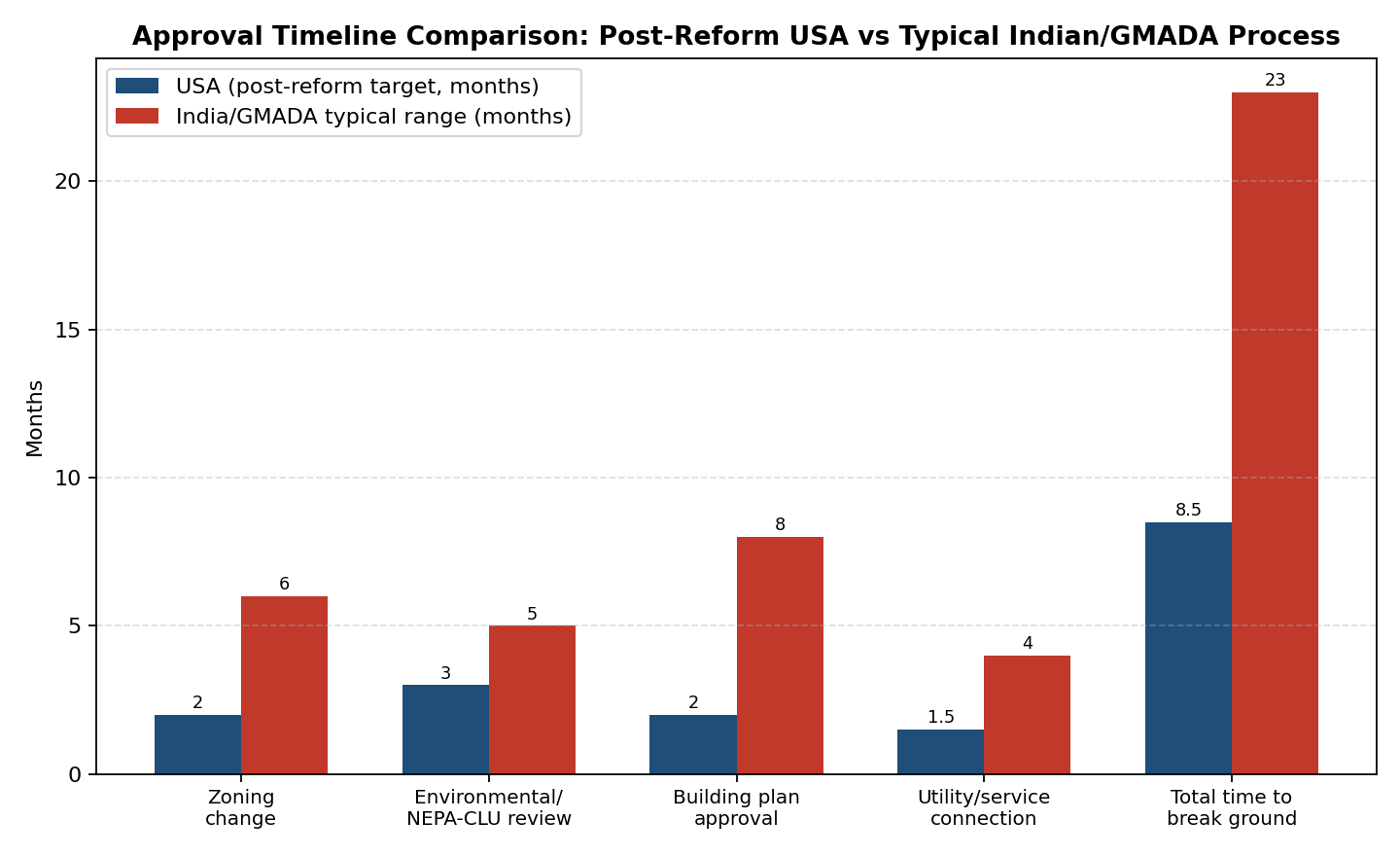
Faster approvals reduce the risk premium developers build into pricing and attract more developers into a market — meaning approval-speed reform is, in effect, a supply-side affordability tool, not just an administrative convenience.
India-First: What This Really Means for the Indian Housing Market
Direct Answer: India already has stronger nationwide consumer protection in RERA (2016) than the US has ever legislated federally. India’s real gap versus the new US reform isn’t law-on-paper — it’s approval-process speed, digital transparency, and consistent execution across states and local development authorities like GMADA.
| Dimension | United States (post-ROAD Act) | India (national picture) |
|---|---|---|
| Consumer protection framework | Fragmented state-by-state; no single national buyer-protection law | RERA (2016) — mandatory registration, escrow accounts, delay penalties, nationwide |
| Affordable housing push | New grant programs (Build Now Act, Innovation Fund) | PMAY — running since 2015, credit-linked subsidy |
| Approval philosophy | Historically zoning-restrictive; law now nudges density | Master-plan/FAR-based; density often under-utilised |
| Institutional investor rules | New restriction just enacted (350+ home threshold) | No equivalent restriction on bulk buying |
| Digital land records | Patchy, varies by county | Improving — DILRMP, GMADA’s single-window tool |
| Environmental review | NEPA — now exempting small infill housing | Project-scale; CLU and zoning-linked |
India’s RERA mandates escrow accounts for buyer payments and statutory delay penalties nationwide — protections the US federal system has never had. The US bill doesn’t touch consumer protection at all; it is purely a supply-side reform.
Narrowing to Punjab: Why This Should Matter to a Local Investor
Direct Answer: Punjab’s Tricity real estate market — spanning Mohali, Zirakpur, Panchkula and New Chandigarh — has genuinely strong demand growth from IT City, the airport corridor, and infrastructure projects like the Ring Road, but strong demand without matching approval-process speed produces exactly the imbalance the US law is trying to correct: prices rising faster than delivered supply.
Airport Road has reportedly seen roughly 157% price appreciation over five years, GMADA’s Aerocity and Eco City land-pooling schemes have drawn heavy investor interest, and the under-construction Mohali Airport Link Road and proposed Tricity Ring Road are actively re-rating entire corridors before they’re even complete. A land-pooling announcement or SCO e-auction can move prices within weeks, while the actual approvals and construction that create livable supply take years.
Prices moving on land-pooling news or master-plan drafts — before a single approval is granted — is the same early-stage speculative pattern that eventually forces regulatory correction, whether in a US zoning board or a Punjab development authority.
Can GMADA Learn From This? A Sector-by-Sector Look
Direct Answer: GMADA could realistically adapt three ideas from the US reform without copying its zoning law: performance-linked approval-speed targets modeled on the US Build Now Act, a fully searchable public land-parcel database, and a formal, time-bound internal appeals process for stalled but compliant projects.
GMADA vs US Planning Agencies: Structural Comparison
| Feature | US System (post-reform) | GMADA (Punjab) |
|---|---|---|
| Legal basis | 21st Century ROAD to Housing Act + local zoning | Punjab Regional & Town Planning Act, 1995; PAPRA, 1995 |
| Approval tracking | Varies by jurisdiction; federal push for public databases | Online “Know My Single Window Status” — already live |
| Land supply mechanism | Density bonuses, transit-oriented zoning | Land-pooling (Eco City, Aerocity), sector e-auctions |
| Incentive for faster approvals | $200M/year competitive grant (Build Now Act) | No equivalent performance-linked grant identified |
| Investor restrictions | New federal cap on institutional purchases | No restriction on bulk/investor buying |
| Public land transparency | Searchable public land database required | Master plans published; no parcel-level land bank |
| Master plan update cycle | Ongoing, incentive-linked | Periodic — e.g. Kurali draft, July 2026, pending approval |
Should GMADA Adopt Similar Reforms?
Not wholesale — Punjab’s legal architecture, land ownership patterns and consumer-protection needs are genuinely different from America’s. But three specific ideas are adoptable without new state legislation, using systems that already exist:
- Publish average single-window approval times by sector, since the “Know My Single Window Status” tool already collects the underlying data.
- Build a searchable public land-parcel database — which plots are pooled, under CLU review, or sanctioned — reducing the information asymmetry investors currently rely on informal broker networks to close.
- Introduce a time-bound internal appeal window for licensed colonies stuck in multi-year process limbo, mirroring the US bill’s formal zoning-board appeals mechanism.
If you are evaluating a GMADA-linked project, ask your consultant directly whether the promoter’s PAPRA licence and CLU are fully sanctioned or still “in process” — the gap between those two states is exactly where Punjab’s version of America’s approval-delay problem shows up.
Mohali, New Chandigarh, Aerocity, PR7 — Corridor by Corridor
Direct Answer: Mohali’s IT City needs the US bill’s density lesson, Aerocity/PR7 needs its infrastructure-sequencing lesson given two missed GMADA road deadlines, New Chandigarh needs patient long-horizon sequencing rather than speed, and Zirakpur’s core need is approval-process transparency rather than new zoning categories.
- Mohali IT City & Sector 66A corridor — the strongest rental-demand pocket in Tricity, anchored by 80+ IT companies and a stated target of roughly 1.14 lakh direct jobs. The US bill’s support for point-access, single-stairway apartment buildings exists specifically to fit more housing on constrained urban land.
- Aerocity & PR7 / Airport Road — GMADA’s flagship airport-linked township, with a 2,490-acre Aerotropolis expansion approved in 2026 and the Mohali Airport Link Road targeted for June 2026 completion (GMADA has missed two earlier deadlines, December 2025 and March 2026).
- New Chandigarh (Mullanpur) — GMADA’s “city of excellence,” planned since 2007 with Singapore-based Jurong Consultants, remains a long-horizon play anchored by projects like Mullanpur Medicity.
- Zirakpur — the connectivity play, with direct access to Chandigarh, Panchkula, the Shimla highway and Airport Road. Inventory exists; approval-cycle transparency matters more here than new zoning.
- Panchkula — administratively in Haryana but functionally part of the same Tricity demand pool, offering a useful external benchmark against GMADA’s own jurisdiction.
GMADA has missed two previous deadlines for the Mohali Airport Link Road — December 2025 and March 2026. This kind of infrastructure-delivery risk, not zoning risk, is the dominant pricing variable in the Aerocity/PR7 corridor today.
What This Means for Each Kind of Reader
For the Indian and Punjab Government: the US bill is a live case study in using financial incentives — not just mandates — to push local bodies toward faster approvals.
For GMADA and PUDA officials: the most exportable idea isn’t a law, it’s a habit — publish approval-time data publicly and let market pressure reward the sectors that move fastest.
For developers and builders: predictable approval timelines reduce the risk premium priced into launch rates.
For investors: corridors where GMADA’s infrastructure delivery has been most consistent — not merely most announced — are where the “approval-speed dividend” is most likely to show up.
For NRIs: the US institutional-investor restriction is a reminder that RERA-verified, individually-owned units are structurally insulated from any future Indian equivalent.
For first-time buyers: track GMADA’s published single-window status tools directly, rather than relying solely on informal broker timelines.
For luxury buyers: corridors with completed (not just announced) infrastructure carry lower holding-cost risk.
For commercial investors: proximity to completed transit is a more defensible thesis than proximity to planned transit.
Expert-Style Analysis: Five Perspectives on the Same Reform
(Analytical commentary reflecting how professionals in each field typically evaluate this kind of policy shift — not verbatim quotes from named individuals.)
The urban economist’s view: would frame this as confirmation that supply-side, process-focused reform is now the dominant global policy consensus for housing affordability.
The developer’s view: would welcome any move toward predictable, time-bound approvals, since uncertainty in the approval pipeline is one of the largest hidden costs in a project’s financial model.
The investor’s view: would weight infrastructure-delivery track record more heavily than master-plan announcements when selecting a corridor.
The town planner’s view: would note GMADA’s land-pooling model is already structurally closer to the US bill’s goals — the opportunity is tightening execution speed, not redesigning the model.
The housing policy expert’s view: would argue that pairing RERA’s disclosure requirements with GMADA-level approval-time publishing would replicate the US reform’s core transparency goal without new legislation.
“The investors who read policy news like this and actually act on it are the ones who ask a different question than most buyers. Instead of asking ‘is this a good sector,’ they ask ‘is this authority’s own delivery track record improving or slipping.’ That second question is where real returns get decided.” — Manindar Verma, Managing Director, Royals Property Consultant
Policy Recommendations at a Glance
| Recommendation | Modeled on | Implementing body |
|---|---|---|
| Publish average single-window approval times by sector | Build Now Act incentive logic | GMADA |
| Create a searchable public land-parcel database | US public land database requirement | GMADA / PUDA |
| Introduce a time-bound internal appeal window | US local zoning-board appeals process | GMADA |
| Tie state infrastructure funding to GMADA meeting its own deadlines | US grant-for-performance model | Punjab Government |
| Clearer density guidance near completed transit | US transit-oriented development guidance | GMADA / Town Planning Dept. |
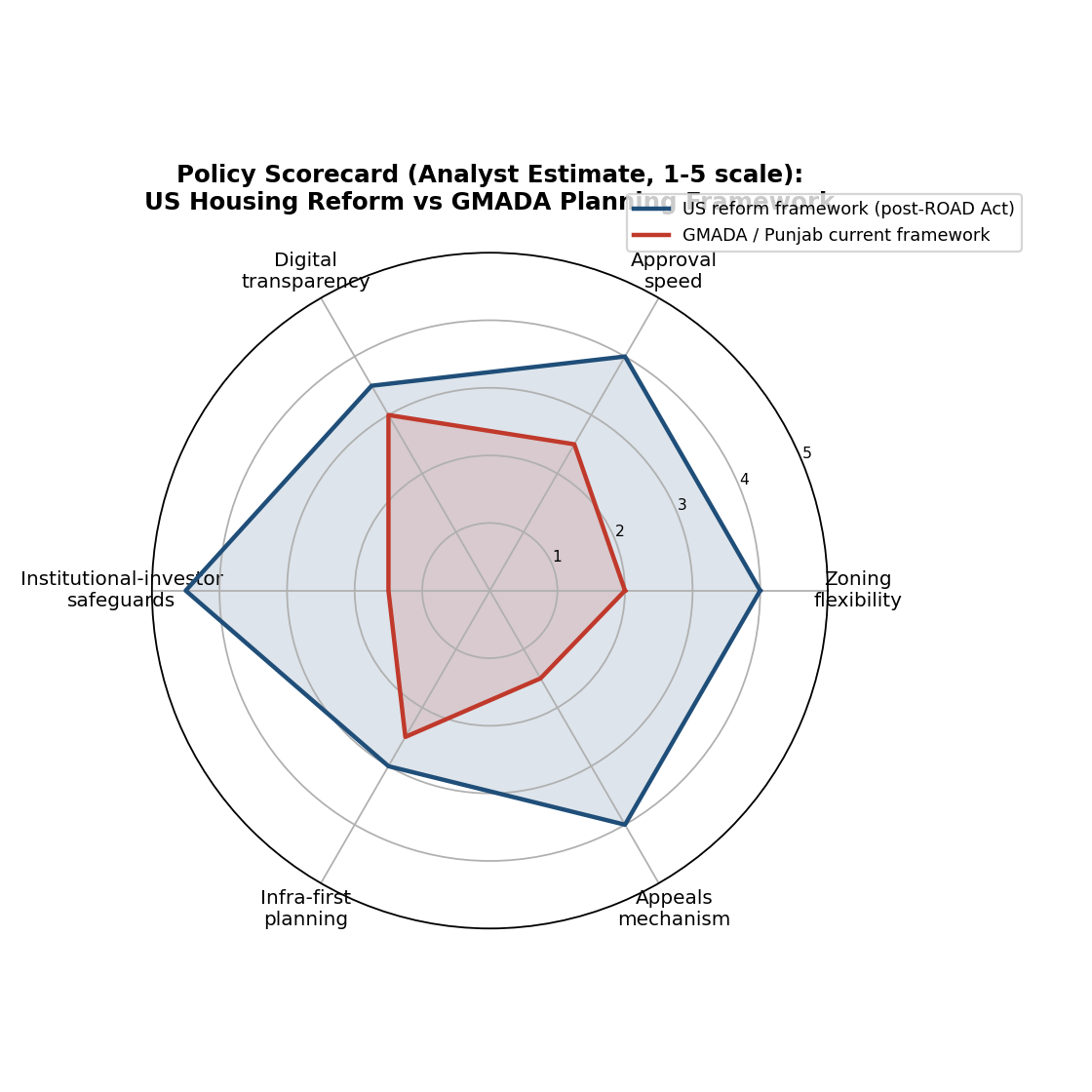
Suggested Infographics (For Editorial/Design Team)
- “How a Housing Project Gets Approved” — three-panel flow: USA → India → GMADA single-window + PAPRA.
- GMADA jurisdiction map highlighting Mohali, Zirakpur, Derabassi, Kharar, Mullanpur, Fatehgarh Sahib, Mandi Gobindgarh and the newly drafted Kurali zone.
- Timeline graphic of the US bill’s journey alongside GMADA’s Kurali master plan timeline.
Key Takeaways for Punjab Investors
- The US just proved, at national scale, that approval speed and zoning flexibility move prices more than subsidies do.
- Infrastructure delivery track record now matters more than master-plan announcements. GMADA’s own missed deadlines on the Airport Link Road are a more reliable pricing signal than any land-pooling press release.
- Punjab’s RERA-plus-PAPRA framework is already more consumer-protective on paper than the US federal system has ever been — the execution gap, not the legal gap, is the real opportunity.
- Corridors where GMADA has actually delivered infrastructure carry a different risk profile than corridors still running on land-pooling promises, like parts of New Chandigarh and the fresh Kurali zone.
Should GMADA Adopt Similar Reforms?
Not wholesale — but three specific, narrow ideas (published approval-time data, a searchable public land-parcel database, and a formal appeals window) are adoptable without any new state legislation. The real question isn’t “should GMADA become more American.” It’s “is GMADA’s own single-window system being used to its full transparency potential” — and right now, the honest answer is not yet.
What Homebuyers Should Watch Over the Next Five Years
Watch three things: whether GMADA’s infrastructure deadlines start landing on time (the Airport Link Road will be an early test case); whether approval-time transparency shows up in GMADA’s public communication; and whether India’s national housing conversation begins to absorb the supply-side, approval-speed argument the US has just legislated into law. The sectors that benefit first will be the ones where infrastructure is already real, not merely planned.
Frequently Asked Questions
It’s a US federal law, passed by Congress in June 2026 and enacted July 11, 2026, that reforms zoning, speeds up housing approvals, funds local governments that build more homes, and restricts large investors from buying single-family houses.
He said he was withholding his signature in protest over a separate, unrelated bill (the SAVE America Act) not passing the Senate — but he did not veto it, so it became law automatically under US constitutional rules.
Not directly or legally — India has its own RERA and state-level planning laws. Its relevance is as a policy case study for GMADA, PUDA and Indian planning bodies on approval speed and zoning reform.
GMADA’s Change of Land Use (CLU) rules and master-plan density (FAR/FSI) provisions serve a similar function to US zoning — determining what can legally be built where.
GMADA already has a single-window clearance system and an online status-tracking tool; publishing approval-time data and adding a formal appeals window for stalled projects are realistic near-term steps.
Mohali (especially IT City and Aerocity) offers stronger long-term rental demand and airport-linked growth; Zirakpur offers better near-term liquidity and connectivity. The right choice depends on your investment horizon.
New Chandigarh (Mullanpur) is GMADA’s planned “city of excellence,” conceived with Singapore-based Jurong Consultants in 2007. It remains a long-horizon investment play built around institutional anchors like Mullanpur Medicity.
On paper, yes — RERA’s escrow, registration and delay-penalty provisions are stronger than anything the US has at a federal level. India’s gap is in approval speed and administrative execution, not consumer-protection law.
The Punjab Apartment and Property Regulation Act, 1995 (PAPRA) governs how private colonies and apartment projects get licensed in GMADA’s jurisdiction — Letter of Intent, colony licence, Form APR-I and building-plan sanction, before a promoter can legally sell.
It’s a reminder that large-scale investor ownership can attract regulatory restriction over time; RERA-verified, individually titled property remains the structurally safer long-term holding for NRI investors in Punjab.
Glossary of Terms
| Term | Meaning |
|---|---|
| ROAD to Housing Act | 21st Century ROAD to Housing Act — the US federal housing reform law enacted July 11, 2026 |
| HUD | US Department of Housing and Urban Development — issues zoning and permitting guidance under the new law |
| NEPA | National Environmental Policy Act — now exempting small infill housing from lengthy federal review |
| GMADA | Greater Mohali Area Development Authority — Punjab’s statutory planning body covering Mohali, Zirakpur, Kharar, Derabassi, Mullanpur, Fatehgarh Sahib, Mandi Gobindgarh and Ropar |
| PAPRA | Punjab Apartment and Property Regulation Act, 1995 — governs colony licensing in GMADA’s jurisdiction |
| CLU | Change of Land Use — formal permission converting land for residential/commercial/industrial use |
| FAR / FSI | Floor Area Ratio / Floor Space Index — the density a plot is legally permitted to build |
| RERA | Real Estate (Regulation and Development) Act, 2016 — mandates project registration and buyer protection nationwide |
| Build Now Act | US bill section creating a $200M/year grant rewarding local governments for measurable housing-supply growth |
| Single-Window System | GMADA’s online portal for tracking application and approval status across departments |
Related Guides on Royals Property Consultant
Want a plain-language read on how this US reform connects to a specific GMADA sector you’re watching? Send your requirement directly to Manindar Verma on WhatsApp — no account, no email required.
💬 Send to WhatsApp Goes straight to Manindar Verma’s WhatsApp · Zero brokerage · Reply within 2 hoursSchema Markup & Sources
FAQ, NewsArticle and Breadcrumb JSON-LD are ready in the companion reference doc — ask if you want them pasted inline here too.
Sources
- Bipartisan Policy Center — section-by-section explainers on the 21st Century ROAD to Housing Act
- Congress.gov / GovTrack.us — official bill text, H.R. 6644
- NPR, NBC News, CNBC, Deseret News — coverage of the bill becoming law (July 10–11, 2026)
- Wikipedia — “21st Century ROAD to Housing Act” (legislative timeline)
- Niskanen Center — policy analysis of the Build Now Act and related provisions
- National Association of Counties (NACo) — county-impact analysis
- Greater Mohali Area Development Authority (GMADA) — official notifications and single-window portal (gmada.gov.in)
- Punjab Apartment and Property Regulation Act, 1995 (PAPRA)
- Public reporting on the Mohali Airport Link Road and Kurali master plan draft (July 2026)
Disclaimer: This article is an independent editorial analysis for informational purposes and does not constitute legal, financial or investment advice. Approval-timeline comparisons and the policy scorecard are illustrative, analyst-level estimates, not official government statistics. Verify current RERA registration, GMADA approval status and pricing directly before making any investment decision.
GMADA approval reforms, Punjab real estate policy 2026, Mohali zoning reform, New Chandigarh infrastructure planning, RERA vs US housing law, GMADA single window approval