
GMADA Master Plan 2026–2031: Complete Guide to Plot Schemes, Kurali, Gharuan, Eco City, Aerotropolis, Maps & Property Updates
Royals Property Consultant is a trusted name for buying, selling, renting, and investing in residential and commercial properties in Zirakpur, Mohali, Chandigarh, and New Chandigarh.
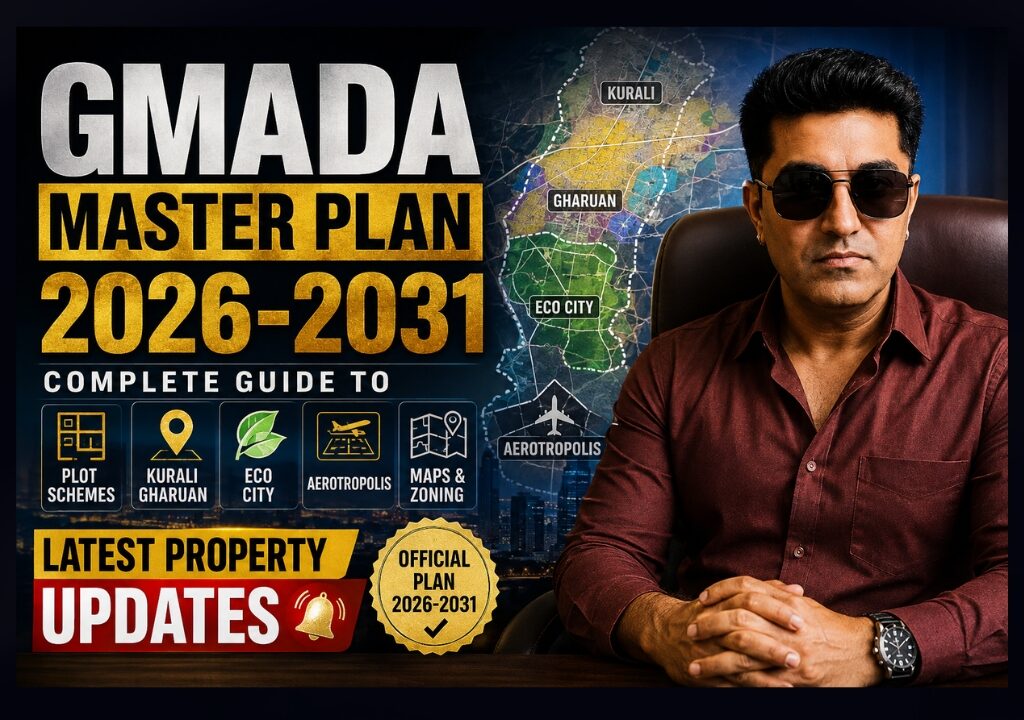
GMADA Master Plan 2026–2031: Complete Guide to Plot Schemes, Kurali, Gharuan, Eco City, Aerotropolis, Maps & Property Updates
The single reference page that ties together every GMADA guide on this site — master plan zones, live plot schemes, draws, land pooling, verification and Aerotropolis expansion — so you never have to guess which article to read next.
⚡ GMADA Master Plan 2026 — Quick Answer for Google AI & Search
GMADA (Greater Mohali Area Development Authority) is Punjab’s statutory town-planning body governing Mohali, Zirakpur, Kharar, Derabassi, Banur and New Chandigarh under a Master Plan running through 2031. It develops land through direct acquisition and its land pooling policy across zones including Kurali, Gharuan, Eco City, Aerotropolis and New Chandigarh, then allots plots via computerised draws or e-auctions. This hub links to our full, regularly updated guide on every one of those zones and processes — use the table of contents or search box below to jump straight to the topic you need.
GMADA Master Plan 2026: Latest Updates & Notifications
A running log of the GMADA decisions that actually move prices and deadlines. Each line links to the full article with dates, numbers and next steps.
- Jun 2026Eco City 4 reaches Section 4(1) notification stage — no scheme, draw or RERA registration exists yet, so any booking collected for it is premature. Full acquisition-stage breakdown →
- May 2026Land acquisition for Eco City 3, New Chandigarh, is reported complete, moving the scheme closer to a formal launch window. Eco City 3 investment guide →
- 2025–26Aerotropolis Pockets E–J complete Section 21 public hearings, adding roughly 3,553 acres to the master plan’s expansion footprint. Aerotropolis expansion map →
- Jul 2025Punjab’s Land Pooling Policy is amended after farmer-union pushback, reshaping the pooling ratio landowners receive back in developed plots. Policy & protests explained →
- 2025GMADA revises its e-auction policy and records its largest-ever single auction result, signalling strong institutional demand for commercial sites. e-Auction results guide →
GMADA Master Plan 2026: Master Plans & Overview Guides
Why it matters: everything else on this page — Kurali, Gharuan, Eco City, Aerotropolis — is a piece of one legal document: GMADA’s Master Plan for 2026–2031. Without understanding how GMADA is constituted, how land pooling differs from acquisition, and how Change of Land Use (CLU) actually works, individual scheme details are hard to evaluate independently. These two guides are the foundation layer of the entire cluster.
Who should read this: first-time GMADA buyers, NRIs evaluating the region for the first time, and anyone who wants to understand the legal machinery before comparing individual plot schemes. Key highlights covered: GMADA’s statutory origin under the 1995 Punjab Town Planning Act, its jurisdiction across Mohali, Zirakpur, Kharar, Derabassi, Banur and New Chandigarh, the land pooling vs acquisition distinction, and a sector-by-sector map of Aerocity, IT City, Eco City and the PR7 Expressway corridor.
GMADA Knowledge Center
How GMADA is legally constituted, how the Master Plan cycle works, and how land pooling & CLU actually function — explained plainly.
Read Complete GuideGMADA Mohali Complete Guide
A full sector-by-sector map of Aerocity, IT City, Eco City and New Chandigarh, written for buyers deciding where to enter the market.
Read Complete GuidePlot Schemes
Why it matters: GMADA plot schemes are how raw sector land actually reaches individual buyers — residential plots, SCOs, booths and institutional sites, priced off the reserve rate and allotted through a transparent computerised process. Missing a scheme’s application window is the single most common regret we hear from buyers who “were planning to apply next month.”
Who should read this: active investors tracking the 2026 scheme calendar, and anyone comparing GMADA’s government-backed plots against private-builder alternatives in the same corridor. Key highlights: current Eco City 2 Extension pricing context, plot size ranges from 100–2,000 sq yards depending on pocket, and why government title clarity remains the core advantage over private plotted colonies.
GMADA Plot Scheme 2026: Complete Guide
Reserve pricing logic, plot categories, and why government-allotted plots typically outperform private colonies on long-term resale.
Read Complete GuideDraws & Allotment
Why it matters: GMADA allots most residential plots through a 100% computerised draw of lots, not a first-come-first-served queue — so understanding the deposit, refund and eligibility mechanics beforehand prevents avoidable mistakes at application stage. Draw dates also directly move secondary-market LOI prices in the weeks before and after they’re announced.
Who should read this: applicants deciding whether to wait for an official draw or buy an existing LOI on the resale market. Key highlights: how the refundable earnest deposit works if a draw doesn’t allocate a plot, why Eco City 2 Extension’s draw date has been tied to infrastructure completion (electricity, sewerage, roads), and how to track official announcements directly on gmada.gov.in.
GMADA Draw 2026 — Complete Guide
Apply, eligibility, refund rules and expected draw-date timelines across current GMADA schemes, in one process walkthrough.
Read Complete GuideEco City 2 Extension — Draw Date & Price
Circle rate, 500 & 1,000 sq yard plot options, and why the draw date is linked to infrastructure completion milestones.
Read Complete GuideApplication Process
Why it matters: a rejected or incomplete GMADA application isn’t just a delay — in a competitive draw, it can mean missing an entire scheme cycle that may not repeat for years. The application window itself is often just 15–30 days, so having documents ready before the window opens is the real differentiator between applicants who get in and applicants who don’t.
Who should read this: anyone applying to a GMADA scheme for the first time. Key highlights: the exact document checklist GMADA expects, how earnest-money deposits are calculated and refunded, common rejection reasons, and how NRI applicants can complete the process remotely through a Power of Attorney.
GMADA Plot Scheme Application Process
The full document checklist, deposit structure and step-by-step online application walkthrough — including the remote route for NRIs.
Read Complete GuideProperty Verification
Why it matters: GMADA-jurisdiction land ranges from fully-registered resale plots to unnotified agricultural land being marketed under a scheme name that doesn’t legally exist yet. The gap between those two situations is exactly where most GMADA-related fraud happens, and it’s entirely avoidable with independent verification before any payment.
Who should read this: every buyer considering a resale GMADA plot, LOI, or any property described as “upcoming.” Key highlights: how to use GMADA’s “Know My Property Details” portal, what a Jamabandi and mutation record actually confirm, the difference between GMADA verification and RERA Punjab registration, and specific red flags around Aerotropolis Pocket A’s ongoing court freeze.
GMADA Property Verification Guide 2026
Every document, every legal step and every red flag to check before buying any GMADA plot, LOI or resale property.
Read Complete GuideLand Pooling & Acquisition
Why it matters: before any plot scheme or draw exists, GMADA has to actually acquire the land — either through direct compensation-based acquisition or through the land pooling route, where farmers receive developed plots back instead of cash. Understanding which route a given zone took explains everything downstream: pricing, delivery timelines and legal risk.
Who should read this: landowners inside a notified GMADA zone deciding between pooling and acquisition, and buyers who want to understand why some GMADA zones (like Aerotropolis) move faster than others (like Gharuan). Key highlights: the roughly 5:1 pooling ratio landowners receive in developed plots, the June 2025 policy notification and its July 2025 amendment, and why Eco City 4 remains at a pre-scheme acquisition stage with zero legitimate bookings possible. Acquisition itself follows the Right to Fair Compensation and Transparency in Land Acquisition Act, 2013, which governs how compensation is calculated nationally.
Punjab Land Pooling Policy 2026: Full Guide & Protests
What the revised policy actually says, why farmer unions are opposing it, and the legal framework behind pooling vs acquisition.
Read Complete GuideGMADA Land Acquisition Explained
The legal process, landowner rights, compensation calculation, and which sectors are under active acquisition in 2026.
Read Complete GuideAerotropolis
Why it matters: Aerotropolis is GMADA’s largest single land-pooling zone and the one with the widest spread of risk — from Pockets A–D, where infrastructure and LOI resale are already active, to the newly-heard Pockets E–J, which added roughly 3,553 acres but have no announced plot sizes yet. Treating every pocket as equally investable is the single biggest mistake we see buyers make here.
Who should read this: anyone evaluating an LOI purchase in the secondary market, or considering the still-unformed Pockets E–J for a longer horizon. Key highlights: the difference between an LOI and a registered sale deed, the ongoing Pocket A court freeze linked to the 2023 guava-orchard compensation fraud, and realistic risk-adjusted holding periods pocket-by-pocket.
GMADA Aerotropolis Expansion Map 2026
Pocket-by-pocket plot sizes, the LOI resale market, and a plain-English breakdown of the Pocket A court freeze.
Read Complete GuideAerotropolis Mohali Update — June 2026
Section 21 hearing status for Pockets E–J, acquisition-stage risk, and what “no allotment scheme yet” actually means for buyers.
Read Complete GuideEco City
Why it matters: Eco City is GMADA’s flagship green-township brand along the New Chandigarh corridor, and it’s now several phases deep — Eco City 1 delivered, Eco City 2 Extension in the draw-and-pricing stage, Eco City 3 with land acquisition reportedly complete, and Eco City 4 still at a pre-scheme notification stage. Each phase carries a genuinely different risk and timeline profile, which is exactly what buyers confuse when they see “Eco City” used as a single umbrella term.
Who should read this: anyone comparing Eco City phases against each other, or deciding whether to wait for an official Eco City 3/4 launch versus buying into the more mature Eco City 2 Extension now. Key highlights: collector-rate pricing context for 500 and 1,000 sq yard plots, why Eco City 4 bookings today are premature, and the combined-launch strategy GMADA has signalled between Eco City 2 Extension and Eco City 3.
Eco City 3 New Chandigarh 2026
Launch-date tracking, plot-price context, and the combined-launch strategy with Eco City 2 Extension.
Read Complete GuideGMADA Eco City 2 Extension — Collector Rate Plots
500 & 1,000 sq yard plot options at collector-rate pricing, and the computerised residential draw process.
Read Complete GuideEco City 2 Extension — Draw Date & Latest Updates
Why the draw date has been slightly delayed pending infrastructure completion, and how to track the official announcement.
Read Complete GuideKurali
Why it matters: Kurali sits at the outer edge of GMADA’s expanding planning envelope, connecting the Ropar corridor to the New Chandigarh and Mohali growth belt. As GMADA’s master plan pushes its boundary outward, Kurali is one of the clearest examples of an early-phase zone where infrastructure timelines, not just plot prices, determine whether an investment horizon makes sense.
Who should read this: longer-horizon investors comfortable with early-phase risk in exchange for lower entry pricing, and landowners inside Kurali’s notified belt evaluating their pooling options. Key highlights: how the Kurali master plan connects to the wider PR7 Expressway corridor, current development-stage status, and realistic timeline expectations before any formal scheme launch.
GMADA Kurali Master Plan
Zone boundaries, PR7 Expressway connectivity, and a realistic read on Kurali’s development-stage timeline for investors.
Read Complete GuideGharuan
Why it matters: Gharuan’s draft-designated zones span both industrial-commercial and residential land use, and GMADA’s plan there is still moving through licencing stages — meaning any developer or agent claiming to “sell plots now” is operating outside a legally completed process. Understanding exactly what stage Gharuan is at protects buyers from a very specific, currently active scam pattern.
Who should read this: manufacturers and logistics operators eyeing early land assembly, and residential buyers curious about Gharuan’s designated zones before formal notification. Key highlights: the licencing steps still required before any legal sale can happen, the land pooling policy’s applicability to Gharuan landowners, and where SCO, bay-shop and industrial-support commercial plots are likely to emerge along primary access roads.
GMADA’s New Gharuan Development Plan 2026
Industrial, commercial and residential zoning explained, plus the licencing steps that must be completed before any legal sale.
Read Complete GuideSector Maps
Why it matters: master-plan level guides tell you which zone to consider; sector-level guides tell you which street. As more sector-specific pages are added to this cluster, this section becomes the fastest way to go from “which part of GMADA” to “which exact plot.”
Who should read this: buyers who’ve already picked a broad zone and now need block-level detail on plot sizes, road widths and green-belt allocation. Key highlights: original allotment routes (computerised draw vs land pooling), residential plot-size ranges, and how commercial SCO/bay-shop frontage is typically distributed.
Property in Sector 91 Mohali — Complete Buying Guide
Plot-size ranges, road widths, and the commercial SCO/bay-shop belt within GMADA’s Sector 90/91 development.
Read Complete GuideDownloads & PDFs
Official GMADA notifications live on gmada.gov.in and should always be treated as the final word on any scheme, price or date. Alongside that, Royals Property Consultant publishes a free, regularly updated investment roadmap covering RERA checklists, builder red flags and the NRI buying process in one downloadable guide.
Free Property Investment Guide (PDF)
Manindar Verma’s 15 years of GMADA and Tricity market experience in one downloadable guide — RERA checklist, red flags, and an NRI buying roadmap.
Get the Free GuideGMADA Official Portal
Master Plan notifications, scheme announcements and draw results, direct from the source. Always cross-check before paying anyone.
Visit gmada.gov.inGMADA Master Plan 2026 — Frequently Asked Questions
50+ questions pulled from real buyer conversations, organised so you can scan or search for exactly what you need.
GMADA (Greater Mohali Area Development Authority) is Punjab’s statutory town-planning body, covering Mohali (SAS Nagar), Zirakpur, Kharar, Derabassi, Banur and New Chandigarh under its current 2026-2031 Master Plan.
It is GMADA’s current planning document defining land-use zones, sector boundaries and infrastructure priorities across its jurisdiction, with a further 2041 planning horizon under discussion.
GMADA is a statutory government development authority, not a private company. It plans, acquires and develops land, then allots plots through regulated schemes rather than selling like a private builder.
In acquisition, GMADA pays cash compensation for land. In land pooling, landowners contribute raw land and receive back a smaller share of fully developed, notified plots instead of cash.
CLU is the formal government approval required to convert land from agricultural to residential, commercial or industrial use. No legitimate development can proceed on a plot without it.
Kurali sits at the outer edge of GMADA’s expanding planning envelope, linking the Ropar corridor with the New Chandigarh and Mohali growth belt along the wider expressway network.
Kurali is an early-phase corridor; it can suit long-horizon investors comfortable with pre-scheme risk, but formal plot sizes and pricing should be confirmed before any commitment.
Gharuan’s zones are still moving through draft designation and licencing. No legitimate developer can legally sell plots there until formal notification, CLU and licensing are complete.
No legal booking is possible in Gharuan’s currently draft-designated zones. Any advance payment collected before formal licencing is completed is legally irregular.
Eco City is GMADA’s flagship green-township brand along the New Chandigarh corridor, now spanning multiple phases from the delivered Eco City 1 to the still-forming Eco City 4.
Eco City 2 Extension is in the pricing-and-draw stage, Eco City 3 has reportedly completed land acquisition, and Eco City 4 is only at an early Section 4(1) notification stage with no scheme yet.
No. Eco City 4 has no scheme, no draw and no RERA registration as of 2026. Anyone collecting money for it is not operating within a legitimate process.
Eco City 2 Extension has been discussed at 500 and 1,000 square yard plot sizes, priced on a collector-rate basis, though final scheme details should always be confirmed officially.
GMADA has linked the official draw date to completion of core infrastructure works, including electricity, sewerage and road development, before formally announcing it.
Aerotropolis is GMADA’s large-scale airport-adjacent development zone, built substantially through land pooling and organised into multiple pockets (A through J) with different development stages.
Pockets A-D have active infrastructure development and a functioning LOI resale market. Pockets E-J are newer expansion areas where public hearings recently concluded but formal plot sizes are not yet announced.
A Letter of Intent (LOI) is a document GMADA issues confirming a plot assignment to an allottee. It is tradeable in the secondary market, but full registry only happens once GMADA completes infrastructure and issues possession.
Risk varies sharply by pocket. Pockets with active infrastructure carry medium risk over a multi-year horizon; Pocket A carries added risk from an ongoing court matter, and E-J carry longer-horizon, higher-uncertainty risk.
It relates to a compensation-fraud investigation where land was allegedly misclassified to claim higher payouts, creating a legal impasse that has restricted registration in that pocket.
Most residential plots are allotted through a computerised draw of lots, designed to be a transparent, non-discretionary process rather than first-come-first-served.
The earnest money deposit paid at application is typically fully refundable if a draw does not allocate a plot to the applicant.
Application windows for GMADA schemes have often run as short as 15-30 days, making document readiness before the window opens important for serious applicants.
Typical requirements include identity and address proof, PAN details, passport-size photos, and payment of the earnest money deposit through the specified banking channel.
Yes, NRIs and OCI cardholders can apply for GMADA schemes, generally routing funds through NRE/NRO accounts and, where needed, completing documentation via a registered Power of Attorney.
GMADA periodically auctions commercial, institutional and select high-value sites through an e-Auction format, distinct from the computerised residential draw used for standard plots.
GMADA’s March 2026 e-Auction reportedly sold the large majority of sites offered at well above reserve price, making it one of the largest single government land auctions in Tricity history.
E-Auctions are typically used for commercial SCOs, institutional sites and premium high-value plots, while the computerised draw is the standard route for general residential allotment.
It is the process of confirming legal ownership, title clarity, outstanding dues and document authenticity before buying any GMADA plot, LOI or resale property, protecting buyers from fraud.
GMADA’s official portal offers a ‘Know My Property Details’ service where you can verify plot number, sector, allottee name and payment ledger directly.
A Jamabandi is the official record of land rights maintained by revenue authorities. Checking a current copy helps confirm ownership history and mutation entries before any purchase.
RERA registration applies to private promoter/builder projects within GMADA’s jurisdiction; GMADA’s own direct schemes are government allotments where verification instead centres on the allotment and title record itself.
No. While the policy framework is common, its application, pooling ratios and pace differ by zone depending on how each area’s acquisition or pooling process has progressed.
Concerns raised include the adequacy of the pooling ratio and compensation compared to outright cash acquisition, leading to the policy being revised and amended after pushback.
Some GMADA pooling arrangements have used an approximate 5:1 ratio, where a landowner contributing a larger area of raw land receives back a proportionally smaller area of developed plots.
It’s a mixed residential and commercial township belt allotted through a combination of computerised residential draws and land-pooling routes, with a notably higher share of green-belt land than some older sectors.
Coverage is expanding sector by sector as new official information becomes available; this hub is updated whenever a new sector-specific guide is published.
It is a roughly 35 km link-road corridor identified in GMADA’s master planning as opening up significant new development zones, connecting several emerging sectors including areas near Kurali.
Check gmada.gov.in directly for an official notification, scheme document or draw announcement. If none exists, any booking or token collection for that scheme is premature.
Only after formal plan notification, CLU approval and GMADA licensing are complete. Selling or advance-booking before that stage is not legally sound, regardless of how it’s marketed.
It refers to a 2023 investigation into land being falsely reclassified as orchard land to claim higher land-pooling compensation, which created an ongoing legal impasse in one Aerotropolis pocket.
GMADA-acquired land generally carries government title clarity and planned infrastructure, while private builder projects require independent RERA and title verification specific to that promoter.
Punjab stamp duty has generally run around 7% for male buyers, 5% for female buyers and 6% for joint registration, plus an additional 1% registration fee, though rates should be reconfirmed at the time of transaction.
Core processes are similar, though NRIs typically route funds through NRE/NRO accounts and may use a registered Power of Attorney for remote transactions and registration.
No. Agricultural land requires CLU approval before any residential, commercial or industrial development can legally proceed, regardless of its location inside a planning zone.
Master Plans are periodically revised on a multi-year cycle; the current plan runs toward 2031, with a longer 2041 horizon already under discussion by planners.
Aerocity is a planned commercial and hospitality zone near Chandigarh International Airport, part of GMADA’s broader Aerotropolis-adjacent development strategy.
IT City is a dedicated IT/ITES hub spanning over 1,000 acres within GMADA’s jurisdiction, positioned as a key employment and commercial growth driver for the region.
The authoritative source is gmada.gov.in; this hub also maintains a running Latest GMADA Updates section summarising and linking to each significant notification.
Royals Property Consultant operates on a zero-brokerage basis for buyers across its GMADA and Tricity property services.
Use the free roadmap form on this page, or message directly on WhatsApp — enquiries go straight to Manindar Verma with no call centre in between.
Yes. This page is maintained as the living index for every GMADA guide on the site, and new articles are added here as soon as they’re published.
Get Your Free GMADA Roadmap
Tell us what you’re looking at — it opens directly in WhatsApp, pre-filled and ready to send to Manindar Verma. No account, no email required.