
GMADA’s New Gharuan Development Plan Explained:Industrial, Commercial & Residential Growth Opportunities in Mohali
Royals Property Consultant is a trusted name for buying, selling, renting, and investing in residential and commercial properties in Zirakpur, Mohali, Chandigarh, and New Chandigarh.
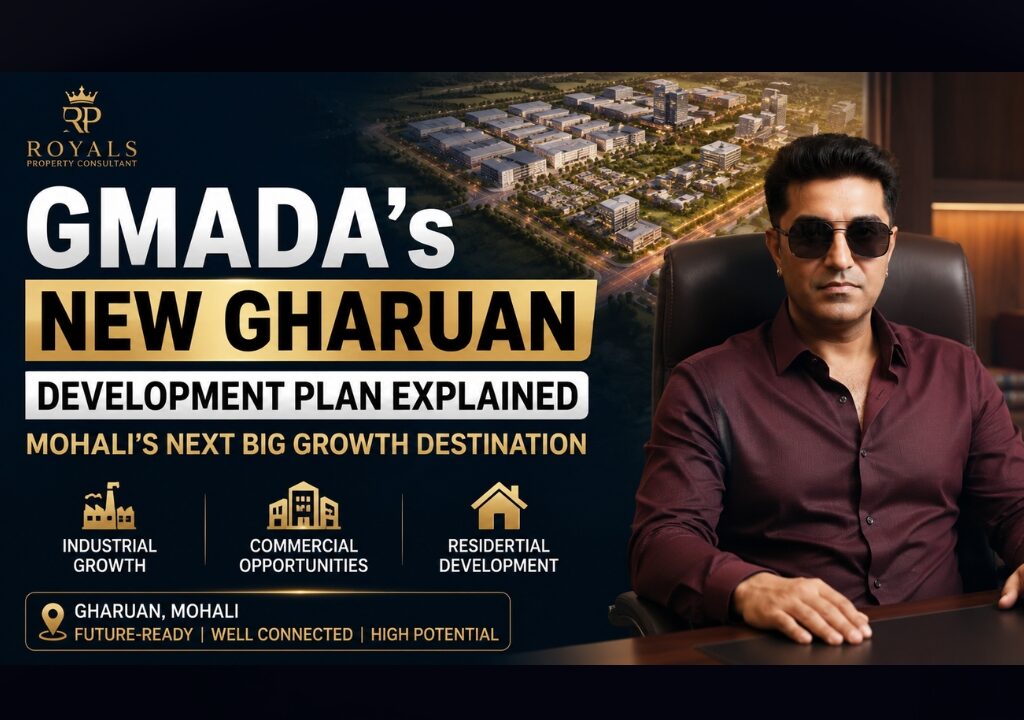
GMADA’s New Gharuan Development Plan Explained:
Industrial, Commercial & Residential Growth Opportunities in Mohali
A proposed amendment covering ~3,000 acres across 16 villages near Gharuan. What it means for buyers, investors, NRIs & landowners — full expert analysis inside.
In late June 2026, a significant planning announcement came from the Directorate of Town and Country Planning, Punjab. The government is proposing to amend the GMADA regional plan to formally introduce industrial, commercial, and residential land use designations across approximately 3,000 acres spanning 16 villages in and around Gharuan, SAS Nagar (Mohali).
For most buyers and investors outside the planning community, Gharuan is still a largely unfamiliar name. But within GMADA’s broader development vision for Greater Mohali, this draft plan represents a meaningful step — formalising land use in an area that sits at an important geographic junction between Kharar, Mohali’s outer sectors, and the Chandigarh International Airport corridor.
This article breaks down exactly what the draft plan proposes, which villages are included, what it means for residential buyers, industrial investors, commercial developers, and landowners — and what risks every serious buyer should understand before acting on the news.
The GMADA Gharuan development plan is a proposed amendment to the Greater Mohali Area Development Authority’s regional plan, covering nearly 3,000 acres across 16 villages near Gharuan in SAS Nagar. The draft designates several villages as industrial, commercial, or residential zones while retaining others as agricultural. It is currently at the draft stage — not yet approved — and public objections and suggestions are being invited under Punjab’s planning laws. Investors and buyers should treat this as an early-signal opportunity, not a guaranteed development outcome.
- What is the GMADA Gharuan Draft Development Plan?
- Why is Gharuan Becoming Important?
- Complete List of 16 Villages & Proposed Land Use
- Residential Development Explained
- Industrial Development Opportunities
- Commercial Development Opportunities
- How Will Property Prices Be Affected?
- Infrastructure & Connectivity
- Impact on Nearby Areas
- Who Should Consider Investing?
- Risks Every Buyer Must Know
- Expert Analysis by Manindar Verma
- 25+ FAQs — Buyers, Investors & NRIs
- Final Thoughts
What is the GMADA Gharuan Draft Development Plan?
GMADA — the Greater Mohali Area Development Authority — was constituted under Section 29(1) of the Punjab Regional and Town Planning and Development Act, 1995 through a government notification in August 2006. Its jurisdiction covers the planning and development of Mohali, Kharar, Zirakpur, Dera Bassi, Banur, and surrounding areas, including New Chandigarh (Mullanpur) and Fatehgarh Sahib.
The regional plan GMADA operates under defines land use zones across its entire jurisdiction — what can be built where, what land can be used for industrial activity, which areas are designated for residential colonies, and which remain agricultural or green belts. This zoning has direct legal implications: a landowner cannot develop industrial infrastructure on agricultural land without a formal change in land use (CLU), and a private developer cannot build a residential colony unless the zone permits it.
The Gharuan draft plan, being prepared by the Directorate of Town and Country Planning, Punjab, proposes to amend this existing regional plan. The stated purpose is to introduce industrial and commercial activity in the Gharuan area — effectively formally recognising and enabling the kind of mixed-use development that the district is already trending toward.
What Has Prompted This Amendment?
A few factors have accelerated Gharuan’s planning significance. First, the organic pressure of urbanisation along the Kharar-Gharuan-Banur corridor, which is already seeing commercial and industrial activity without formal zoning. Second, GMADA’s own ongoing projects — Aerocity, IT City, Eco City 3 in New Chandigarh, and the Aerotropolis — are generating satellite demand in outer areas like Gharuan. Third, the Punjab government’s industrial policy push requires formally zoned industrial land to attract large manufacturers and logistics operators.
The parallel amendment at Manauli village — converting 54 acres from institutional to industrial and warehouse use — points to a broader rationalisation exercise. As Sectors 81 and 83 already host IISER and ISB, and IT City Sector 82 Alpha accommodates educational institutions, the Manauli institutional zone was effectively redundant. Repurposing it for warehousing and industry is a practical planning correction.
Why is Gharuan Becoming Important?
Location is the most straightforward explanation. Gharuan sits at a strategic geographic node in SAS Nagar district, positioned between Kharar to the north and Mohali’s developed sectors to the south.
Airport Proximity
- Chandigarh International Airport (IXC) within the broader Mohali district
- Airport road corridor actively developing with logistics & commercial users
- Aerocity GMADA project already operational nearby
Urban Proximity
- Connected to Kharar, one of the fastest-growing towns in Tricity
- Near Mohali’s outer sectors (90s range) under development
- Part of the wider SAS Nagar urban agglomeration
Education & Healthcare
- IISER and ISB in Sectors 81–83 nearby
- IT City (Sector 82 Alpha) housing educational institutions
- Fortis and Max hospitals within the Mohali belt
Highway Connectivity
- PR9 (Kharar-Banur road) connects to Mohali’s main network
- 200-foot wide road from Aerocity junction to PR9 under construction by GMADA
- Road from Aerocity junction to airport also being built
Industrial Corridor Logic
- Existing Mohali industrial phases (I–XI) drive demand for overflow land
- GMADA’s Industrial Park in Sector 101 and 103 attracting manufacturers
- Warehousing demand from Aerotropolis ecosystem
Future Growth Vector
- GMADA’s 11,103-acre land acquisition drive across Greater Mohali
- Punjab government’s village development commitment creates confidence
- Land pooling policy giving landowners a stake in development
Complete List of 16 Villages — Proposed Land Use
The draft plan covers approximately 3,000 acres across 16 villages. Villages have been broadly divided into three categories: residential, industrial/commercial, and agricultural retention zones.
| # | Village | Proposed Zone | Expected Impact |
|---|---|---|---|
| 1 | Gharuan | RESIDENTIAL | Group housing, plotted colonies, residential development possible |
| 2 | Mamupur | RESIDENTIAL | Residential colony development; increased land value expected |
| 3 | Sakrulapur | RESIDENTIAL | Residential zone — builders and developers likely to seek CLU |
| 4 | Barauli | RESIDENTIAL | Residential development zone; proximity to Gharuan core |
| 5 | Hasanpur | RESIDENTIAL | Residential colony designation; landowner valuations to rise |
| 6 | Roorkee Pukhta | RESIDENTIAL | Residential zone; outer ring of the proposed residential belt |
| 7 | Simbal Majra | RESIDENTIAL | Residential designation aligns with Kharar corridor growth |
| 8 | Peer Suhana | RESIDENTIAL | Residential zone; already has some peripheral development activity |
| 9 | Machhipur | AGRICULTURAL | Retained as agricultural; limited development activity expected |
| 10 | Thedi | AGRICULTURAL | Retained as agricultural; green buffer in the plan |
| 11 | Sil Kapda | AGRICULTURAL | No immediate development activity; farmland retained |
| 12 | Batta | AGRICULTURAL | Agricultural retention; may benefit indirectly from surrounding growth |
| 13 | Bibipur | AGRICULTURAL | Agricultural zone retained in the draft plan |
| 14 | Roda | AGRICULTURAL | Farmland retained; no formal development designation |
| 15 | Bajheri | AGRICULTURAL | Green zone; agricultural character maintained |
| 16 | Mahmudpur / Sotal | AGRICULTURAL | Agricultural buffer; outer ring of the plan boundary |
Note: Gharuan and 7 other villages are proposed as residential zones. Machhipur and 8 others remain agricultural. Industrial and commercial activity is proposed broadly for the Gharuan area, with specific sector demarcation to follow upon formal notification.
📥 Free Property Investment Guide — Mohali & Tricity
GMADA plans, sector-wise analysis, NRI checklist — all in one guide.
Residential Development Explained
The designation of Gharuan, Mamupur, Sakrulapur, Barauli, Hasanpur, Roorkee Pukhta, Simbal Majra, and Peer Suhana as residential zones is the part of the plan most relevant to home buyers and apartment investors. Once formally notified, these villages would be eligible for:
Group Housing
- Multi-storey apartment complexes become eligible for CLU and licence
- Developers can design gated societies with standard amenities
- Density norms governed by GMADA master plan regulations
Plotted Colonies
- Private developers can seek licences for plotted residential colonies
- Residential plots in 100–500 gaj range typically emerge in such zones
- Landowners may sell or co-develop under land pooling options
Affordable Housing
- Outer zones like Gharuan typically attract affordable entry-level housing
- Proximity to industrial zones creates employer-driven housing demand
- 1–2 BHK demand expected from logistics and manufacturing workforce
Premium Villas & Floors
- Plots with green surroundings attract luxury villa township developers
- Low-density residential development may be proposed in some pockets
- NRI buyers seeking quieter Tricity locations may find these zones attractive
Industrial Development Explained
Based on the pattern of other GMADA industrial zones in SAS Nagar, the Gharuan industrial zone is likely to attract light manufacturing units, warehousing and logistics facilities, packaging industries, auto-ancillary units, food processing operations, and potentially IT-enabled services (ITeS) support offices.
Warehousing & Logistics
Warehousing is arguably the highest near-term demand use case for the Gharuan industrial zone. Mohali’s growing role as a distribution hub for North India — driven by the airport, the expanding industrial base, and e-commerce logistics — has created significant demand for Grade-A and Grade-B warehousing space. Current zoned industrial land in Mohali’s existing phases is largely absorbed. A new formally zoned industrial area near Gharuan, with road connectivity to PR9 and the airport corridor, would be immediately attractive to logistics and 3PL operators.
Employment Generation
This is the factor that creates residential demand. Industrial zone designation in Gharuan would generate employment — directly in factories and warehouses, and indirectly in support services, transportation, retail, and food. Workers need housing. That is the fundamental economic chain that makes residential zone designation alongside industrial zones logical and demand-supported.
Manauli Village — The Parallel Amendment
The concurrent proposal to convert 54 acres at Manauli village from institutional to industrial and warehouse use is part of the same rationalisation. Officials noted that Sectors 81 and 83 already have large institutional footprints with IISER and ISB, and IT City Sector 82 Alpha has educational land allocations. The Manauli institutional land was therefore not serving its intended purpose. Converting it to warehousing is a pragmatic planning correction.
Commercial Development Opportunities
SCO & Retail Strips
- Shop-cum-office (SCO) format typically follows residential colony development
- Neighbourhood retail serves residential cluster needs
- High street commercial along main access roads
Office & Mixed Use
- Small office spaces supporting industrial anchor tenants
- Co-working formats emerging in outer Mohali corridors
- Mixed-use ground-floor commercial in residential blocks
Industrial Support Services
- Fuel stations, truck stops, and vehicle service centres
- Canteen, hospitality, and logistics support businesses
- Wholesale and trade commerce along industrial periphery
How Will Property Prices Be Affected?
| Phase | Timeframe | Price Trend | What Drives It | Risk |
|---|---|---|---|---|
| Announcement Phase | Now (Draft Stage) | +5% to +15% enquiry premium | Sentiment, speculative enquiries | HIGH |
| Formal Notification Phase | 6–18 months | +15% to +25% | Legal clarity, first CLU applications | MEDIUM |
| Development Phase | 2–5 years | +30% to +60% | Infrastructure, first possession, employment | MEDIUM |
| Maturity Phase | 5–10 years | +80% to +150%+ | Fully operational zone, established activity | LOW |
Infrastructure Projects Supporting Growth
Impact on Nearby Areas
| Area | How Gharuan Plan Affects It | Direction |
|---|---|---|
| Kharar | Gharuan’s residential zones form Kharar’s extended catchment. Buyers priced out of Kharar’s core may find value in Gharuan adjacent villages. | 🟢 Positive |
| Mohali (Developed Sectors) | Indirectly benefits — more jobs in Gharuan corridor increase overall Mohali demand. Established sectors see value reinforced as the broader district gains credibility. | 🟢 Positive |
| Aerocity | The 200-foot road connecting Aerocity to PR9 directly links Aerocity to the Gharuan corridor. Industrial activity in Gharuan can feed Aerocity’s logistics ecosystem. | 🟢 Positive |
| Airport Road | Airport Road’s logistics and commercial tenants benefit from a larger industrial hinterland extending toward Gharuan. | 🟡 Neutral–Positive |
| IT City | IT City’s workforce housing demand may see a secondary supply emerging in Gharuan’s residential zones — moderating rental prices slightly. | 🟡 Mild Impact |
| New Chandigarh | Gharuan adds to the broader Greater Mohali story, improving the district’s overall investment narrative that benefits New Chandigarh too. | 🟢 Positive |
| Banur | The PR9 road that connects Gharuan also serves Banur. Industrial development in Gharuan adds economic momentum to the Kharar-Banur axis. | 🟡 Indirect Positive |
Who Should Consider Investing in Gharuan?
Risks Every Buyer Must Know
⚠️ Risk 1: Draft Status — Plan Not Yet Approved
The most fundamental risk is that the plan is still at the draft objection stage. Any plan amendment under the Punjab Regional and Town Planning and Development Act can be modified, delayed, or in rare cases, dropped after public hearings. No buyer or investor should assume the current draft designations are final.
⚠️ Risk 2: Land Title Complexity
Agricultural land in 16 villages typically has complex ownership structures — joint family lands, disputed Fard Jamabandi records, pending mutation entries. Always obtain a Fard (not older than 2 months), verify via the Punjab Land Records portal, and have an independent lawyer review title before any transaction.
⚠️ Risk 3: No RERA Registration Yet
Until a developer completes CLU and licence processes after formal plan notification, no project in these villages can be legitimately RERA-registered. Any advance booking before this process is complete is legally questionable. Avoid such schemes.
⚠️ Risk 4: Environmental and Agricultural Clearances
Agricultural land conversion in Punjab requires state-level clearances and sometimes environmental impact assessments for large industrial projects. These can add time and cost to development timelines.
⚠️ Risk 5: Speculative Pricing by Agents
Plan announcements historically attract aggressive land brokers who quote inflated prices citing “GMADA zone” status. Verify actual draft designations from published notices. Work only with RERA-registered consultants.
⚠️ Risk 6: Liquidity Risk
Land in early-stage planning zones is illiquid. If you need to exit before the zone is developed and operational, finding a buyer at a fair price can be difficult. Draft-stage land investments should be made with capital you can afford to hold for the full development cycle.
Summary — Pros & Cons
- Early-stage entry into a GMADA-backed development zone
- Land prices still reflect agricultural / village levels
- Strong connectivity corridor — PR9, Airport Road, Aerocity
- Industrial zone creates self-sustaining residential demand
- Punjab government committed to village infrastructure development
- Land pooling policy offers landowners structured participation
- Pattern mirrors early Aerocity and New Chandigarh entry points
- Formal GMADA planning reduces unregulated development risk over time
- Plan is at draft stage — not yet formally notified
- Timelines for plan approval and project execution unclear
- Speculative pricing by unregulated agents already emerging
- Land title complexity in village settings
- No RERA coverage until post-CLU stage
- Liquidity risk — long hold period required
- Environmental and agricultural clearance timelines
- Changes post-public objections could alter zone designations
Expert Analysis — Manindar Verma
Fact
The Directorate of Town and Country Planning, Punjab is proposing to amend GMADA’s regional plan to introduce industrial and commercial designations across approximately 3,000 acres in 16 villages near Gharuan, SAS Nagar. This is confirmed from The Tribune’s June 26, 2026 reporting. A parallel amendment at Manauli (54 acres, institutional to industrial/warehouse) is also in the public notice stage. Both are at the objection and suggestion stage, not formally notified.
Market Observation
In every comparable GMADA development announcement — Aerocity, IT City, New Chandigarh, Aerotropolis — there is a consistent pattern: land prices in the announcement zone jump 10–20% on sentiment alone within 3–6 months of the first credible news reports. Markets that waited for a formal notification to enter still made strong returns over a 5-year horizon in all these cases. Gharuan is likely to follow a similar sentiment curve.
Opinion
From a practitioner’s perspective, the Gharuan plan makes planning sense. The PR9 corridor connecting Kharar to Banur already has organic commercial and industrial activity that lacks formal zoning. Regularising this through a GMADA amendment is overdue and logical.
The most sensible approach for a serious buyer or investor at this stage: monitor the plan’s formal notification timeline, engage a RERA-registered consultant for title assessment of specific land parcels of interest, and build entry around a formal notification trigger rather than a draft announcement alone.
Buyer Checklist — Before Investing in Gharuan Zone
Frequently Asked Questions — GMADA Gharuan Development Plan
Final Thoughts
The GMADA Gharuan development plan is a meaningful planning signal, not a completed project. That distinction matters enormously for buyers and investors trying to decide whether — and how — to act on this news.
At the macro level, the plan makes geographic and economic sense. Gharuan sits at a natural urban edge in SAS Nagar’s growth trajectory. The PR9 corridor, the airport road infrastructure, and GMADA’s broader industrial and residential expansion have been moving in this direction for years. A formal land use designation gives structure to what was previously an organically developing zone — and historically, that formalisation has been a catalyst for real and sustained appreciation in comparable areas.
At the transaction level, however, the plan requires disciplined patience. The most common mistake after such announcements is confusing planning intent with execution reality. The smartest approach: monitor the formal notification, complete rigorous title due diligence on specific parcels of interest, build entry decisions around confirmed milestones rather than draft announcements, and hold with a 7–10 year horizon if entering early.
📚 Related Guides — Mohali & Tricity Real Estate
GMADA Mohali Complete Guide 2026 — Everything You Need to Know Property in Mohali — Projects, Sectors & Current Market GMADA Properties Mohali — Government-Backed Plots & Townships Aerotropolis Mohali 2026 — Latest News & Investment Analysis Best Places to Invest in Mohali — NRI Guide 2026 Eco City 3 New Chandigarh 2026 — Complete Investment Guide Plot Prices in Mohali 2026 — Sector-Wise Guide Property in Kharar — Investment & Residential Guide Free Smart Property Investment Guide — Download Now NRI Property Investment Guide — Tricity EditionGMADA New Gharuan Development Plan, Gharuan Development Plan 2026, GMADA Master Plan 2026, New Gharuan Mohali, Gharuan Property Investment, Mohali Real Estate 2026, GMADA News Today, Gharuan Master Plan, Industrial Growth Mohali, Commercial Property Mohali, Residential Projects Mohali, GMADA Expansion, Mohali Smart City, Punjab Property News, Gharuan Investment Guide, Mohali Property Market, Future of Gharuan Mohali, GMADA Sector Plan, Mohali Infrastructure Projects, Gharuan Commercial Hub, Industrial Corridor Mohali, Best Investment in Mohali,