
GMADA Kurali Master Plan 2026: Why 78 Villages Could Become Punjab’s Next Real Estate Growth Corridor
Royals Property Consultant is a trusted name for buying, selling, renting, and investing in residential and commercial properties in Zirakpur, Mohali, Chandigarh, and New Chandigarh.
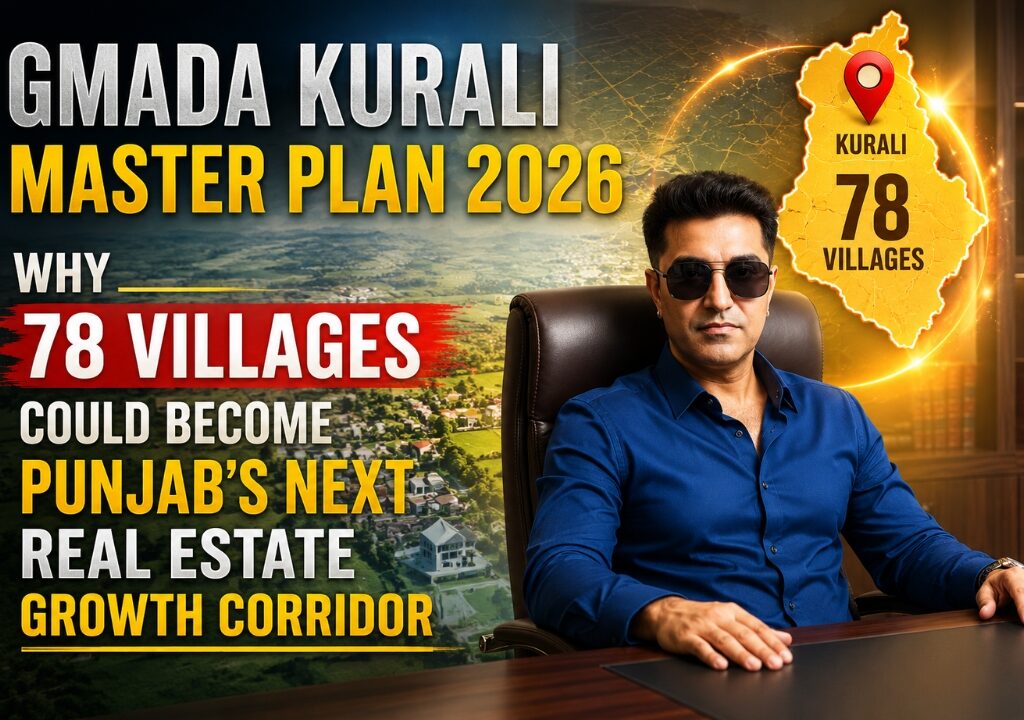
GMADA Kurali Master Plan 2026: Why 78 Villages Could Become Punjab’s Next Real Estate Growth Corridor
The Greater Mohali Area Development Authority (GMADA) has released the draft of a separate master plan for Kurali Municipal Council and 78 surrounding villages, and invited public objections and suggestions within 30 days. If you have been watching the Mohali–Kharar corridor over the last decade, you already know what usually follows a GMADA master plan draft: land use change, road planning, and eventually, private development. This guide breaks down exactly what the Kurali draft master plan means today, what it could mean over the next 10 years, and how different types of buyers and landowners should think about it — without the hype.
Table of Contents
- What Exactly Happened — GMADA Kurali Master Plan Overview
- Why This Matters in 2026
- What Is GMADA and What Has It Already Built
- Why Kurali — Location, Connectivity and Growth Direction
- Understanding the 78 Villages
- From Draft to Development — The Master Plan Process
- Land Use Transformation Explained
- Historical Case Studies — Kharar, Zirakpur, New Chandigarh
- Investment Perspective — By Buyer Type
- Risk Analysis
- Legal and Bank Financing Angle
- Pros and Cons
- Who Should Invest — and Who Should Wait
- Expert Insights
- Frequently Asked Questions
- Final Verdict
What Exactly Happened — GMADA Kurali Master Plan Overview
GMADA has prepared a draft master plan specifically for Kurali and 78 villages around it, under the Punjab Regional and Town Planning and Development Act, 1995. This is a separate plan — earlier, in the 2009 regional plan, Mohali, New Chandigarh, Zirakpur, Dera Bassi, Banur and Kharar all got their own master plans, but Kurali remained part of the broader regional document without a dedicated plan of its own. With Mohali and Kharar urbanising rapidly and pushing outward, GMADA has now decided Kurali needs its own structured development framework.
The Kurali Municipal Council’s Executive Officer has confirmed that the draft is ready and that the 30-day public objection window is the next formal step, after which the plan moves toward finalisation. Copies of the draft are available at the GMADA head office, the district town planner offices in Mohali and Kharar, the Kurali Municipal Council office, and on the PUDA website.
Why This Matters in 2026 — Even Though Development Will Take Years
A draft master plan is not a construction permit, and it is not an overnight price trigger. What it is, is the first formal signal that a government planning authority intends to bring organised residential, commercial, industrial and institutional zoning to an area that has so far grown informally. For investors, the reason this stage matters is timing — the corridors that eventually became Zirakpur, Kharar and New Chandigarh all passed through exactly this stage once, and the buyers who understood the process (not just the headline) positioned themselves earliest, with the clearest understanding of risk.
The Kurali master plan draft also matters because it proposes something concrete: GMADA Kurali master plan documents reportedly earmark land for residential, commercial, industrial, institutional and public utility use, along with road widening, transport network planning, green belts, drinking water and sewerage infrastructure. That is the same category of planning document that preceded the transformation of Kharar and Zirakpur over the last 15–20 years.
What Is GMADA — And What Has It Already Built
GMADA (Greater Mohali Area Development Authority) is the Punjab government body responsible for planned urban development across S.A.S Nagar district and the surrounding influence area of Chandigarh. Over roughly two decades, GMADA’s planning has directly shaped:
- Mohali — from a modest satellite town into one of North India’s established residential and IT destinations.
- Aerocity and IT City — commercial and technology-led development anchored around Chandigarh International Airport.
- New Chandigarh (Mullanpur) — a planned township built from the ground up with Jurong Consultants (Singapore) as master plan consultants.
- Zirakpur and Dera Bassi — corridors that moved from agricultural and semi-urban land to dense residential and commercial real estate markets.
- Kharar — currently under its own LPA Master Plan 2031, with an active mixed-use corridor along NH-21 linking IT City through Kharar toward Kurali.
The common thread across all of these: each one started with a draft master plan, went through objections and a state government approval process, and only then saw private developers, colonisers, and infrastructure contractors move in at scale. The GMADA Kurali master plan is at the very first of those stages.
Why Kurali — Location, Connectivity and Growth Direction
Connectivity
Kurali sits on NH-21, directly connected to Kharar and onward to Mohali and Chandigarh on one side, and toward Ropar on the other. It already carries visible traffic from the IT City–Kharar–Kurali corridor, which Kharar’s own master plan formally recognises as a Future Development Corridor. Kurali is also linked toward New Chandigarh via an existing east-west road connection, placing it within reach of Chandigarh, Panchkula and Mohali without needing new highway infrastructure to be built from scratch.
Infrastructure
The draft plan reportedly proposes expanded and widened roads, a formal transport network, green belts, water supply and sewerage systems — the basic infrastructure backbone every GMADA-planned town has needed before private development could scale. This is an early-stage proposal, not a delivered project, and timelines depend entirely on state approval and budget allocation.
Employment Growth
Kurali does not yet have an IT City or an industrial park of its own, but its proximity to Mohali’s IT City and to Punjab’s broader industrial belt toward Ropar means any organised commercial or industrial zoning in the new master plan could plug directly into an existing employment ecosystem, rather than needing one to be created from nothing.
Future Growth Direction
Urban expansion in the Mohali–Chandigarh region has consistently moved outward along existing highways rather than jumping to disconnected locations. Kharar is now largely built up and increasingly regulated; Zirakpur and Dera Bassi are maturing markets. Kurali, sitting at the next point along NH-21, is a logical — though by no means guaranteed — next stage in that outward growth pattern.
Understanding the 78 Villages
The draft master plan covers Kurali Municipal Council and 78 villages in its vicinity. Detailed, village-wise land use classification will only be publicly finalised after the objection period and state approval — GMADA has not published a granular sector-by-sector breakdown at the draft stage. What we do know from the current draft:
| Aspect | Current Status (Draft Stage) |
|---|---|
| Governing Act | Punjab Regional and Town Planning and Development Act, 1995 |
| Coverage | Kurali Municipal Council + 78 surrounding villages |
| Predominant existing land use | Agricultural and rural, with the Kurali town core already urbanised |
| Proposed zoning categories | Residential, commercial, industrial, institutional, public utility |
| Infrastructure proposals | Road widening, transport network, green belts, water supply, sewerage |
| Public objection window | 30 days from draft release |
Officials have publicly acknowledged that land use category changes in several of these villages could affect existing landowners’ interests — which is exactly why the objection and suggestion window carries real weight and should not be treated as a formality.
From Draft to Development — The Master Plan Process
Every GMADA-notified town has gone through the same broad sequence. Understanding where Kurali currently sits in this sequence is the single most important thing an investor or landowner should internalise before making any decision.
- Draft notification — the current stage. Draft released, objections invited for 30 days.
- Public objections and suggestions — landowners, residents and stakeholders formally respond.
- Review and revision — former Chief Town Planner Gurpreet Singh has publicly noted the plan should be finalised only after traffic studies, population growth projections and socio-economic surveys are factored in.
- State government approval — the plan requires Punjab government sign-off before it can be notified as final.
- Final notification — the legally binding master plan is published.
- Land use classification locked in — every parcel gets a defined zone (residential, commercial, industrial, institutional, green belt, agricultural).
- Sector and road planning — detailed layout plans, road alignments and utility corridors are drawn up.
- Development permissions open up — Change of Land Use (CLU) and building plan approvals become possible within notified zones.
- Private developers enter — colonisers and builders begin acquiring and developing land in line with the approved zoning.
- Price discovery and construction — as licensed colonies and approved projects come up, organised pricing benchmarks emerge.
- Urbanisation — the area transitions from a rural/agricultural profile to a planned urban extension.
Kurali, as of this draft, is only at step one. Every subsequent step in Kharar and Zirakpur’s history took years, not months — a fact that should temper any narrative of overnight transformation.
Land Use Transformation Explained
One of the most important — and most misunderstood — parts of any master plan is what each zoning category legally permits. This is the difference between land that can be developed and land that legally cannot be, regardless of what a broker tells you.
| Zone | What It Typically Permits |
|---|---|
| Agricultural | Farming and allied use only. No residential/commercial construction without a formal Change of Land Use (CLU). |
| Residential | Housing, licensed colonies, group housing — subject to density norms set in the final plan. |
| Commercial | Retail, offices, mixed-use developments in designated commercial pockets or corridors. |
| Industrial | Manufacturing, warehousing, logistics — typically away from residential zones. |
| Institutional | Schools, hospitals, government and public-purpose buildings. |
| Green belt | No construction permitted — reserved for environmental and open-space purposes. |
| Public utilities | Roads, water treatment, sewerage, substations, and similar infrastructure. |
Until the final notification, no parcel in the 78 villages has a legally locked zoning classification. Buying land today on the assumption of a particular future zone is a speculative bet, not a documented fact — this is the single most important risk point in this entire guide.
Historical Case Studies — What Kharar, Zirakpur and New Chandigarh Teach Us
Kurali is frequently compared to Kharar’s trajectory a decade ago, and to Zirakpur before that. The comparison is useful, but only if the details are honest.
| Corridor | Master Plan Trigger | What Actually Drove Appreciation | Common Investor Mistakes |
|---|---|---|---|
| Zirakpur | Early GMADA/PUDA regional planning + NH connectivity | Airport Road development, dense licensed colonisation, sustained end-user demand | Buying in unauthorised colonies without checking licensing status |
| Kharar | Kharar LPA Master Plan (Jurong Consultants) | IT City spillover demand, NH-21 mixed-use corridor | Assuming all Kharar land is equally investable — many pockets remain under active enforcement scrutiny |
| New Chandigarh (Mullanpur) | Dedicated township master plan, 2007 onward | Ground-up planned township execution, government-anchored development | Underestimating how long ground-up township infrastructure takes to mature |
The consistent lesson: appreciation followed infrastructure delivery and legal clarity, not the draft notification itself. Investors who bought purely on draft-stage news, without verifying zoning and licensing at each subsequent stage, are the ones who ran into the delays, litigation and unauthorised-colony risks that Kharar is dealing with even now, in parallel with its master plan maturing.
Investment Perspective — By Buyer Type
Short-Term View
In the 1–2 year window, the Kurali draft stage offers no organised, licensed inventory to transact in yet. Any land transaction now is pre-zoning and carries the full uncertainty of the process outlined above.
Long-Term View
Over a 5–10 year horizon, if the plan progresses through objections, state approval, and final notification broadly on the lines proposed, Kurali’s NH-21 location and proximity to Mohali’s employment base give it a structurally sound case for eventual organised residential and commercial development — following the same arc as Kharar and Zirakpur before it.
By Buyer Profile
- Small investors: Should treat this as a multi-year watch-and-verify opportunity, not an immediate transaction.
- NRIs: Distance makes hands-on due diligence harder — engaging a local, RERA-aware consultant before any commitment is essential rather than optional.
- Farm land owners within the 78 villages: The objection window is the single most important, time-bound opportunity to protect your interests — professional advice before filing (or not filing) an objection is worth seeking now.
- Builders and colonisers: Will realistically only be able to move once zoning is finalised and CLU becomes possible in designated pockets.
- Commercial and industrial investors: Should track which specific villages get commercial/industrial zoning once the plan is finalised, rather than assuming coverage across the entire 78-village area.
- Rental and long-term investors: Will likely find better-defined opportunities only after licensed colonies begin to emerge — several years out at minimum.
Risk Analysis
| Risk | What It Means Practically |
|---|---|
| Master plan / approval delay | State approval timelines for master plans have historically run into years, not months. |
| Political and policy change | Zoning priorities and infrastructure budgets can shift with changes in government focus. |
| Litigation | Land use disputes and court interventions have delayed and reshaped master plans elsewhere in the GMADA jurisdiction. |
| Land title issues | Revenue record mismatches are common in rural Punjab land — always verify before any commitment. |
| Unauthorised colonies | Nearby Kharar has seen active enforcement action against unlicensed colonies — the same regulatory posture will likely apply to Kurali. |
| Speculation without fundamentals | Draft-stage buying based purely on “78 villages” headlines, without checking specific village zoning later, is the most common avoidable mistake. |
| Liquidity | Pre-zoning land is illiquid — exiting before organised development arrives can be difficult. |
Legal and Bank Financing Angle
Under the Punjab Regional and Town Planning and Development Act, 1995, construction that violates a notified master plan is not permitted, and unauthorised layouts cannot simply be regularised by paying a fine in sensitive planning zones — enforcement action, including demolition, has been carried out in comparable GMADA jurisdictions. On financing: banks generally do not extend standard home loans against raw agricultural land. Financing typically becomes meaningfully available only after a Change of Land Use is approved and a project is on RERA-registered, licensed land — which, for Kurali, is a future-stage consideration, not a present one. Always verify mutation, registry and revenue records independently before any transaction, regardless of what stage the master plan is at.
Pros and Cons
| Pros | Cons |
|---|---|
| NH-21 connectivity to Mohali, Chandigarh and Ropar already exists | Plan is only at draft stage — no locked-in zoning yet |
| Proximity to Mohali’s IT City employment base | Full approval and notification process has historically taken years |
| Follows a planning template that worked in Kharar, Zirakpur and New Chandigarh | No organised, licensed inventory exists yet for buyers |
| Early, time-bound objection window gives landowners real influence | Unauthorised colony and litigation risk mirrors nearby Kharar |
| Government-anchored infrastructure proposals (roads, water, sewerage) | Bank financing largely unavailable until CLU stage |
Who Should Invest — And Who Should Wait
Long-horizon investors who are comfortable holding for 7–10+ years, who can independently verify land titles and zoning at each stage, and who are buying with patience rather than urgency, are the profile best suited to track Kurali from this point. Landowners within the 78 villages have a genuine, immediate reason to engage now — through the objection process, not through a land sale. Buyers looking for near-term liquidity, guaranteed timelines, or bank-financed purchases should wait until the final notification and CLU stage, exactly as informed buyers did in Kharar and Zirakpur before committing capital.
Expert Insights
“Every corridor we have watched mature in the Mohali–Chandigarh belt — Zirakpur, Kharar, New Chandigarh — followed the exact same sequence Kurali is entering now: draft, objections, approval, final notification, and only then real development. The mistake I see investors make is treating the draft stage as if it were the finish line. It is the starting gun. The right move at this stage is due diligence and patience, not a rushed transaction.” — Manindar Verma, Managing Director, Royals Property Consultant
Frequently Asked Questions
1. What is the GMADA Kurali master plan?
It is a draft development plan prepared by GMADA under the Punjab Regional and Town Planning and Development Act, 1995, covering Kurali Municipal Council and 78 surrounding villages, proposing residential, commercial, industrial, institutional and infrastructure zoning for the area.
2. Has the GMADA Kurali master plan been finalised?
No. As of now, only the draft has been released, with a 30-day window for public objections and suggestions. Finalisation requires review, a public hearing process, and Punjab state government approval.
3. Which villages are included in the Kurali master plan?
The draft covers Kurali Municipal Council and 78 villages in its vicinity. A detailed, village-by-village zoning map is expected only after the plan is finalised.
4. Can I buy land in Kurali right now based on this master plan?
You can, but it should be treated as a long-term, pre-zoning purchase with independent legal verification — not a transaction based on assumed future zoning, since nothing is legally locked in until final notification.
5. Will banks give a loan for land in the 78 Kurali villages?
Standard home loans are generally not available against raw agricultural land. Financing typically becomes realistic only after Change of Land Use approval within a notified, licensed development.
6. How is Kurali connected to Mohali and Chandigarh?
Kurali sits on NH-21, connected through Kharar to Mohali and Chandigarh, and onward toward Ropar, with an additional link toward New Chandigarh.
7. Is Kurali the “next Kharar”?
It has some of the same fundamentals — NH connectivity and proximity to an established urban core — but it is several planning stages behind where Kharar is today. Direct comparisons should account for that timeline gap.
8. What should landowners in the 78 villages do right now?
Review the draft plan copies available at GMADA’s offices, the Kurali Municipal Council office, or the PUDA website, and consider filing suggestions or objections within the 30-day window if the proposed zoning affects their land.
9. What is the biggest risk in investing in Kurali right now?
Speculative buying based on the “78 villages” headline without verifying that a specific parcel’s eventual zoning, title, and licensing status actually supports development — the same risk that has caused enforcement action against unauthorised colonies in nearby Kharar.
10. Who should I contact for guidance on Kurali or the wider Mohali–Kharar corridor?
An independent, RERA-registered local consultant who can verify documents and zoning stage-by-stage — Royals Property Consultant offers this guidance for buyers across the Mohali, Zirakpur, Kharar and New Chandigarh corridor.
Final Verdict
The GMADA Kurali master plan draft is a genuine, government-issued planning signal — not marketing spin — and it deserves informed attention rather than either dismissal or blind enthusiasm. It sits at the earliest possible stage of a process that, in Kharar, Zirakpur and New Chandigarh, ultimately took years to mature into organised, investable real estate. The opportunity in Kurali is real for patient, long-horizon buyers and directly relevant for landowners in the 78 villages right now, through the objection process. It is not yet a market for buyers seeking short-term liquidity or bank-financed transactions. As with every corridor before it, the investors who do well here will be the ones who track each stage — draft, objections, approval, final notification, CLU — rather than the ones who acted on the headline alone.
Tell Us What You’re Looking For
Share your requirement and our team will get back to you on WhatsApp.
Need Expert Guidance?
Need expert guidance for buying, selling, or investing in property across Mohali, Zirakpur, Chandigarh, Panchkula, and New Chandigarh? Contact Royals Property Consultant for professional assistance and market insights.
📞 Call +91 98787 59508 | 💬 WhatsApp Now
Author: Manindar Verma, Managing Director, Royals Property Consultant. With 15+ years of real estate experience across Zirakpur, Mohali, Chandigarh, Panchkula, and New Chandigarh, Manindar Verma has guided hundreds of families and investors through property decisions across the GMADA jurisdiction.
Kurali master plan 78 villages, Kurali real estate investment, GMADA Kurali notification, Kurali Punjab property, Kurali land use plan, Kurali growth corridor, GMADA master plan 2026, Kurali Mohali connectivity, Kurali CLU, Kurali NRI investment, property near Kurali, GMADA regional plan Kurali