
GMADA Kurali Master Plan

GMADA Kurali Master Plan 2026

GMADA Kurali Master Plan 2026: Why 78 Villages Could Become Punjab’s Next Real Estate Growth Corridor

Royals Property Consultant is a trusted name for buying, selling, renting, and investing in residential and commercial properties in Zirakpur, Mohali, Chandigarh, and New Chandigarh.
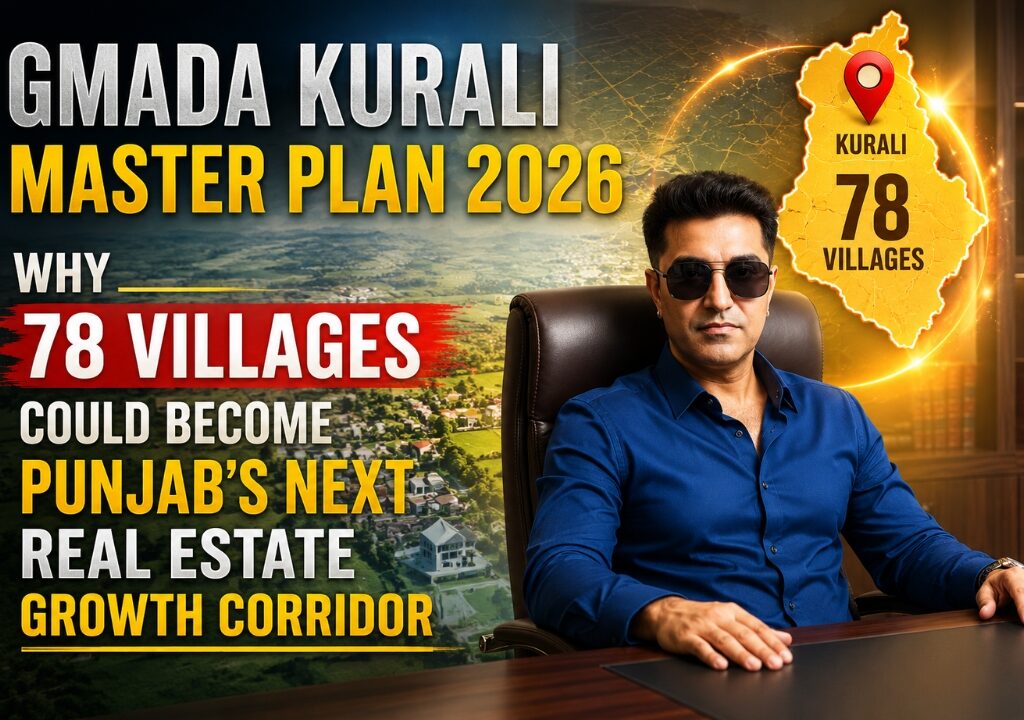
GMADA Kurali Master Plan

GMADA Kurali Master Plan 2026: Why 78 Villages Could Become Punjab’s Next Real Estate Growth Corridor

The Greater Mohali Area Development Authority (GMADA) has released the draft of a separate master plan for Kurali Municipal Council and 78 surrounding villages, and invited public objections and suggestions within 30 days. If you have been watching the Mohali–Kharar corridor over the last decade, you already know what usually follows a GMADA master plan draft: land use change, road planning, and eventually, private development. This guide breaks down exactly what the Kurali draft master plan means today, what it could mean over the next 10 years, and how different types of buyers and landowners should think about it — without the hype.

Table of Contents

  1. What Exactly Happened — GMADA Kurali Master Plan Overview
  2. Why This Matters in 2026
  3. What Is GMADA and What Has It Already Built
  4. Why Kurali — Location, Connectivity and Growth Direction
  5. Understanding the 78 Villages
  6. From Draft to Development — The Master Plan Process
  7. Land Use Transformation Explained
  8. Historical Case Studies — Kharar, Zirakpur, New Chandigarh
  9. Investment Perspective — By Buyer Type
  10. Risk Analysis
  11. Legal and Bank Financing Angle
  12. Pros and Cons
  13. Who Should Invest — and Who Should Wait
  14. Expert Insights
  15. Frequently Asked Questions
  16. Final Verdict

What Exactly Happened — GMADA Kurali Master Plan Overview

GMADA has prepared a draft master plan specifically for Kurali and 78 villages around it, under the Punjab Regional and Town Planning and Development Act, 1995. This is a separate plan — earlier, in the 2009 regional plan, Mohali, New Chandigarh, Zirakpur, Dera Bassi, Banur and Kharar all got their own master plans, but Kurali remained part of the broader regional document without a dedicated plan of its own. With Mohali and Kharar urbanising rapidly and pushing outward, GMADA has now decided Kurali needs its own structured development framework.

The Kurali Municipal Council’s Executive Officer has confirmed that the draft is ready and that the 30-day public objection window is the next formal step, after which the plan moves toward finalisation. Copies of the draft are available at the GMADA head office, the district town planner offices in Mohali and Kharar, the Kurali Municipal Council office, and on the PUDA website.

Why This Matters in 2026 — Even Though Development Will Take Years

A draft master plan is not a construction permit, and it is not an overnight price trigger. What it is, is the first formal signal that a government planning authority intends to bring organised residential, commercial, industrial and institutional zoning to an area that has so far grown informally. For investors, the reason this stage matters is timing — the corridors that eventually became Zirakpur, Kharar and New Chandigarh all passed through exactly this stage once, and the buyers who understood the process (not just the headline) positioned themselves earliest, with the clearest understanding of risk.

The Kurali master plan draft also matters because it proposes something concrete: GMADA Kurali master plan documents reportedly earmark land for residential, commercial, industrial, institutional and public utility use, along with road widening, transport network planning, green belts, drinking water and sewerage infrastructure. That is the same category of planning document that preceded the transformation of Kharar and Zirakpur over the last 15–20 years.

What Is GMADA — And What Has It Already Built

GMADA (Greater Mohali Area Development Authority) is the Punjab government body responsible for planned urban development across S.A.S Nagar district and the surrounding influence area of Chandigarh. Over roughly two decades, GMADA’s planning has directly shaped:

  • Mohali — from a modest satellite town into one of North India’s established residential and IT destinations.
  • Aerocity and IT City — commercial and technology-led development anchored around Chandigarh International Airport.
  • New Chandigarh (Mullanpur) — a planned township built from the ground up with Jurong Consultants (Singapore) as master plan consultants.
  • Zirakpur and Dera Bassi — corridors that moved from agricultural and semi-urban land to dense residential and commercial real estate markets.
  • Kharar — currently under its own LPA Master Plan 2031, with an active mixed-use corridor along NH-21 linking IT City through Kharar toward Kurali.

The common thread across all of these: each one started with a draft master plan, went through objections and a state government approval process, and only then saw private developers, colonisers, and infrastructure contractors move in at scale. The GMADA Kurali master plan is at the very first of those stages.

Why Kurali — Location, Connectivity and Growth Direction

Connectivity

Kurali sits on NH-21, directly connected to Kharar and onward to Mohali and Chandigarh on one side, and toward Ropar on the other. It already carries visible traffic from the IT City–Kharar–Kurali corridor, which Kharar’s own master plan formally recognises as a Future Development Corridor. Kurali is also linked toward New Chandigarh via an existing east-west road connection, placing it within reach of Chandigarh, Panchkula and Mohali without needing new highway infrastructure to be built from scratch.

Infrastructure

The draft plan reportedly proposes expanded and widened roads, a formal transport network, green belts, water supply and sewerage systems — the basic infrastructure backbone every GMADA-planned town has needed before private development could scale. This is an early-stage proposal, not a delivered project, and timelines depend entirely on state approval and budget allocation.

Employment Growth

Kurali does not yet have an IT City or an industrial park of its own, but its proximity to Mohali’s IT City and to Punjab’s broader industrial belt toward Ropar means any organised commercial or industrial zoning in the new master plan could plug directly into an existing employment ecosystem, rather than needing one to be created from nothing.

Future Growth Direction

Urban expansion in the Mohali–Chandigarh region has consistently moved outward along existing highways rather than jumping to disconnected locations. Kharar is now largely built up and increasingly regulated; Zirakpur and Dera Bassi are maturing markets. Kurali, sitting at the next point along NH-21, is a logical — though by no means guaranteed — next stage in that outward growth pattern.

Understanding the 78 Villages

The draft master plan covers Kurali Municipal Council and 78 villages in its vicinity. Detailed, village-wise land use classification will only be publicly finalised after the objection period and state approval — GMADA has not published a granular sector-by-sector breakdown at the draft stage. What we do know from the current draft:

AspectCurrent Status (Draft Stage)
Governing ActPunjab Regional and Town Planning and Development Act, 1995
CoverageKurali Municipal Council + 78 surrounding villages
Predominant existing land useAgricultural and rural, with the Kurali town core already urbanised
Proposed zoning categoriesResidential, commercial, industrial, institutional, public utility
Infrastructure proposalsRoad widening, transport network, green belts, water supply, sewerage
Public objection window30 days from draft release

Officials have publicly acknowledged that land use category changes in several of these villages could affect existing landowners’ interests — which is exactly why the objection and suggestion window carries real weight and should not be treated as a formality.

From Draft to Development — The Master Plan Process

Every GMADA-notified town has gone through the same broad sequence. Understanding where Kurali currently sits in this sequence is the single most important thing an investor or landowner should internalise before making any decision.

  1. Draft notification — the current stage. Draft released, objections invited for 30 days.
  2. Public objections and suggestions — landowners, residents and stakeholders formally respond.
  3. Review and revision — former Chief Town Planner Gurpreet Singh has publicly noted the plan should be finalised only after traffic studies, population growth projections and socio-economic surveys are factored in.
  4. State government approval — the plan requires Punjab government sign-off before it can be notified as final.
  5. Final notification — the legally binding master plan is published.
  6. Land use classification locked in — every parcel gets a defined zone (residential, commercial, industrial, institutional, green belt, agricultural).
  7. Sector and road planning — detailed layout plans, road alignments and utility corridors are drawn up.
  8. Development permissions open up — Change of Land Use (CLU) and building plan approvals become possible within notified zones.
  9. Private developers enter — colonisers and builders begin acquiring and developing land in line with the approved zoning.
  10. Price discovery and construction — as licensed colonies and approved projects come up, organised pricing benchmarks emerge.
  11. Urbanisation — the area transitions from a rural/agricultural profile to a planned urban extension.

Kurali, as of this draft, is only at step one. Every subsequent step in Kharar and Zirakpur’s history took years, not months — a fact that should temper any narrative of overnight transformation.

Land Use Transformation Explained

One of the most important — and most misunderstood — parts of any master plan is what each zoning category legally permits. This is the difference between land that can be developed and land that legally cannot be, regardless of what a broker tells you.

ZoneWhat It Typically Permits
AgriculturalFarming and allied use only. No residential/commercial construction without a formal Change of Land Use (CLU).
ResidentialHousing, licensed colonies, group housing — subject to density norms set in the final plan.
CommercialRetail, offices, mixed-use developments in designated commercial pockets or corridors.
IndustrialManufacturing, warehousing, logistics — typically away from residential zones.
InstitutionalSchools, hospitals, government and public-purpose buildings.
Green beltNo construction permitted — reserved for environmental and open-space purposes.
Public utilitiesRoads, water treatment, sewerage, substations, and similar infrastructure.

Until the final notification, no parcel in the 78 villages has a legally locked zoning classification. Buying land today on the assumption of a particular future zone is a speculative bet, not a documented fact — this is the single most important risk point in this entire guide.

Historical Case Studies — What Kharar, Zirakpur and New Chandigarh Teach Us

Kurali is frequently compared to Kharar’s trajectory a decade ago, and to Zirakpur before that. The comparison is useful, but only if the details are honest.

CorridorMaster Plan TriggerWhat Actually Drove AppreciationCommon Investor Mistakes
ZirakpurEarly GMADA/PUDA regional planning + NH connectivityAirport Road development, dense licensed colonisation, sustained end-user demandBuying in unauthorised colonies without checking licensing status
KhararKharar LPA Master Plan (Jurong Consultants)IT City spillover demand, NH-21 mixed-use corridorAssuming all Kharar land is equally investable — many pockets remain under active enforcement scrutiny
New Chandigarh (Mullanpur)Dedicated township master plan, 2007 onwardGround-up planned township execution, government-anchored developmentUnderestimating how long ground-up township infrastructure takes to mature

The consistent lesson: appreciation followed infrastructure delivery and legal clarity, not the draft notification itself. Investors who bought purely on draft-stage news, without verifying zoning and licensing at each subsequent stage, are the ones who ran into the delays, litigation and unauthorised-colony risks that Kharar is dealing with even now, in parallel with its master plan maturing.

Investment Perspective — By Buyer Type

Short-Term View

In the 1–2 year window, the Kurali draft stage offers no organised, licensed inventory to transact in yet. Any land transaction now is pre-zoning and carries the full uncertainty of the process outlined above.

Long-Term View

Over a 5–10 year horizon, if the plan progresses through objections, state approval, and final notification broadly on the lines proposed, Kurali’s NH-21 location and proximity to Mohali’s employment base give it a structurally sound case for eventual organised residential and commercial development — following the same arc as Kharar and Zirakpur before it.

By Buyer Profile

  • Small investors: Should treat this as a multi-year watch-and-verify opportunity, not an immediate transaction.
  • NRIs: Distance makes hands-on due diligence harder — engaging a local, RERA-aware consultant before any commitment is essential rather than optional.
  • Farm land owners within the 78 villages: The objection window is the single most important, time-bound opportunity to protect your interests — professional advice before filing (or not filing) an objection is worth seeking now.
  • Builders and colonisers: Will realistically only be able to move once zoning is finalised and CLU becomes possible in designated pockets.
  • Commercial and industrial investors: Should track which specific villages get commercial/industrial zoning once the plan is finalised, rather than assuming coverage across the entire 78-village area.
  • Rental and long-term investors: Will likely find better-defined opportunities only after licensed colonies begin to emerge — several years out at minimum.

Risk Analysis

RiskWhat It Means Practically
Master plan / approval delayState approval timelines for master plans have historically run into years, not months.
Political and policy changeZoning priorities and infrastructure budgets can shift with changes in government focus.
LitigationLand use disputes and court interventions have delayed and reshaped master plans elsewhere in the GMADA jurisdiction.
Land title issuesRevenue record mismatches are common in rural Punjab land — always verify before any commitment.
Unauthorised coloniesNearby Kharar has seen active enforcement action against unlicensed colonies — the same regulatory posture will likely apply to Kurali.
Speculation without fundamentalsDraft-stage buying based purely on “78 villages” headlines, without checking specific village zoning later, is the most common avoidable mistake.
LiquidityPre-zoning land is illiquid — exiting before organised development arrives can be difficult.

Under the Punjab Regional and Town Planning and Development Act, 1995, construction that violates a notified master plan is not permitted, and unauthorised layouts cannot simply be regularised by paying a fine in sensitive planning zones — enforcement action, including demolition, has been carried out in comparable GMADA jurisdictions. On financing: banks generally do not extend standard home loans against raw agricultural land. Financing typically becomes meaningfully available only after a Change of Land Use is approved and a project is on RERA-registered, licensed land — which, for Kurali, is a future-stage consideration, not a present one. Always verify mutation, registry and revenue records independently before any transaction, regardless of what stage the master plan is at.

Pros and Cons

ProsCons
NH-21 connectivity to Mohali, Chandigarh and Ropar already existsPlan is only at draft stage — no locked-in zoning yet
Proximity to Mohali’s IT City employment baseFull approval and notification process has historically taken years
Follows a planning template that worked in Kharar, Zirakpur and New ChandigarhNo organised, licensed inventory exists yet for buyers
Early, time-bound objection window gives landowners real influenceUnauthorised colony and litigation risk mirrors nearby Kharar
Government-anchored infrastructure proposals (roads, water, sewerage)Bank financing largely unavailable until CLU stage

Who Should Invest — And Who Should Wait

Long-horizon investors who are comfortable holding for 7–10+ years, who can independently verify land titles and zoning at each stage, and who are buying with patience rather than urgency, are the profile best suited to track Kurali from this point. Landowners within the 78 villages have a genuine, immediate reason to engage now — through the objection process, not through a land sale. Buyers looking for near-term liquidity, guaranteed timelines, or bank-financed purchases should wait until the final notification and CLU stage, exactly as informed buyers did in Kharar and Zirakpur before committing capital.

Expert Insights

“Every corridor we have watched mature in the Mohali–Chandigarh belt — Zirakpur, Kharar, New Chandigarh — followed the exact same sequence Kurali is entering now: draft, objections, approval, final notification, and only then real development. The mistake I see investors make is treating the draft stage as if it were the finish line. It is the starting gun. The right move at this stage is due diligence and patience, not a rushed transaction.” — Manindar Verma, Managing Director, Royals Property Consultant

Frequently Asked Questions

1. What is the GMADA Kurali master plan?
It is a draft development plan prepared by GMADA under the Punjab Regional and Town Planning and Development Act, 1995, covering Kurali Municipal Council and 78 surrounding villages, proposing residential, commercial, industrial, institutional and infrastructure zoning for the area.

2. Has the GMADA Kurali master plan been finalised?
No. As of now, only the draft has been released, with a 30-day window for public objections and suggestions. Finalisation requires review, a public hearing process, and Punjab state government approval.

3. Which villages are included in the Kurali master plan?
The draft covers Kurali Municipal Council and 78 villages in its vicinity. A detailed, village-by-village zoning map is expected only after the plan is finalised.

4. Can I buy land in Kurali right now based on this master plan?
You can, but it should be treated as a long-term, pre-zoning purchase with independent legal verification — not a transaction based on assumed future zoning, since nothing is legally locked in until final notification.

5. Will banks give a loan for land in the 78 Kurali villages?
Standard home loans are generally not available against raw agricultural land. Financing typically becomes realistic only after Change of Land Use approval within a notified, licensed development.

6. How is Kurali connected to Mohali and Chandigarh?
Kurali sits on NH-21, connected through Kharar to Mohali and Chandigarh, and onward toward Ropar, with an additional link toward New Chandigarh.

7. Is Kurali the “next Kharar”?
It has some of the same fundamentals — NH connectivity and proximity to an established urban core — but it is several planning stages behind where Kharar is today. Direct comparisons should account for that timeline gap.

8. What should landowners in the 78 villages do right now?
Review the draft plan copies available at GMADA’s offices, the Kurali Municipal Council office, or the PUDA website, and consider filing suggestions or objections within the 30-day window if the proposed zoning affects their land.

9. What is the biggest risk in investing in Kurali right now?
Speculative buying based on the “78 villages” headline without verifying that a specific parcel’s eventual zoning, title, and licensing status actually supports development — the same risk that has caused enforcement action against unauthorised colonies in nearby Kharar.

10. Who should I contact for guidance on Kurali or the wider Mohali–Kharar corridor?
An independent, RERA-registered local consultant who can verify documents and zoning stage-by-stage — Royals Property Consultant offers this guidance for buyers across the Mohali, Zirakpur, Kharar and New Chandigarh corridor.

Final Verdict

The GMADA Kurali master plan draft is a genuine, government-issued planning signal — not marketing spin — and it deserves informed attention rather than either dismissal or blind enthusiasm. It sits at the earliest possible stage of a process that, in Kharar, Zirakpur and New Chandigarh, ultimately took years to mature into organised, investable real estate. The opportunity in Kurali is real for patient, long-horizon buyers and directly relevant for landowners in the 78 villages right now, through the objection process. It is not yet a market for buyers seeking short-term liquidity or bank-financed transactions. As with every corridor before it, the investors who do well here will be the ones who track each stage — draft, objections, approval, final notification, CLU — rather than the ones who acted on the headline alone.


Tell Us What You’re Looking For

Share your requirement and our team will get back to you on WhatsApp.


Need Expert Guidance?

Need expert guidance for buying, selling, or investing in property across Mohali, Zirakpur, Chandigarh, Panchkula, and New Chandigarh? Contact Royals Property Consultant for professional assistance and market insights.

📞 Call +91 98787 59508  |  💬 WhatsApp Now


Author: Manindar Verma, Managing Director, Royals Property Consultant. With 15+ years of real estate experience across Zirakpur, Mohali, Chandigarh, Panchkula, and New Chandigarh, Manindar Verma has guided hundreds of families and investors through property decisions across the GMADA jurisdiction.

Kurali master plan 78 villages, Kurali real estate investment, GMADA Kurali notification, Kurali Punjab property, Kurali land use plan, Kurali growth corridor, GMADA master plan 2026, Kurali Mohali connectivity, Kurali CLU, Kurali NRI investment, property near Kurali, GMADA regional plan Kurali
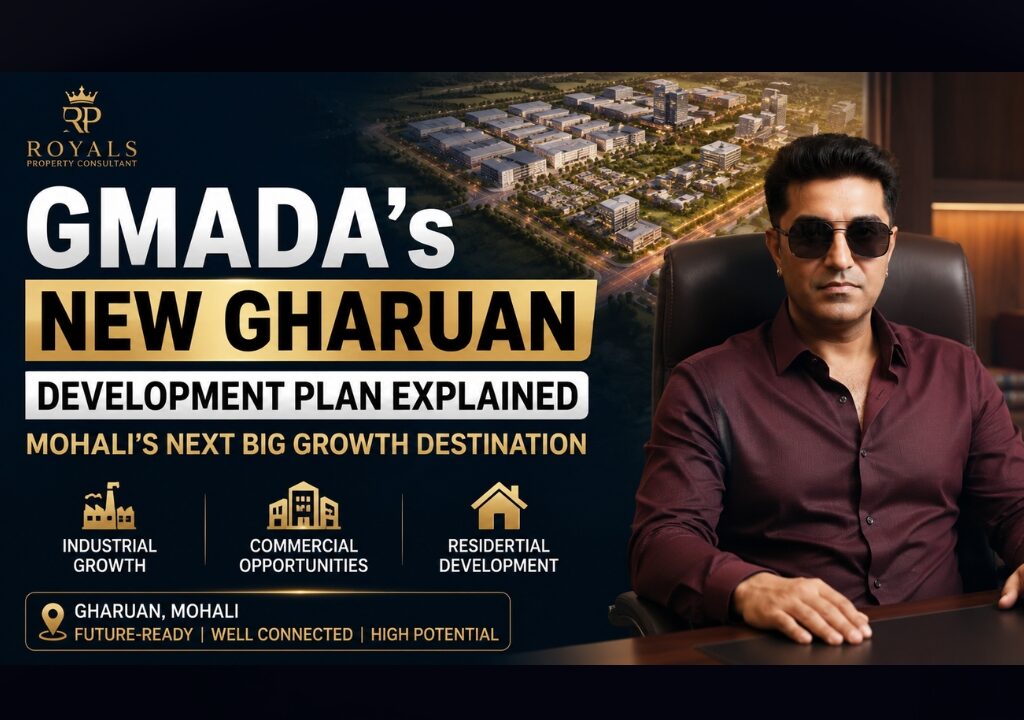
GMADA's New Gharuan Development Plan Explained

GMADA’s New Gharuan Development Plan Explained

GMADA’s New Gharuan Development Plan Explained:Industrial, Commercial & Residential Growth Opportunities in Mohali

Royals Property Consultant is a trusted name for buying, selling, renting, and investing in residential and commercial properties in Zirakpur, Mohali, Chandigarh, and New Chandigarh.

GMADA's New Gharuan Development Plan Explained
💬
📍 June 2026 Draft Plan · GMADA · SAS Nagar, Mohali

GMADA’s New Gharuan Development Plan Explained:
Industrial, Commercial & Residential Growth Opportunities in Mohali

A proposed amendment covering ~3,000 acres across 16 villages near Gharuan. What it means for buyers, investors, NRIs & landowners — full expert analysis inside.

MV
Manindar Verma
Managing Director · Royals Property Consultant | RERA: PBRERA-CHD04-REA0390
📅 June 2026 ⏱ 15 min read 📍 Mohali | SAS Nagar
GMADA Gharuan Development Industrial Zone Mohali Residential Zone Land Use Amendment Mohali Real Estate 2026 SAS Nagar

In late June 2026, a significant planning announcement came from the Directorate of Town and Country Planning, Punjab. The government is proposing to amend the GMADA regional plan to formally introduce industrial, commercial, and residential land use designations across approximately 3,000 acres spanning 16 villages in and around Gharuan, SAS Nagar (Mohali).

For most buyers and investors outside the planning community, Gharuan is still a largely unfamiliar name. But within GMADA’s broader development vision for Greater Mohali, this draft plan represents a meaningful step — formalising land use in an area that sits at an important geographic junction between Kharar, Mohali’s outer sectors, and the Chandigarh International Airport corridor.

This article breaks down exactly what the draft plan proposes, which villages are included, what it means for residential buyers, industrial investors, commercial developers, and landowners — and what risks every serious buyer should understand before acting on the news.

⚡ Quick Answer — Google SGE & AI Search

The GMADA Gharuan development plan is a proposed amendment to the Greater Mohali Area Development Authority’s regional plan, covering nearly 3,000 acres across 16 villages near Gharuan in SAS Nagar. The draft designates several villages as industrial, commercial, or residential zones while retaining others as agricultural. It is currently at the draft stage — not yet approved — and public objections and suggestions are being invited under Punjab’s planning laws. Investors and buyers should treat this as an early-signal opportunity, not a guaranteed development outcome.

~3,000
Acres Under Draft Plan
16
Villages Included
3
Zone Types Proposed
Draft
Current Status
54
Manauli Acres (Industrial)
Disclaimer: All information is based on publicly available draft plan reports and official notifications as of June 2026. This article does not constitute financial or legal advice. Investors must verify all details independently and consult a qualified professional before any property decision.

What is the GMADA Gharuan Draft Development Plan?

GMADA — the Greater Mohali Area Development Authority — was constituted under Section 29(1) of the Punjab Regional and Town Planning and Development Act, 1995 through a government notification in August 2006. Its jurisdiction covers the planning and development of Mohali, Kharar, Zirakpur, Dera Bassi, Banur, and surrounding areas, including New Chandigarh (Mullanpur) and Fatehgarh Sahib.

The regional plan GMADA operates under defines land use zones across its entire jurisdiction — what can be built where, what land can be used for industrial activity, which areas are designated for residential colonies, and which remain agricultural or green belts. This zoning has direct legal implications: a landowner cannot develop industrial infrastructure on agricultural land without a formal change in land use (CLU), and a private developer cannot build a residential colony unless the zone permits it.

The Gharuan draft plan, being prepared by the Directorate of Town and Country Planning, Punjab, proposes to amend this existing regional plan. The stated purpose is to introduce industrial and commercial activity in the Gharuan area — effectively formally recognising and enabling the kind of mixed-use development that the district is already trending toward.

Important: The distinction between a draft plan and a notified plan matters significantly. A draft plan signals intent and direction — but it carries no legal binding until formally notified by the Punjab Government. All investment decisions should account for this uncertainty.

What Has Prompted This Amendment?

A few factors have accelerated Gharuan’s planning significance. First, the organic pressure of urbanisation along the Kharar-Gharuan-Banur corridor, which is already seeing commercial and industrial activity without formal zoning. Second, GMADA’s own ongoing projects — Aerocity, IT City, Eco City 3 in New Chandigarh, and the Aerotropolis — are generating satellite demand in outer areas like Gharuan. Third, the Punjab government’s industrial policy push requires formally zoned industrial land to attract large manufacturers and logistics operators.

The parallel amendment at Manauli village — converting 54 acres from institutional to industrial and warehouse use — points to a broader rationalisation exercise. As Sectors 81 and 83 already host IISER and ISB, and IT City Sector 82 Alpha accommodates educational institutions, the Manauli institutional zone was effectively redundant. Repurposing it for warehousing and industry is a practical planning correction.

Why is Gharuan Becoming Important?

Location is the most straightforward explanation. Gharuan sits at a strategic geographic node in SAS Nagar district, positioned between Kharar to the north and Mohali’s developed sectors to the south.

✈️

Airport Proximity

  • Chandigarh International Airport (IXC) within the broader Mohali district
  • Airport road corridor actively developing with logistics & commercial users
  • Aerocity GMADA project already operational nearby
🏙️

Urban Proximity

  • Connected to Kharar, one of the fastest-growing towns in Tricity
  • Near Mohali’s outer sectors (90s range) under development
  • Part of the wider SAS Nagar urban agglomeration
🎓

Education & Healthcare

  • IISER and ISB in Sectors 81–83 nearby
  • IT City (Sector 82 Alpha) housing educational institutions
  • Fortis and Max hospitals within the Mohali belt
🛣️

Highway Connectivity

  • PR9 (Kharar-Banur road) connects to Mohali’s main network
  • 200-foot wide road from Aerocity junction to PR9 under construction by GMADA
  • Road from Aerocity junction to airport also being built
🏭

Industrial Corridor Logic

  • Existing Mohali industrial phases (I–XI) drive demand for overflow land
  • GMADA’s Industrial Park in Sector 101 and 103 attracting manufacturers
  • Warehousing demand from Aerotropolis ecosystem
📈

Future Growth Vector

  • GMADA’s 11,103-acre land acquisition drive across Greater Mohali
  • Punjab government’s village development commitment creates confidence
  • Land pooling policy giving landowners a stake in development

Complete List of 16 Villages — Proposed Land Use

The draft plan covers approximately 3,000 acres across 16 villages. Villages have been broadly divided into three categories: residential, industrial/commercial, and agricultural retention zones.

# Village Proposed Zone Expected Impact
1 Gharuan RESIDENTIAL Group housing, plotted colonies, residential development possible
2 Mamupur RESIDENTIAL Residential colony development; increased land value expected
3 Sakrulapur RESIDENTIAL Residential zone — builders and developers likely to seek CLU
4 Barauli RESIDENTIAL Residential development zone; proximity to Gharuan core
5 Hasanpur RESIDENTIAL Residential colony designation; landowner valuations to rise
6 Roorkee Pukhta RESIDENTIAL Residential zone; outer ring of the proposed residential belt
7 Simbal Majra RESIDENTIAL Residential designation aligns with Kharar corridor growth
8 Peer Suhana RESIDENTIAL Residential zone; already has some peripheral development activity
9 Machhipur AGRICULTURAL Retained as agricultural; limited development activity expected
10 Thedi AGRICULTURAL Retained as agricultural; green buffer in the plan
11 Sil Kapda AGRICULTURAL No immediate development activity; farmland retained
12 Batta AGRICULTURAL Agricultural retention; may benefit indirectly from surrounding growth
13 Bibipur AGRICULTURAL Agricultural zone retained in the draft plan
14 Roda AGRICULTURAL Farmland retained; no formal development designation
15 Bajheri AGRICULTURAL Green zone; agricultural character maintained
16 Mahmudpur / Sotal AGRICULTURAL Agricultural buffer; outer ring of the plan boundary

Note: Gharuan and 7 other villages are proposed as residential zones. Machhipur and 8 others remain agricultural. Industrial and commercial activity is proposed broadly for the Gharuan area, with specific sector demarcation to follow upon formal notification.

📥 Free Property Investment Guide — Mohali & Tricity

GMADA plans, sector-wise analysis, NRI checklist — all in one guide.

Download Free Guide →

Residential Development Explained

The designation of Gharuan, Mamupur, Sakrulapur, Barauli, Hasanpur, Roorkee Pukhta, Simbal Majra, and Peer Suhana as residential zones is the part of the plan most relevant to home buyers and apartment investors. Once formally notified, these villages would be eligible for:

🏗️

Group Housing

  • Multi-storey apartment complexes become eligible for CLU and licence
  • Developers can design gated societies with standard amenities
  • Density norms governed by GMADA master plan regulations
🏘️

Plotted Colonies

  • Private developers can seek licences for plotted residential colonies
  • Residential plots in 100–500 gaj range typically emerge in such zones
  • Landowners may sell or co-develop under land pooling options
🏠

Affordable Housing

  • Outer zones like Gharuan typically attract affordable entry-level housing
  • Proximity to industrial zones creates employer-driven housing demand
  • 1–2 BHK demand expected from logistics and manufacturing workforce
🏡

Premium Villas & Floors

  • Plots with green surroundings attract luxury villa township developers
  • Low-density residential development may be proposed in some pockets
  • NRI buyers seeking quieter Tricity locations may find these zones attractive
What Buyers Need to Understand: Currently, no residential project can legally advertise possession from a village that is purely “proposed residential” in a draft plan. The plan must be formally notified, a developer must secure a CLU, and obtain a licence from GMADA before selling. Any seller offering to book a plot or apartment in these villages before that process is complete deserves serious scrutiny.

Industrial Development Explained

⚡ What Industries Are Likely to Come?

Based on the pattern of other GMADA industrial zones in SAS Nagar, the Gharuan industrial zone is likely to attract light manufacturing units, warehousing and logistics facilities, packaging industries, auto-ancillary units, food processing operations, and potentially IT-enabled services (ITeS) support offices.

Warehousing & Logistics

Warehousing is arguably the highest near-term demand use case for the Gharuan industrial zone. Mohali’s growing role as a distribution hub for North India — driven by the airport, the expanding industrial base, and e-commerce logistics — has created significant demand for Grade-A and Grade-B warehousing space. Current zoned industrial land in Mohali’s existing phases is largely absorbed. A new formally zoned industrial area near Gharuan, with road connectivity to PR9 and the airport corridor, would be immediately attractive to logistics and 3PL operators.

Employment Generation

This is the factor that creates residential demand. Industrial zone designation in Gharuan would generate employment — directly in factories and warehouses, and indirectly in support services, transportation, retail, and food. Workers need housing. That is the fundamental economic chain that makes residential zone designation alongside industrial zones logical and demand-supported.

Manauli Village — The Parallel Amendment

The concurrent proposal to convert 54 acres at Manauli village from institutional to industrial and warehouse use is part of the same rationalisation. Officials noted that Sectors 81 and 83 already have large institutional footprints with IISER and ISB, and IT City Sector 82 Alpha has educational land allocations. The Manauli institutional land was therefore not serving its intended purpose. Converting it to warehousing is a pragmatic planning correction.

Commercial Development Opportunities

🏪

SCO & Retail Strips

  • Shop-cum-office (SCO) format typically follows residential colony development
  • Neighbourhood retail serves residential cluster needs
  • High street commercial along main access roads
🏢

Office & Mixed Use

  • Small office spaces supporting industrial anchor tenants
  • Co-working formats emerging in outer Mohali corridors
  • Mixed-use ground-floor commercial in residential blocks

Industrial Support Services

  • Fuel stations, truck stops, and vehicle service centres
  • Canteen, hospitality, and logistics support businesses
  • Wholesale and trade commerce along industrial periphery

How Will Property Prices Be Affected?

Disclaimer: The following price scenarios are informed market analysis based on historical patterns in comparable GMADA zones. They are NOT guarantees, predictions, or investment advice.
Phase Timeframe Price Trend What Drives It Risk
Announcement Phase Now (Draft Stage) +5% to +15% enquiry premium Sentiment, speculative enquiries HIGH
Formal Notification Phase 6–18 months +15% to +25% Legal clarity, first CLU applications MEDIUM
Development Phase 2–5 years +30% to +60% Infrastructure, first possession, employment MEDIUM
Maturity Phase 5–10 years +80% to +150%+ Fully operational zone, established activity LOW
In outer Mohali corridors, the smartest investors we’ve seen don’t wait for possession. They do serious legal due diligence early, take a calibrated position in the announcement phase, and hold through the development cycle. But they never over-leverage and never skip title verification. The risk in draft-stage land is real — but so is the early-mover advantage, if you know what you’re buying.
— Manindar Verma, Managing Director, Royals Property Consultant

Infrastructure Projects Supporting Growth

🛣️
200-Foot Wide Road — Aerocity Junction to Kharar-Banur (PR9)
GMADA is constructing a 200-foot wide road from the Aerocity/Airport road junction to PR9 (Kharar-Banur road). This road will dramatically improve connectivity between the airport corridor and the Gharuan-Kharar belt, creating a direct industrial-logistic spine.
✈️
Airport Road — Aerocity to International Airport
A dedicated road from the Aerocity junction to Chandigarh International Airport is under construction. Combined with the airport’s continued expansion, this enhances the overall corridor value in which Gharuan sits.
🏭
Industrial Parks — Sectors 101 & 103
GMADA’s formal Industrial Parks in Sectors 101 and 103 are in active land acquisition and objection-hearing stages. These set a proven template for how Gharuan’s industrial zone is likely to be structured and executed.
🌆
IT City Sector 82 Alpha — 1,700 Acres
GMADA’s flagship IT township is actively under development with roads, parks, and institutional land allotted. IT City’s expansion indirectly pushes workforce housing demand northward toward areas like Gharuan.
🏙️
Village Development Commitment — Punjab Government
In June 2026, the Punjab Government committed to develop villages giving up agricultural land alongside planned townships — sewerage, water supply, and road infrastructure integrated with GMADA’s systems. A significant boost to the liveability of new zones like Gharuan.
🚇
Metro Connectivity — Under Discussion
Chandigarh–Mohali metro extension proposals remain under discussion. A metro announcement would significantly revalue areas in the Gharuan-Kharar corridor — historically the most powerful catalyst in similar Tricity locations.

Impact on Nearby Areas

AreaHow Gharuan Plan Affects ItDirection
Kharar Gharuan’s residential zones form Kharar’s extended catchment. Buyers priced out of Kharar’s core may find value in Gharuan adjacent villages. 🟢 Positive
Mohali (Developed Sectors) Indirectly benefits — more jobs in Gharuan corridor increase overall Mohali demand. Established sectors see value reinforced as the broader district gains credibility. 🟢 Positive
Aerocity The 200-foot road connecting Aerocity to PR9 directly links Aerocity to the Gharuan corridor. Industrial activity in Gharuan can feed Aerocity’s logistics ecosystem. 🟢 Positive
Airport Road Airport Road’s logistics and commercial tenants benefit from a larger industrial hinterland extending toward Gharuan. 🟡 Neutral–Positive
IT City IT City’s workforce housing demand may see a secondary supply emerging in Gharuan’s residential zones — moderating rental prices slightly. 🟡 Mild Impact
New Chandigarh Gharuan adds to the broader Greater Mohali story, improving the district’s overall investment narrative that benefits New Chandigarh too. 🟢 Positive
Banur The PR9 road that connects Gharuan also serves Banur. Industrial development in Gharuan adds economic momentum to the Kharar-Banur axis. 🟡 Indirect Positive

Who Should Consider Investing in Gharuan?

🌍
NRI Buyers
Long-term horizon investors who can hold 5–10 years through the development cycle. Land in draft-stage zones historically delivers strong returns for patient capital. Ensure Power of Attorney and NRE/NRO compliance.
🏭
Industrial Investors
Manufacturers and logistics operators seeking to acquire land before zone formalisation raises prices. Early mover advantage is significant in GMADA industrial zones historically.
🏗️
Developers & Builders
Real estate developers who can assemble land in the residential-designated villages, complete CLU process after formal notification, and develop plotted or group housing projects.
💼
Commercial Investors
SCO plots, industrial support retail, truck stops, hospitality, and fuel stations are likely to emerge along primary access roads. Commercial plots in such zones tend to generate strong yield once operational.
🏠
Landowners
Existing landowners in the 16 villages — especially those in residential-designated areas — should explore the Punjab Government’s land pooling policy and GMADA’s acquisition process.
📈
Long-Term Investors
Patient capital with a 7–10 year view can enter at draft-stage land prices, absorb the plan approval risk, and exit at significantly higher valuations once the zone is developed. Similar patterns were seen in Aerocity and New Chandigarh.
Interested in Gharuan Area Property?
Share your details and our expert will connect with you directly on WhatsApp.
📍 Zero Buyer Brokerage · RERA Certified · Confidential Consultation

Risks Every Buyer Must Know

⚠️ Risk 1: Draft Status — Plan Not Yet Approved

The most fundamental risk is that the plan is still at the draft objection stage. Any plan amendment under the Punjab Regional and Town Planning and Development Act can be modified, delayed, or in rare cases, dropped after public hearings. No buyer or investor should assume the current draft designations are final.

⚠️ Risk 2: Land Title Complexity

Agricultural land in 16 villages typically has complex ownership structures — joint family lands, disputed Fard Jamabandi records, pending mutation entries. Always obtain a Fard (not older than 2 months), verify via the Punjab Land Records portal, and have an independent lawyer review title before any transaction.

⚠️ Risk 3: No RERA Registration Yet

Until a developer completes CLU and licence processes after formal plan notification, no project in these villages can be legitimately RERA-registered. Any advance booking before this process is complete is legally questionable. Avoid such schemes.

⚠️ Risk 4: Environmental and Agricultural Clearances

Agricultural land conversion in Punjab requires state-level clearances and sometimes environmental impact assessments for large industrial projects. These can add time and cost to development timelines.

⚠️ Risk 5: Speculative Pricing by Agents

Plan announcements historically attract aggressive land brokers who quote inflated prices citing “GMADA zone” status. Verify actual draft designations from published notices. Work only with RERA-registered consultants.

⚠️ Risk 6: Liquidity Risk

Land in early-stage planning zones is illiquid. If you need to exit before the zone is developed and operational, finding a buyer at a fair price can be difficult. Draft-stage land investments should be made with capital you can afford to hold for the full development cycle.

Summary — Pros & Cons

✅ Opportunities
  • Early-stage entry into a GMADA-backed development zone
  • Land prices still reflect agricultural / village levels
  • Strong connectivity corridor — PR9, Airport Road, Aerocity
  • Industrial zone creates self-sustaining residential demand
  • Punjab government committed to village infrastructure development
  • Land pooling policy offers landowners structured participation
  • Pattern mirrors early Aerocity and New Chandigarh entry points
  • Formal GMADA planning reduces unregulated development risk over time
⚠️ Risks
  • Plan is at draft stage — not yet formally notified
  • Timelines for plan approval and project execution unclear
  • Speculative pricing by unregulated agents already emerging
  • Land title complexity in village settings
  • No RERA coverage until post-CLU stage
  • Liquidity risk — long hold period required
  • Environmental and agricultural clearance timelines
  • Changes post-public objections could alter zone designations

Expert Analysis — Manindar Verma

MV
Manindar Verma
Managing Director · Royals Property Consultant · RERA: PBRERA-CHD04-REA0390

15+ years in Tricity real estate · 500+ families served · Specialist in GMADA properties, NRI investment, and Mohali-Zirakpur-Chandigarh market

Fact

The Directorate of Town and Country Planning, Punjab is proposing to amend GMADA’s regional plan to introduce industrial and commercial designations across approximately 3,000 acres in 16 villages near Gharuan, SAS Nagar. This is confirmed from The Tribune’s June 26, 2026 reporting. A parallel amendment at Manauli (54 acres, institutional to industrial/warehouse) is also in the public notice stage. Both are at the objection and suggestion stage, not formally notified.

Market Observation

In every comparable GMADA development announcement — Aerocity, IT City, New Chandigarh, Aerotropolis — there is a consistent pattern: land prices in the announcement zone jump 10–20% on sentiment alone within 3–6 months of the first credible news reports. Markets that waited for a formal notification to enter still made strong returns over a 5-year horizon in all these cases. Gharuan is likely to follow a similar sentiment curve.

Opinion

From a practitioner’s perspective, the Gharuan plan makes planning sense. The PR9 corridor connecting Kharar to Banur already has organic commercial and industrial activity that lacks formal zoning. Regularising this through a GMADA amendment is overdue and logical.

The most sensible approach for a serious buyer or investor at this stage: monitor the plan’s formal notification timeline, engage a RERA-registered consultant for title assessment of specific land parcels of interest, and build entry around a formal notification trigger rather than a draft announcement alone.

Buyer Checklist — Before Investing in Gharuan Zone

📋 Gharuan Investment Due Diligence Checklist
Confirm the formal notification status of the GMADA Gharuan plan — do not rely on news reports alone
Obtain current Fard Jamabandi (not older than 2 months) from the Punjab Land Records portal
Verify ownership via sale deeds and mutation entries — check for joint family or undivided share complications
Get a non-encumbrance certificate from the concerned Tehsildar/Sub-Registrar
Confirm the specific village and survey number falls within the residential or industrial zone as drafted
If buying from a developer — confirm CLU and GMADA licence status; do not accept advance bookings before licencing
Work only with RERA-registered consultants (verify on prera.co.in)
Set realistic holding timeline expectations — minimum 3–5 years, ideally 7–10 for full development cycle
Allocate only capital you can hold illiquid for the full period
NRIs: Ensure all transactions route through NRE/NRO accounts; obtain Power of Attorney if transacting remotely

Frequently Asked Questions — GMADA Gharuan Development Plan

Q1. What exactly is the GMADA Gharuan development plan?
It is a proposed amendment to the GMADA regional plan, initiated by the Directorate of Town and Country Planning, Punjab. The amendment proposes to formally designate approximately 3,000 acres across 16 villages near Gharuan in SAS Nagar for industrial, commercial, and residential use. As of June 2026, it is at the public objection and suggestion stage, not yet formally notified.
Q2. Is this plan already approved by the Punjab Government?
No. The plan is currently a draft proposal. Public suggestions and objections are being invited under Punjab’s planning laws. The plan will be finalised and formally notified only after this public consultation process is complete and the government approves the final version.
Q3. Which villages have been proposed for residential designation?
According to the draft plan, Gharuan, Mamupur, Sakrulapur, Barauli, Hasanpur, Roorkee Pukhta, Simbal Majra, and Peer Suhana have been proposed as residential zones. These villages are where group housing colonies, plotted developments, and residential infrastructure are intended to be permitted upon formal notification.
Q4. Which villages remain agricultural under the draft plan?
Machhipur, Thedi, Sil Kapda, Batta, Bibipur, Roda, Bajheri, Mahmudpur, and Sotal are proposed to retain agricultural zone designation. These villages are not earmarked for residential or industrial development in the current draft. This can change in future plan revisions.
Q5. Can I buy agricultural land in Gharuan right now for investment?
There is no legal restriction on buying agricultural land in Punjab as an individual Indian citizen. However, you cannot use or develop it for non-agricultural purposes until CLU (Change of Land Use) is granted — which happens only after the zone is formally notified in the GMADA plan. Due diligence on title, encumbrances, and zone designation is critical before any transaction.
Q6. What is the parallel Manauli village amendment about?
Alongside the Gharuan plan, the government has also invited suggestions and objections on converting approximately 54 acres at Manauli village — currently designated as an institutional zone — into industrial and warehouse use. The nearby Sectors 81 and 83 already have large institutional facilities (IISER, ISB), making Manauli’s institutional designation redundant. The land is better suited for warehousing and industrial use.
Q7. What type of industries are likely to come to the Gharuan industrial zone?
Based on the pattern of other GMADA industrial zones in SAS Nagar, the Gharuan zone is likely to attract light manufacturing, logistics and warehousing, auto-ancillary units, packaging, food processing, and possibly IT-enabled services support operations. The proximity to the Kharar-Banur corridor and the airport road makes it particularly attractive for 3PL and logistics businesses.
Q8. How far is Gharuan from Chandigarh International Airport?
Gharuan is located within the broader SAS Nagar (Mohali) district and falls within the airport’s surrounding development zone. The 200-foot wide road GMADA is constructing from the Aerocity-Airport road junction to PR9 (Kharar-Banur road) will significantly improve Gharuan’s connectivity to the airport corridor when complete.
Q9. Can NRIs invest in land or property in Gharuan?
Yes, NRIs with Indian passports can invest in residential and commercial property in India, including SAS Nagar / Mohali. Agricultural land purchase is generally restricted for NRIs under FEMA regulations. NRIs interested in residential plots or apartments in Gharuan should wait for the plan to be formally notified and for licensed projects to be launched. All payments must route through NRE/NRO banking channels. A Power of Attorney is advisable for remote transactions.
Q10. Will property prices in Gharuan rise significantly after this plan?
Based on historical patterns in comparable GMADA zones, land values typically appreciate in phases — a sentiment-driven initial jump of 10–20%, followed by larger appreciation once the plan is formally notified, and the most substantial gains once physical infrastructure is delivered. However, these are market observations, not guarantees. Timeline delays, plan modifications, and execution risks can significantly alter these trajectories.
Q11. What is a CLU (Change of Land Use) and why does it matter?
A CLU is the formal permission granted by GMADA or the state authority that allows a piece of agricultural land to be used for residential, commercial, or industrial development. Without CLU, a developer cannot legally build on agricultural land even if the master plan designates it for non-agricultural use. Buyers should only purchase from developers who have CLU in hand.
Q12. Is Gharuan covered under RERA Punjab?
RERA Punjab covers all real estate projects in Punjab where a developer sells residential or commercial property. Once a developer in Gharuan completes the CLU and licencing process and launches a project for sale, that project must be registered with RERA Punjab before any unit can be sold. Until then, no RERA protection applies. Verify any project’s RERA registration at prera.co.in before committing money.
Q13. Will the Punjab Government develop the villages of Gharuan?
Yes — in principle. In June 2026, the Punjab Government announced a commitment that villages giving up agricultural land for GMADA’s development will have their infrastructure (sewerage, water, roads) integrated with GMADA’s systems within three years of land acquisition. Chief Minister Bhagwant Mann framed this as a guarantee rather than a policy aspiration. Whether this commitment is honoured within the stated timeline will be an important signal for buyers.
Q14. What is the land pooling option for Gharuan landowners?
The Punjab Government notified a land pooling policy in June 2025 (amended July 2025) that allows landowners to participate in development by surrendering agricultural land in exchange for a share of developed residential or commercial land. GMADA’s Aerotropolis scheme has already used this mechanism. Gharuan landowners in residential-designated zones should explore whether this policy applies to their land and consult with GMADA directly.
Q15. Can a developer start selling plots in Gharuan now citing this plan?
No legitimate developer can legally sell plots or apartments in Gharuan’s draft-designated residential zones without completing the full licencing process — which requires formal plan notification, CLU, and GMADA licence. Any advance booking or token amount collection before this process is complete is legally irregular under RERA Punjab. Treat such offers as a red flag and seek independent legal advice.
Q16. What is the Fard Jamabandi and why is it important?
Fard Jamabandi is the official record of land ownership maintained by Punjab’s Revenue Department. It shows who legally owns a piece of agricultural land, the survey number, current use classification, and any encumbrances. For any land transaction in villages like Gharuan, a recent Fard (not older than 2 months) is a mandatory starting point for due diligence. It is available on the Punjab Land Records portal (plrs.org.in).
Q17. How does this plan compare to IT City or Aerocity at a similar stage?
IT City and Aerocity were at a comparable draft/early-notification stage approximately 8–12 years before reaching their current maturity and pricing levels. Both showed initial speculative interest followed by a consolidation period while approvals and infrastructure moved forward, then a sharper appreciation phase as physical development became visible. Gharuan’s stage is earlier — and therefore offers more upside if the plan proceeds, but also carries more uncertainty.
Q18. What documents should I collect before any land transaction in Gharuan?
Essential documents include: current Fard Jamabandi, copy of the Shajra plan (from Patwari, signed), sale deeds chain, non-encumbrance certificate from the Tehsildar, property tax receipts if applicable, identity proofs of all owners, and mutation entries confirming ownership. For any transaction where land is held in a developer’s or company’s name, also verify company incorporation documents and board resolutions authorising the sale.
Q19. Who is the best property consultant to contact for Gharuan area investment advice?
Royals Property Consultant, led by Manindar Verma (RERA: PBRERA-CHD04-REA0390), is a RERA-certified real estate advisory firm with 15+ years of experience across Mohali, Zirakpur, Chandigarh, Kharar, and New Chandigarh. We offer zero buyer brokerage. For Gharuan investment queries, call or WhatsApp +91 98787 59508.

Final Thoughts

The GMADA Gharuan development plan is a meaningful planning signal, not a completed project. That distinction matters enormously for buyers and investors trying to decide whether — and how — to act on this news.

At the macro level, the plan makes geographic and economic sense. Gharuan sits at a natural urban edge in SAS Nagar’s growth trajectory. The PR9 corridor, the airport road infrastructure, and GMADA’s broader industrial and residential expansion have been moving in this direction for years. A formal land use designation gives structure to what was previously an organically developing zone — and historically, that formalisation has been a catalyst for real and sustained appreciation in comparable areas.

At the transaction level, however, the plan requires disciplined patience. The most common mistake after such announcements is confusing planning intent with execution reality. The smartest approach: monitor the formal notification, complete rigorous title due diligence on specific parcels of interest, build entry decisions around confirmed milestones rather than draft announcements, and hold with a 7–10 year horizon if entering early.

MV
Manindar Verma — Managing Director, Royals Property Consultant
RERA Certified: PBRERA-CHD04-REA0390

15+ years of real estate experience across Mohali, Zirakpur, Chandigarh, Panchkula, Kharar, and New Chandigarh. Founder of Royals Property Consultant — Tricity’s trusted zero-buyer-brokerage firm. Manindar has guided 500+ families and NRI clients through property purchases across the Tricity real estate market.

Need Expert Guidance for Mohali & Gharuan Area Property?
Contact Royals Property Consultant for professional market insights, project evaluation, and zero-brokerage investment advisory across Mohali, Zirakpur, Kharar, Chandigarh, Panchkula, and New Chandigarh.
🏛 RERA: PBRERA-CHD04-REA0390 | Zero Buyer Brokerage | 15+ Years | 500+ Families Served

GMADA New Gharuan Development Plan, Gharuan Development Plan 2026, GMADA Master Plan 2026, New Gharuan Mohali, Gharuan Property Investment, Mohali Real Estate 2026, GMADA News Today, Gharuan Master Plan, Industrial Growth Mohali, Commercial Property Mohali, Residential Projects Mohali, GMADA Expansion, Mohali Smart City, Punjab Property News, Gharuan Investment Guide, Mohali Property Market, Future of Gharuan Mohali, GMADA Sector Plan, Mohali Infrastructure Projects, Gharuan Commercial Hub, Industrial Corridor Mohali, Best Investment in Mohali,