Housing Ministry Reorganization 2026 — MoHUA Split Explained
Royals Property Consultant is a trusted name for buying, selling, renting, and investing in residential and commercial properties in Zirakpur, Mohali, Chandigarh, and New Chandigarh.
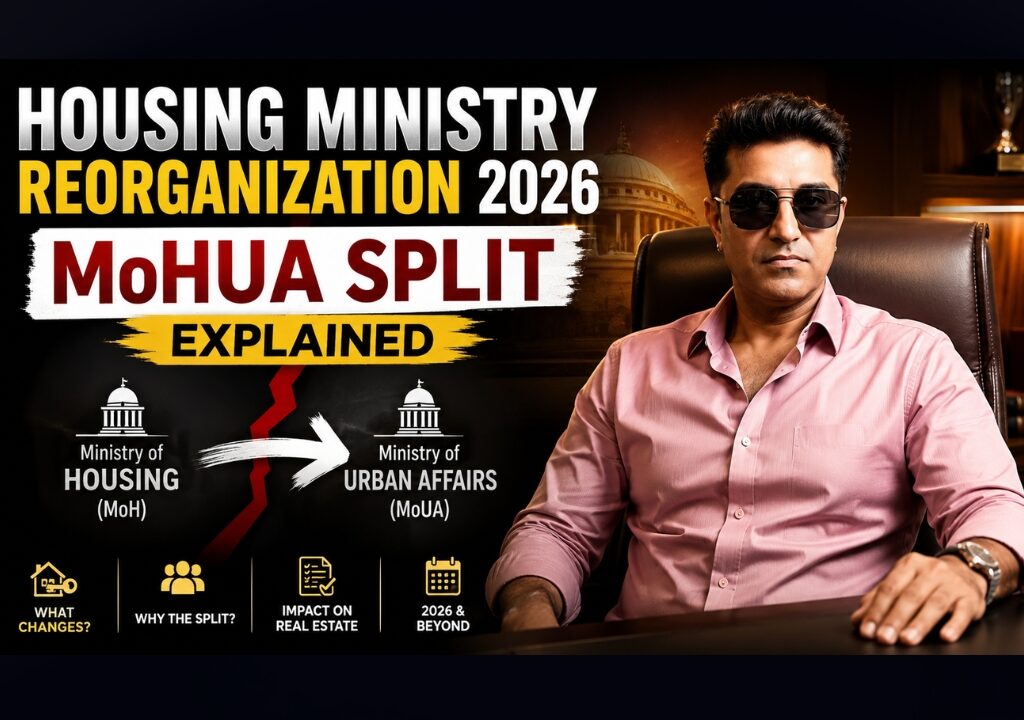
Housing Ministry Reorganization Explained
What the New MoHUA Structure Means for RERA, PMAY, DDA, Homebuyers & India’s Real Estate Market
The Union Government has bifurcated the Ministry of Housing and Urban Affairs into two departments. Here is what actually changed, why it matters for every property buyer, seller, investor, developer, and NRI — and what it means specifically for Punjab and GMADA.
⚡ Quick Answer — Google AI & Search Overview
The Union Government has bifurcated the Ministry of Housing and Urban Affairs (MoHUA) into two new departments through an amendment to the Government of India (Allocation of Business) Rules, 1961, notified in late July 2026: the Department of Capital Development, which will handle Delhi and NCR-specific agencies including the DDA, DMRC, NCRTC, CPWD, and the National Capital Region Planning Board; and the Department of Urban Development, which retains national housing policy, PMAY-U, AMRUT, Swachh Bharat Mission, HUDCO, and urban transport planning for the rest of India — including states like Punjab and cities like Mohali and Chandigarh.
📋 Table of Contents
- Breaking News Summary
- Understanding MoHUA
- What Changed — Old vs New Structure
- Why the Government Reorganized the Ministry
- Impact on Homebuyers
- Impact on Developers & Builders
- Impact on RERA
- Impact on PMAY-Urban
- Impact on DDA
- Impact on Other States
- Impact on Punjab & GMADA
- Expert Analysis
- Risks & Challenges
- Future Outlook
- Frequently Asked Questions
- Myths vs Facts
- Royals Property Consultant — Expert Opinion
- Official Resources
- Related Reading
- Ask Us How This Affects Your Property
1. Breaking News Summary
The reorganisation was formalised on July 24, 2026, and represents one of the most significant administrative changes to India’s urban governance framework in recent years. A proposal along similar lines had been reported as under consideration as early as May 2026, when it was framed primarily around giving Delhi and the NCR a more dedicated administrative structure.
Departments Created
- Department of Capital Development — overseeing Delhi and the National Capital Region specifically, including the Delhi Development Authority (DDA), Delhi Metro Rail Corporation (DMRC), National Capital Region Transport Corporation (NCRTC), Central Public Works Department (CPWD), and the National Capital Region Planning Board. Secretary: D. Thara (IAS, Gujarat cadre, 1995 batch).
- Department of Urban Development — retaining responsibility for national urban policy, housing (including PMAY-Urban), water supply and sanitation, urban transport planning, climate adaptation, and flagship missions such as AMRUT and Swachh Bharat Mission, along with institutions like HUDCO and NIUA. Secretary: Satendra Singh (IAS, Jharkhand cadre, 1995 batch).
Leadership Realignment
Alongside the structural split, Katikithala Srinivas — who had headed MoHUA — moved to lead the Ministry of Development of North Eastern Region. The ministry continues to be led politically by Cabinet Minister Manohar Lal Khattar, with Tokhan Sahu as Minister of State.
Stated Objective
The government’s rationale, as reported, centres on giving Delhi and the NCR a dedicated administrative and policy framework given the scale and complexity of capital-region governance, while allowing the Department of Urban Development to focus on national urban policy and housing schemes without the administrative load of day-to-day NCR-specific matters.Current Implementation Status
As of this writing, the bifurcation has been notified and secretary-level appointments made. Detailed departmental rules of business, staffing allocation, and agency-by-agency transition plans are still being worked out — a typical, expected phase following any ministry-level reorganisation of this scale.
2. Understanding the Ministry of Housing & Urban Affairs
MoHUA traces its lineage back over seven decades, evolving through several name changes before settling into its current form. Headquartered at Nirman Bhawan in New Delhi, the ministry’s core mandate spans housing policy, urban planning frameworks, urban infrastructure funding, and the regulatory environment that underpins India’s real estate sector — most notably through the model RERA Act that individual states, including Punjab, have adapted into their own regulations.
Major Flagship Schemes Under MoHUA’s Umbrella
| Scheme | Focus Area |
|---|---|
| Pradhan Mantri Awas Yojana – Urban (PMAY-U) | Affordable housing for urban poor and economically weaker sections |
| AMRUT (Atal Mission for Rejuvenation and Urban Transformation) | Urban infrastructure — water supply, sewerage, green spaces |
| Smart Cities Mission | Technology-enabled urban infrastructure and governance |
| Swachh Bharat Mission (Urban) | Sanitation and solid waste management |
| Metro Rail Projects (policy oversight) | Urban transit infrastructure funding and coordination |
Before the bifurcation, all of these functions sat under a single ministry with one Secretary also managing Delhi-specific matters — a structure the government’s reorganisation is intended to change.
3. What Changed — Old vs New Structure
| Function / Agency | Old Structure | New Structure |
|---|---|---|
| Overall administration | Single Secretary, MoHUA | Two Secretaries — one per department |
| DDA, DMRC, NCRTC, CPWD, NCR Planning Board | Under MoHUA generally | Department of Capital Development |
| National housing policy & PMAY-U | Under MoHUA generally | Department of Urban Development |
| AMRUT, Swachh Bharat Mission, PM SVANidhi | Under MoHUA generally | Department of Urban Development |
| HUDCO, NIUA | Under MoHUA generally | Department of Urban Development |
| Water supply, sanitation, urban transport planning (national) | Under MoHUA generally | Department of Urban Development |
| Political leadership | Manohar Lal Khattar (Cabinet Minister), Tokhan Sahu (MoS) | Unchanged — same ministers oversee both departments |
⚠ What’s Not Yet Fully Detailed Publicly
The publicly reported notification confirms the department split, agency allocation, and secretary appointments. Granular details — such as the precise administrative “rules of business” for RERA-related central coordination and specific staffing transitions — are still emerging. Where this guide states an expectation rather than a confirmed fact, we’ve flagged it clearly; always cross-check the latest notifications on mohua.gov.in.4. Why the Government Reorganized the Ministry
- Administrative focus: Splitting a large, dual-mandate ministry into two more focused departments, each with clearer accountability.
- Faster decision-making for NCR projects: A dedicated Secretary and department structure for Delhi/NCR-specific agencies like DDA, DMRC, and NCRTC.
- Cleaner national policy focus: The Department of Urban Development can concentrate on nationwide schemes — PMAY-U, AMRUT, Smart Cities-adjacent work — without NCR-specific administrative overhead competing for bandwidth.
- Acknowledging NCR’s administrative complexity: The move formally recognises that Delhi and the NCR involve a scale and density of overlapping jurisdictions that arguably warrants separate, dedicated administrative treatment.
Whether this genuinely translates into faster approvals, reduced bureaucracy, and better digital governance nationally — including for states like Punjab — will depend on implementation over the coming months and is discussed further in the Risks & Challenges and Future Outlook sections below.
5. Impact on Homebuyers
| Area | Likely Near-Term Impact |
|---|---|
| Property registration | Unaffected — remains a state government function |
| RERA complaint handling | Unaffected in the near term — state RERA authorities (like Punjab RERA) continue to operate independently; central coordination sits with the Department of Urban Development going forward |
| Project approvals (state/local) | Unaffected — remains with state authorities like GMADA |
| PMAY-U beneficiary processing | Continues under the Department of Urban Development; no confirmed disruption reported |
| Home loan processing | Unaffected — governed by RBI and individual banks, not MoHUA directly |
💡 What Buyers Should Actually Watch
The most relevant thing for a Punjab-based buyer to track over the coming months is whether the Department of Urban Development issues any updated central guidance affecting RERA coordination, PMAY-U eligibility, or urban infrastructure funding — not the internal Delhi/NCR-specific split, which primarily affects agencies operating in the capital region.6. Impact on Developers & Builders
- Compliance: No immediate change to state-level RERA compliance requirements for Tricity developers.
- Approvals: Delhi/NCR developers now route capital-region-specific matters through the new Department of Capital Development; Punjab developers continue through GMADA and state channels.
- Digital systems: Any future central digital-governance initiatives (single-window clearance portals, for instance) would likely emerge from the Department of Urban Development for non-NCR states.
- Regulatory burden: Too early to assess definitively — the near-term effect on developers outside Delhi/NCR is expected to be minimal, pending further departmental rule-making.
7. Impact on RERA
Because Punjab RERA (and equivalent state authorities elsewhere) function with a significant degree of operational independence, the near-term day-to-day experience for a homebuyer filing a complaint or checking a project’s RERA registration should be unaffected. The more relevant question — not yet publicly answered in detail — is whether the restructuring eventually leads to updated central guidance, digital integration initiatives, or coordination mechanisms between state RERA authorities and the Department of Urban Development.
Quick Fact
Punjab RERA operates independently under Punjab’s own rules framed pursuant to the central RERA Act. Always verify a project’s registration status directly on the official Punjab RERA portal (rera.punjab.gov.in) regardless of any central ministry-level changes.8. Impact on PMAY-Urban
For urban poor and first-time affordable-housing buyers across India — including Punjab’s Tricity region — PMAY-U’s subsidy and beneficiary framework continues under the same broad departmental umbrella responsible for national housing policy. No credible reporting has indicated a pause, suspension, or structural change to PMAY-U eligibility criteria as a direct result of this reorganisation.
9. Impact on DDA
This is one of the clearest, most concrete changes in the entire reorganisation. DDA’s planning and land-management functions, along with DMRC and NCRTC, now report through a department focused exclusively on the capital region, rather than sharing bandwidth with nationwide urban policy matters. This is a Delhi/NCR-specific change and does not directly restructure equivalent development authorities in other states, such as Punjab’s GMADA, which remain state-government bodies unaffected by this particular central reorganisation.
10. Impact on Other States
| State | Primary Central Interface Going Forward |
|---|---|
| Punjab | Department of Urban Development — GMADA/PUDA remain state bodies |
| Haryana | Department of Urban Development — HSVP and equivalent bodies remain state bodies |
| Delhi (NCT) | Department of Capital Development — DDA now sits here specifically |
| Uttar Pradesh (NCR districts) | Mixed — NCR-specific coordination may touch the Department of Capital Development; broader UP urban policy through the Department of Urban Development |
| Maharashtra, Gujarat, Tamil Nadu | Department of Urban Development, as before, for national scheme coordination |
11. Impact on Punjab & GMADA
GMADA & PUDA — No Direct Structural Change
The Greater Mohali Area Development Authority and the Punjab Urban Planning and Development Authority operate under the Government of Punjab, not directly under MoHUA. This reorganisation does not restructure GMADA or PUDA themselves. What it can influence, over time, is the central policy and funding environment GMADA operates within — for master plan approvals tied to central scheme funding, PMAY-U-linked affordable housing components, and any future central digital-governance initiatives Punjab chooses to adopt.
Relevance to Mohali, New Chandigarh & Aerotropolis
Large ongoing initiatives — GMADA’s Aerotropolis expansion, IT City development, and master plan work across New Chandigarh — are Punjab-government-led and GMADA-administered. They are not directly altered by this central bifurcation. Buyers and investors tracking these projects should continue monitoring GMADA’s own official notifications as the primary source, while watching for any downstream central guidance from the Department of Urban Development that could affect PMAY-U-linked components or infrastructure funding timelines.
How Buyers in Punjab Should Prepare
- Continue verifying project RERA status directly through the Punjab RERA portal — this is unaffected by the central reorganisation.
- Continue tracking GMADA’s own notifications for master plan, e-auction, and land-pooling updates.
- Watch for any Department of Urban Development guidance specifically affecting PMAY-U or central infrastructure scheme funding relevant to Punjab over the coming months.
- Don’t expect any immediate change to day-to-day registration, approval, or complaint-filing processes in Punjab as a direct result of this specific announcement.
12. Expert Analysis
Splitting a single large ministry into focused departments is a well-established governance pattern intended to sharpen accountability. The logic for treating Delhi/NCR separately is reasonably strong: the capital region carries a disproportionate share of high-profile, multi-agency infrastructure work, and consolidating that under one department can, in principle, speed up decision-making.
The genuine analytical question is coordination. Areas like transit-oriented development depend on metro planning, land use, and housing policy evolving together. With DMRC and NCRTC now under the Department of Capital Development while national housing and urban transport planning sit with the Department of Urban Development, effective interdepartmental mechanisms will matter more, not less, going forward. This is a standard risk with any bifurcation of a previously integrated function, and it is not unique to India — comparable governance restructurings elsewhere have faced similar coordination questions in their early years.
13. Risks & Challenges
| Risk Area | Why It Matters |
|---|---|
| Transition friction | Any major reorganisation involves a period where staff, files, and processes are still being formally reassigned |
| Administrative overlap | Functions like transit-oriented development span both new departments, requiring active coordination |
| Implementation delays | Detailed rules of business and staffing transitions typically take months to fully settle |
| Policy clarity for states | States like Punjab will need clear guidance on which department to approach for specific central scheme matters |
| Capacity building | Two newly appointed Secretaries and their teams will need time to build institutional processes specific to their narrower mandates |
| Technology/digital continuity | Any existing digital systems spanning the old unified ministry may need reconfiguration across the two new departments |
14. Future Outlook
- Short term (0-6 months): Administrative and staffing transition; detailed rules of business published; limited visible change for buyers and developers outside Delhi/NCR.
- Medium term (6-18 months): First policy or scheme-level announcements likely to reveal how the Department of Urban Development prioritises national housing and RERA-adjacent coordination versus how the Department of Capital Development executes NCR projects.
- Long term (18+ months): The reform’s real test — whether project delivery timelines, PMAY-U rollout, and interdepartmental coordination on transit-oriented development measurably improve, or whether new coordination friction offsets the intended gains.
15. Frequently Asked Questions
Why was the Housing Ministry reorganized?
The government split MoHUA into two departments to give Delhi and the NCR a dedicated administrative framework given their scale and complexity, while letting the Department of Urban Development focus on national housing and urban policy.
When did the Housing Ministry reorganization happen?
The bifurcation was formalised through an amendment to the Government of India (Allocation of Business) Rules, 1961, notified on July 24, 2026.
What are the two new departments called?
The Department of Capital Development (Delhi/NCR-focused) and the Department of Urban Development (national urban policy and housing).
Who heads the new departments?
D. Thara is Secretary of the Department of Capital Development, and Satendra Singh is Secretary of the Department of Urban Development.
Will RERA rules change because of this reorganization?
No confirmed change to RERA rules has been reported. RERA remains a state-implemented framework; Punjab RERA continues to operate under its existing structure.
Will PMAY continue as before?
Yes. PMAY-Urban remains under the Department of Urban Development, with no reported disruption to beneficiary processing or scheme continuity.
Will project approvals become faster?
That is the stated intent for Delhi/NCR-specific projects under the new Department of Capital Development; for states like Punjab, approval processes remain primarily state-government functions, largely unaffected in the near term.
How will homebuyers in Punjab benefit?
Directly, very little changes immediately — registration, RERA complaints, and approvals remain state functions. Indirectly, buyers may benefit if the Department of Urban Development’s sharper national focus eventually improves scheme coordination.
What changes for developers?
Developers in Delhi/NCR now interface with the Department of Capital Development for capital-region matters; developers elsewhere, including Punjab, continue largely unchanged in the near term.
Does this affect Punjab directly?
Not structurally — GMADA and PUDA remain Punjab state bodies. The relevant question is whether central policy coordination through the Department of Urban Development improves over time.
How does this impact GMADA?
GMADA is not restructured by this change, since it is a state authority. It may be indirectly affected by future central guidance or funding coordination from the Department of Urban Development.
What is the Department of Capital Development?
A newly created department overseeing Delhi and the NCR specifically, including DDA, DMRC, NCRTC, CPWD, and the National Capital Region Planning Board.
What is the Department of Urban Development?
The department retaining national urban policy, housing (including PMAY-U), AMRUT, Swachh Bharat Mission, water supply and sanitation, and urban transport planning for the rest of India.
Does DDA still exist?
Yes. DDA continues to exist and function, now reporting through the Department of Capital Development rather than the previously unified MoHUA structure.
Who is the current Union Minister for Housing and Urban Affairs?
Manohar Lal Khattar is the Cabinet Minister, with Tokhan Sahu as Minister of State — both continue to oversee the ministry, now spanning two departments.
What happened to the previous MoHUA Secretary?
Katikithala Srinivas, who previously headed MoHUA, has moved to head the Ministry of Development of North Eastern Region.
Does this reorganization affect home loan interest rates?
No. Home loan rates are governed by RBI monetary policy and individual bank decisions, entirely separate from this ministry-level administrative reorganisation.
Will Smart Cities Mission projects be affected?
Smart Cities-related urban infrastructure work generally falls under the Department of Urban Development’s national mandate; no reported disruption to ongoing projects.
Is this reorganization permanent?
It has been implemented through a formal rules amendment, indicating it is intended as a lasting structural change, though government administrative structures can always be revised in future.
Does this affect ongoing RERA complaints in Punjab?
No reported impact — Punjab RERA continues to process complaints under its existing state-level structure and timelines.
What is the National Capital Region Planning Board’s new reporting line?
It now falls under the Department of Capital Development, alongside DDA, DMRC, NCRTC, and CPWD.
Does HUDCO’s role change?
HUDCO continues under the Department of Urban Development, maintaining its national housing finance mandate.
Will this affect GST or stamp duty on property?
No. GST and stamp duty are governed by separate tax frameworks (GST Council and state stamp duty laws respectively) and are not affected by this ministry reorganisation.
How does this compare to previous MoHUA restructurings?
MoHUA has been renamed and reorganised before (notably in 2017), but a formal department-level bifurcation of this scale, specifically separating Delhi/NCR administration, is a distinct and more structurally significant change.
Will transit-oriented development projects be affected?
Potentially, since metro agencies (DMRC, NCRTC) now sit under a different department than national urban transport and housing policy — effective coordination between the two departments will be important to watch.
Are other states expected to get similar dedicated departments?
Not confirmed. The current restructuring is specific to Delhi/NCR; whether this model expands to other metro regions remains to be seen based on future government decisions.
Does this reorganization change RERA’s central Act?
No. The central Real Estate (Regulation and Development) Act itself is unchanged; this is an administrative ministry reorganisation, not a legislative amendment.
Where can I read the official notification?
Official notifications and updates are published on mohua.gov.in — always verify specifics there rather than relying solely on news summaries.
Should I delay a property purchase in Mohali because of this news?
There is no indication this reorganisation should affect purchase timing for Punjab buyers — GMADA, Punjab RERA, and state processes continue functioning as before.
How is Royals Property Consultant tracking this story?
We monitor official MoHUA, GMADA, and Punjab RERA notifications directly and will update our guidance as concrete departmental rules and state-level implications become clearer.
16. Myths vs Facts
FALSE. No change to the central RERA Act or state RERA rules has been reported; this is an administrative ministry restructuring.
FALSE. GMADA is a Punjab state authority, unaffected by this central-level change.
FALSE. PMAY-Urban continues under the Department of Urban Development with no reported disruption.
FALSE. DDA continues to function, now under the Department of Capital Development.
FALSE. Home loan rates are set by RBI policy and individual banks, unrelated to this ministry reorganisation.
FALSE. Registration remains a Punjab state government function, unchanged by this news.
FALSE. The Department of Capital Development is specific to Delhi/NCR; other states continue interfacing with the Department of Urban Development as before.
FALSE. MoHUA continues to exist as the parent ministry; it now operates through two departments rather than one undivided structure.
FALSE. Stamp duty is a state subject, entirely separate from this central administrative reorganisation.
FALSE. RERA registration requirements and processes remain with existing state RERA authorities.
FALSE. It was implemented through an amendment to the Government of India (Allocation of Business) Rules, 1961 — an administrative rule change, not new legislation.
FALSE / TOO EARLY TO CONFIRM. The stated intent targets Delhi/NCR efficiency; any indirect benefit to states like Punjab, if it materialises, would take time to show up in practice.
17. Royals Property Consultant — Expert Opinion
At Royals Property Consultant, we track central and state policy changes — RERA updates, GMADA notifications, and now this MoHUA reorganisation — as part of the legal and market due diligence we provide every client, free of charge. Our role isn’t to predict every policy outcome with certainty; it’s to separate confirmed facts from speculation, so buyers in Zirakpur, Mohali, Chandigarh, Panchkula, and New Chandigarh can make decisions based on what’s actually verified, not headlines alone.
18. Official Resources
Ask Us How This Affects Your Property Decision
Tell us your situation — it opens directly in WhatsApp, pre-filled and ready to send to Manindar Verma.
MoHUA restructuring, Housing Ministry 2026, RERA news, PMAY Urban, DDA news, real estate policy India, urban development ministry, housing governance India