
NRI Property ROI comparison

NRI Property ROI Comparison 2026

NRI Property ROI Comparison 2026: Gurgaon vs Mohali vs Chandigarh

Royals Property Consultant is a trusted name for buying, selling, renting, and investing in residential and commercial properties in Zirakpur, Mohali, Chandigarh, and New Chandigarh.
NRI Property ROI comparison

NRI Property ROI Comparison 2026: Gurgaon vs Mohali vs Chandigarh

A data-backed look at price per sq ft, rental yield, and appreciation trends — for NRIs deciding where ₹1-2 crore actually works hardest.

₹90+INR/USD, 2026
$136BNRI Remittances FY25
~19%NRI Share of Property Buys
5.25%RBI Repo Rate, Jun 2026
15+ yrsTricity Market Experience
⚡ Quick Answer

On a like-for-like basis, Gurgaon offers the deepest liquidity and highest absolute price ceiling but typically the lowest residential rental yield (roughly 2-4%). Mohali offers meaningfully higher rental yields (roughly 4-8%, higher still in select sectors and commercial units) at a fraction of Gurgaon’s entry price, backed by GMADA’s government-planned titles. Chandigarh sits between the two — limited land supply keeps appreciation stable but entry prices and yields resemble a mature, supply-constrained market. The right answer depends on whether an NRI is optimising for yield, appreciation, liquidity, or a family base — not on which city “wins” outright.

Why NRIs Default to Gurgaon and Bangalore — and Why That Deserves a Second Look

Ask an NRI in Toronto, Dubai, or London where to buy property in India, and the reflexive answer is usually Gurgaon or Bangalore. That instinct isn’t irrational — both cities have deep secondary markets, globally recognisable developers, and corporate employment bases that support long-term demand. But “the city everyone mentions first” and “the city that generates the best risk-adjusted return for a specific NRI’s goals” are not always the same city, and the gap between the two rarely gets examined with actual numbers.

This piece does that examination for three markets: Gurgaon (the default), and Mohali and Chandigarh (the Tricity alternative increasingly on NRI shortlists). We are not arguing one market is objectively superior — we are laying out price, yield, and appreciation data side by side so the decision can be made on evidence rather than name recognition.

A note on our data: Indian real estate does not have a single authoritative price index the way listed equities do. The figures in this article are drawn from multiple published listing-portal and industry sources current as of mid-2026, cross-checked against each other, and presented as ranges rather than single “exact” numbers. Where reliable 5-10 year historical trend data was not consistently available across all three cities, we say so explicitly rather than estimate a figure we cannot support.

Part 1: The Macro Backdrop — INR, Remittances, and Interest Rates

Three macro forces shape every NRI property decision in 2026, regardless of which city is chosen:

Currency

INR Depreciation

The rupee has traded above the ₹90/USD mark through parts of 2026 — a level that materially increases the purchasing power of dollar, dirham, and pound earnings converted into Indian real estate, independent of which city is chosen.

Capital Flow

Record Remittances

India received a record $136 billion in inward remittances in FY25, up 14% year-on-year according to RBI data — with a rising share now flowing from the US, UK, Canada, and Singapore rather than only Gulf economies, and a growing portion directed toward real estate rather than household consumption.

Rates

Stable Repo Rate

The RBI held the repo rate at 5.25% in its June 2026 policy review, following rate cuts through 2025 — a stability signal that supports predictable home loan pricing for NRI co-borrowers and Indian family members taking joint loans.

Industry estimates suggest NRIs now account for roughly 18-20% of Indian residential property transactions, up from single digits a decade ago — though this figure varies by source and should be treated as an industry estimate rather than an official statistic, since no single government body publishes a definitive NRI-transaction share.

Part 2: Price Per Sq Ft — Head to Head

Entry price is the most visible number NRIs compare, and it is also the number most exaggerated by both bullish and bearish sources online. Here is what published data actually shows as of mid-2026:

CityBroad Residential Range (₹/sq ft)Affordable Entry PointPremium/Luxury Ceiling
Gurgaon₹8,000 – ₹25,000 (city-wide average commonly cited near ₹13,000-15,000)~₹5,000-8,000 in Sohna / outer New Gurgaon₹40,000-70,000+ on Golf Course Road for ultra-luxury towers
Chandigarh (UT sectors)₹9,000 – ₹18,000+ for apartments; villas considerably higher~₹4,500-6,000 in New Chandigarh / peripheral sectors₹18,000-38,000+ for premium sector apartments and villas
Mohali₹4,300 – ₹12,000 depending on sector~₹4,300-5,000 in Kharar, Sector 124-127₹10,000-16,000 in Airport Road, IT City and premium Aerocity pockets
💡 What this means practically: The same ₹1 crore that buys roughly 650-750 sq ft in a mid-segment Gurgaon sector can buy roughly 1,000-1,400 sq ft in a comparable mid-segment Mohali sector — a materially different starting point for both personal use and rental unit size.

Part 3: Rental Yield Comparison

Yield is where the three markets diverge most sharply, and it is the metric most NRIs underweight relative to appreciation headlines.

CityTypical Residential YieldBest-Case Sector/Segment YieldCommercial Yield
Gurgaon~2.5% (city average per listing-portal data)3-4.5% in select rental-heavy sectorsOffice/retail typically stronger than residential, but entry cost is high
Chandigarh~2-3%Up to 5-10% cited for specific high-turnover sectors (Sector 20, 40, 38 per portal data)6-8% cited for Sector 17 / IT Park / Elante corridor commercial assets
Mohali~4.5-5.5% for standard residentialUp to 6-9% in select sectors and PG/co-living conversions near IT City6-12% cited across pre-leased SCOs, showrooms and office space in Aerocity/IT City
⚠️ Read this carefully: “Best-case sector yield” figures are exactly that — the top of a published range, usually for a specific micro-location or property type, not a guaranteed return for any random property in that city. Treat city-wide averages as your realistic planning baseline and sector-specific highs as the upside case, not the expected case.

Part 4: Appreciation Trends

Historical appreciation is the hardest of these three metrics to compare cleanly, because published trend windows differ by source and by city.

  • Gurgaon: Multiple sources cite double-digit sales growth and 8-15% projected annual appreciation for 2026 in infrastructure-linked corridors like Dwarka Expressway, alongside price corrections in some already-mature micro-markets in late 2025.
  • Chandigarh: Sector-level data shows a wide spread — some established sectors show double-digit one-year appreciation (partly reflecting a low base or specific project launches), while the broader UT market is generally described as stable rather than fast-moving, consistent with its fixed land supply.
  • Mohali: Multiple sources cite roughly 60-80% cumulative appreciation over five years in several sectors, and a widely repeated 12-15% annual appreciation estimate for prime pockets like IT City and Aerocity in 2026 — though these are industry/portal estimates, not an official index figure.
Data limitation, stated plainly: None of these three markets has a single continuous, independently audited 10-year price index comparable to, say, a stock market benchmark. Every appreciation figure above (including ours) traces back to listing-portal or industry-report estimates. We are presenting the ranges most consistently cited across independent sources rather than a single precise number, because a false precision would be less honest than an honest range.

Part 5: ₹2 Crore — Illustrative Scenario Modelling

To make this concrete, here is how a ₹2 crore allocation plays out differently across the three markets, based on the price and yield ranges above. These are illustrative models built from published ranges, not guaranteed outcomes for any specific property.

ScenarioApprox. Space AcquiredIllustrative Annual Rental (at cited yield range)Primary Return Driver
A: Premium apartment, Gurgaon (Golf Course Rd corridor)~900-1,100 sq ft at premium pricing~₹5-9 lakh/year (2.5-4.5% yield)Capital appreciation and liquidity; yield is secondary
B: Premium apartment, Mohali (IT City / Aerocity)~1,800-2,300 sq ft at ₹8,500-11,000/sq ft~₹9-16 lakh/year (5-8% yield)Rental yield plus appreciation; larger unit for the same capital
C: Pre-leased commercial/SCO, MohaliSmaller footprint, commercial-grade unit~₹12-24 lakh/year (6-12% yield range cited)Income-first strategy; least suited to hands-off NRI unless professionally managed
D: Builder floor / sector apartment, Chandigarh~1,100-1,600 sq ft depending on sector~₹4-10 lakh/year (2-5% typical, higher in specific sectors)Long-term capital stability from restricted land supply
Illustrative example, not a guarantee: An NRI deploying ₹2 crore into a Mohali IT City apartment at roughly ₹9,000/sq ft acquires close to double the floor area of an equivalent Gurgaon premium-corridor purchase, at a yield range roughly double as well — the trade-off being Gurgaon’s deeper resale liquidity and more globally recognisable address. Actual outcomes depend on the specific project, tenant profile, and holding period, and should be verified against the specific property under consideration, not this general model.

On taxation: Holding costs, TDS on sale (currently structured around long-term capital gains at 12.5% for properties held over two years, per Budget 2025 changes), and repatriation limits under FEMA apply identically regardless of which of these three cities is chosen — city choice does not change the NRI tax framework, only the underlying asset economics.

Part 6: Connectivity & Quality of Life

FactorGurgaonChandigarhMohali
AirportIGI Delhi, ~30-45 min depending on trafficChandigarh International Airport, within city limitsChandigarh International Airport, often 5-15 min from key sectors
Employment baseDeep corporate/MNC hub, established for 25+ yearsGovernment, healthcare, education-led; growing IT presenceGrowing IT corridor (IT City, Phase 2 expansion) plus Chandigarh spillover
Traffic/congestionHigh in central corridors; improving with Dwarka ExpresswayLow to moderate; planned grid layoutLow to moderate; newer planned sectors
Civic planningMixed — private developer-led growth in many sectorsIndia’s most deliberately planned city; strict building controlGMADA-planned sectors with defined land use and infrastructure-first development
Cultural/diaspora fitBroad, pan-India drawStrong pull for Punjabi diaspora specificallyStrong pull for Punjabi diaspora specifically

Part 7: Who Should Invest Where — An Honest Answer

💬 Manindar Verma — Managing Director, Royals Property Consultant

“I don’t tell NRI clients which of these three cities is ‘best’ — I ask what they’re optimising for. If it’s liquidity and a globally recognisable address you can sell quickly from abroad, Gurgaon’s depth of market is real and shouldn’t be dismissed. If it’s yield and a family base with Punjabi roots, Mohali’s numbers are simply better on paper, and GMADA’s government title structure removes a lot of the remote-verification anxiety NRIs feel. Chandigarh sits in between — you’re paying for stability and restricted supply, not for the highest yield in the room. The mistake isn’t picking any of these three. The mistake is picking one because it’s the first name that came to mind, without ever comparing it against the other two on paper.”
  • Choose Gurgaon if: resale liquidity, corporate-tenant depth, and a nationally recognisable address matter more to you than yield.
  • Choose Mohali if: rental yield, lower entry capital, GMADA title clarity, and Punjab/Tricity roots matter most, and you can work with a local consultant for remote management.
  • Choose Chandigarh if: you want the most stable, supply-constrained market with strong civic planning, and are comfortable with lower yield in exchange for that stability.
  • Avoid all three if: you are buying purely on a relative’s verbal tip without independent RERA and title verification — the city matters far less than the diligence in that scenario.
  • ☐ Payment routed only through NRE, NRO, or FCNR account — cash payments are not permitted under FEMA
  • ☐ RERA registration verified directly on the relevant state portal (Punjab RERA for Mohali/Chandigarh UT areas, Haryana RERA for Gurgaon)
  • ☐ Title search and chain of title verified independently — never solely through a relative or unverified local contact
  • ☐ Power of Attorney, if used, registered, time-bound, and revocable — never treated as a substitute for the registered sale deed itself
  • ☐ Builder/developer track record checked for delivery history, not just brochure claims
  • ☐ TDS and repatriation rules confirmed with a CA before, not after, the transaction
  • ☐ Mutation completed after registration — an un-mutated property is harder to sell or mortgage later, and harder still to manage remotely

For the full legal walkthrough specific to this region, see our detailed guide: NRI Property Investment in Chandigarh: Best 2026 Guide.

Part 9: 2026-2028 Outlook — Where Might Smart Money Move?

Three developments are worth monitoring rather than acting on prematurely:

  • Chandigarh Metro planning: if it progresses from planning to construction, sectors along the proposed corridor in Mohali, Chandigarh and Zirakpur could see valuation effects before the metro is even operational — this has already happened at the announcement stage in comparable Indian cities.
  • IT City Mohali Phase 2: continued employer additions would deepen the rental tenant pool that currently supports Mohali’s yield advantage — this is a demand-side factor to track, not a guarantee.
  • Gurgaon’s Dwarka Expressway maturation: as this corridor’s social infrastructure catches up to the roads already built, appreciation in adjacent sectors is widely expected to continue, though timing is inherently uncertain.

Risk factors NRI buyers should monitor regardless of city: INR volatility affecting the timing of remittance-to-purchase conversion, RERA enforcement consistency, and — specific to Punjab markets — the pace of GMADA/HUDA infrastructure delivery relative to allotment timelines. None of these risks is unique to any one of the three cities; all three carry some version of execution risk.

Frequently Asked Questions

Is Mohali really cheaper than Gurgaon for NRIs?

Yes, on a per-square-foot basis. Published data puts Mohali’s broad residential range at roughly ₹4,300-12,000/sq ft against Gurgaon’s roughly ₹8,000-25,000/sq ft, meaning comparable capital typically buys significantly more floor area in Mohali.

Which city offers better rental yield for NRIs — Gurgaon or Mohali?

Mohali generally offers higher residential rental yields, commonly cited in the 4.5-8% range versus roughly 2.5-4.5% in Gurgaon, though top-end figures in both cities are sector-specific rather than city-wide averages.

Do NRIs need RBI approval to buy property in Gurgaon, Mohali, or Chandigarh?

No. Under FEMA, 1999, NRIs and OCI cardholders can purchase residential or commercial property in any of these locations without prior RBI approval, provided payment is routed through an NRE, NRO, or FCNR account.

Is Chandigarh a safer investment than Mohali because of government planning?

Both markets have government-planning advantages — Chandigarh through the Union Territory’s strict building control, and Mohali through GMADA’s planned sectors and government-backed titles on authority-allotted land. “Safer” depends on which specific project or plot is being compared, not the city alone.

What is the biggest risk in comparing appreciation data across these cities?

The lack of a single independently audited price index. All appreciation figures — including industry-cited ones — come from listing-portal or industry-report estimates, so they should be treated as directional ranges rather than precise, guaranteed figures.

Can NRIs buy commercial property in Mohali’s IT City for rental income?

Yes. NRIs can purchase commercial property under FEMA, and Mohali’s IT City and Aerocity commercial segments are commonly cited with yields in the 6-12% range, though commercial assets typically require more active or professionally managed oversight than residential.

How does the weak rupee actually help NRI property buyers?

With the INR trading above ₹90 to the US dollar through parts of 2026, a fixed foreign-currency remittance converts into more rupees than it would have a few years earlier — effectively increasing purchasing power for the same foreign income, independent of which Indian city is chosen.

Should an NRI prioritise appreciation or rental yield?

It depends on the investment purpose. Buyers planning eventual relocation or a family base often prioritise appreciation and location fit; buyers focused on passive income to cover EMIs or generate returns from abroad often prioritise yield. The three cities in this comparison serve these two goals differently.

Is a Power of Attorney enough for an NRI to complete a purchase remotely?

A POA can authorise someone to sign documents on an NRI’s behalf, but it is not a substitute for a registered sale deed. The POA must itself be properly registered, time-bound, and used only to execute an otherwise legitimate, registered transaction.

What taxes apply when an NRI sells property in India?

Long-term capital gains (for properties held over two years) are taxed at 12.5% under the current framework following Budget 2025 changes, with TDS deducted at the time of sale — the specific rate and applicable deductions should be confirmed with a CA at the time of transaction, as these rules are subject to annual Finance Bill updates.

Comparing Mohali, Zirakpur or Chandigarh for Your NRI Investment?

Get a personalised, data-backed comparison sheet matched to your budget and goals — zero brokerage, 15+ years of Tricity experience, and NRI-specialist documentation support from booking to possession.

MV
Manindar Verma
Managing Director · Royals Property Consultant · RERA: PBRERA-CHD04-REA0390
With 15+ years of active real estate experience across Zirakpur, Mohali, Chandigarh, Panchkula, and New Chandigarh, Manindar Verma has guided over 500 families — including a growing number of NRI clients across Canada, the UAE, the UK, and Australia — through property decisions backed by market data rather than sentiment. This article reflects independent analysis of publicly available market data as of mid-2026 and is not financial or investment advice; NRIs should consult a qualified CA and lawyer before any transaction.

Disclaimer: Real estate price, yield, and appreciation figures cited in this article are drawn from publicly available listing-portal and industry sources as of mid-2026 and are presented as ranges, not guarantees. Past appreciation and cited yields do not guarantee future performance. This article does not constitute financial, tax, or legal advice.

Gurgaon vs Mohali, NRI property investment India, Mohali rental yield, Chandigarh property appreciation, NRI real estate 2026, GMADA NRI investment, NRI property ROI, best city for NRI investment, Punjab property investment, NRI legal checklist
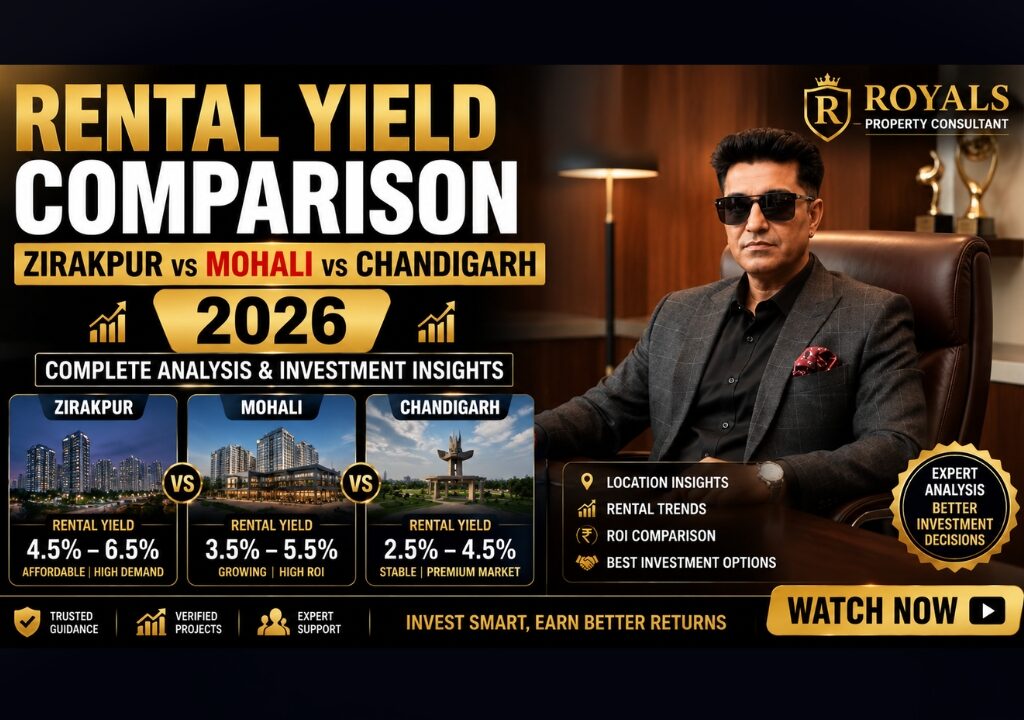

Rental Yield Comparison: Zirakpur vs Mohali vs Chandigarh 2026

Rental Yield Comparison: Zirakpur vs Mohali vs Chandigarh 2026

Rental Yield Comparison: Zirakpur vs Mohali vs Chandigarh 2026

Royals Property Consultant is a trusted name for buying, selling, renting, and investing in residential and commercial properties in Zirakpur, Mohali, Chandigarh, and New Chandigarh.

Rental Yield Comparison: Zirakpur vs Mohali vs Chandigarh 2026
🏛 RERA: PBRERA-CHD04-REA0390 Manindar Verma · Managing Director 📅 Updated June 2026 ⏱ 15 min read
🏠 Tricity Real Estate · Investment Guide 2026

Rental Yield Comparison: Zirakpur vs Mohali vs Chandigarh 2026

3–4% Avg Yield · Zirakpur
2.5–3.5% Avg Yield · Mohali IT Belt
1.5–2.5% Avg Yield · Chandigarh
₹0 Brokerage from Buyers · Royals
Rental yield comparison Zirakpur Mohali Chandigarh 2026 — Royals Property Consultant

If you are sitting on savings and wondering where to put your money in Tricity real estate — Zirakpur, Mohali, or Chandigarh — you are asking exactly the right question. But most articles give you vague answers. This one does not.

We are going to walk through real rental yield ranges across all three markets, break down the areas driving those numbers, and give you an honest picture of where your money works hardest in 2026. Whether you are a first-time investor, a seasoned buyer looking to diversify, or an NRI wanting passive rental income from Punjab — this guide covers your angle.

By the end, you will know which city suits your investment profile, which micro-locations punch above their weight on yield, and what to watch out for before you sign anything.

Tricity Rental Market — 2026 Overview

The Tricity region — Chandigarh, Mohali, and Zirakpur — functions as one interconnected property market, but each city operates with its own yield dynamics, tenant profile, and growth story. Understanding these differences is what separates a smart investment from an expensive mistake.

Chandigarh is the established anchor — premium prices, premium tenants, lower yield but rock-solid capital safety. Mohali is the growth engine — IT parks, GMADA development, and expanding infrastructure driving both demand and appreciation. Zirakpur is the yield play — the most accessible entry price in the belt, the highest gross yield, and the most liquid rental market for quality housing.

Why Rental Yield Comparison Matters More in 2026

Three years ago, real estate buyers in this region were almost entirely focused on capital appreciation — buy, hold, sell at profit. The yield conversation was secondary. That has changed.

With interest rates having remained elevated through much of 2024–25, buyers are now asking a harder question before committing capital: what does this property actually earn me while I hold it? The annual rental yield number has become central to the investment decision — not just a bonus metric.

For NRI investors especially, this shift is pronounced. When you are managing a property from Canada, UK, or UAE and relying on a property manager, a 1.5% yield barely covers costs. A 3.5% yield genuinely contributes to your returns. The difference between these two numbers defines whether a Tricity investment makes financial sense from abroad or not.

Key Context: Rental yield = annual rent collected ÷ property purchase price × 100. A flat bought at a higher price in Chandigarh that rents for a proportionally smaller amount will always yield less than a similar-quality flat bought at a lower entry in Zirakpur with strong tenant demand. Entry price matters as much as rental amount.

City-by-City Rental Yield Comparison

📍 Zirakpur Best Yield
3–4%
Gross Annual Rental Yield
  • Entry Price RangeMid-range
  • Tenant ProfileIT + Families
  • Vacancy RiskLow
  • Capital GrowthStrong ↑
  • Best ForIncome Investors, NRIs
📍 Mohali Balanced
2.5–3.5%
Gross Annual Rental Yield
  • Entry Price RangeMid to High
  • Tenant ProfileIT Professionals
  • Vacancy RiskLow–Medium
  • Capital GrowthStrong ↑↑
  • Best ForGrowth + Income Mix
📍 Chandigarh Capital Safe
1.5–2.5%
Gross Annual Rental Yield
  • Entry Price RangeHigh–Premium
  • Tenant ProfileGovt / Corporate
  • Vacancy RiskVery Low
  • Capital GrowthSteady ↑
  • Best ForCapital Preservation

Zirakpur — Rental Yield Deep Dive

Zirakpur is the yield leader of the Tricity market, and it is not particularly close. The reason is structural: entry prices here are materially lower than Chandigarh while rental demand has been growing steadily — driven by IT professionals from Mohali’s expanding tech belt, healthcare workers from nearby hospitals, and families who want Chandigarh-level urban amenities without Chandigarh’s price tag.

Area-Wise Rental Yield — Zirakpur

✈️ Airport Road (PR7)
3.5–4%

The premium corridor. Airport proximity, growing commercial spine, and excellent connectivity to IT City keep vacancy rates near zero. Quality 3BHK flats here attract professionals who pay on time and stay long.

Top Performer NRI Favourite Low Vacancy
🚇 VIP Road / Baltana
3–3.8%

Rising fast. Metro proximity is bringing a new wave of demand. Currently offers slightly better entry price versus Airport Road with comparable tenant quality — making it the value-yield play right now.

Metro Upside Value Entry Rising Fast
🛣️ Patiala Highway (NH-7)
3–3.5%

The luxury corridor. DLF Valley and premium township projects dominate here. Yield is slightly compressed by higher entry price, but tenant quality is exceptional — government officers, senior IT management, NRIs.

Luxury Premium Tenants DLF Belt
📌 Zirakpur Insight: The highest-yielding units in Zirakpur are quality 2BHK and 3BHK flats in professionally managed gated societies — not standalone builder floors or independent houses. Management quality directly affects vacancy rates and therefore effective yield. Always check the RWA and maintenance track record before buying for rental.

Mohali — Rental Yield Deep Dive

Mohali is a tale of two yield stories. The IT City belt (Sectors 66–82) and the Airport Road extension offer the strongest rental income in the city — driven by genuine corporate demand from companies like Infosys, Quark, DLF IT Park, and a growing startup ecosystem. But Mohali’s higher entry price per square foot versus Zirakpur compresses gross yield even when monthly rents are comparable.

The smart Mohali play is buying in GMADA-sanctioned sectors where both appreciation and rental demand are strong. Properties here benefit from clear title, proper infrastructure, and the institutional confidence that comes with GMADA certification — factors that matter enormously for long-term capital safety.

Area-Wise Rental Yield — Mohali

💻 IT City / Sector 82
3–3.5%

The corporate rental hub. Professionals from Mohali’s IT park belt drive consistent, premium demand. Vacancy risk is minimal for quality 2BHK and 3BHK units within 10 minutes of the tech corridor.

IT Professionals Low Vacancy Premium Rent
🏛️ GMADA Sectors
2.5–3%

Institutional-grade locations with GMADA approval. Entry price is higher, which compresses yield. But the capital safety and long-term appreciation profile here is the strongest in the Mohali market.

GMADA Approved Capital Safe Long-Term Play
🌿 New Chandigarh / Mullanpur
2–3%

The emerging market. Infrastructure is still maturing — which means entry prices are relatively reasonable today and rental demand is growing as PGIMER satellite campus, Panjab University satellite, and township projects attract residents.

Emerging Market Growth Play Educational Belt

Chandigarh — Rental Yield Deep Dive

Chandigarh is the most expensive residential market in the Tricity region — and that premium entry price is the primary reason yields here are the lowest of the three cities. A flat that might cost significantly more in Sector 17 or Sector 35 vicinity than a comparable unit in Zirakpur’s Airport Road belt will not command proportionally higher rent. The result: lower gross yield.

But that does not make Chandigarh a poor investment. For buyers prioritising capital preservation, the security of a UT-administered market with strict land use controls, and the prestige of a Chandigarh address, the trade-off is conscious and rational. Tenant quality here — government officers, senior professionals, established businesses — is also the most reliable in the region.

Area-Wise Rental Yield — Chandigarh & Panchkula

🏛️ Chandigarh Sectors (15–45)
1.5–2.5%

Established sectors with premium capital values. Government and senior professional tenants. Yield is compressed by high entry price but vacancy is extremely rare — sometimes zero for quality properties in good sectors.

Capital Safe Premium Address Govt Tenants
🌄 Panchkula Sectors
2–3%

Haryana’s most organised city. Slightly more accessible entry price than core Chandigarh with growing demand from professionals working in both Chandigarh and Mohali. Better yield than UT sectors with reasonable capital safety.

Haryana Stability Better Yield Growing Demand

Location Analysis — What Drives Yield in Each Market

Connectivity

All three markets share Chandigarh International Airport proximity. Zirakpur’s Airport Road (PR7) is literally the airport access road — a structural advantage that keeps both commercial and residential demand high. Mohali’s IT City corridor connects directly to the NH-44 expressway, providing seamless access to Delhi and the broader highway network. Chandigarh’s internal sector road network is among the best-planned in India, though its peripheral connectivity lags the other two markets for vehicle-dependent commuters.

The Chandigarh Metro project, when operational, will significantly reshape yield dynamics — particularly for VIP Road and Baltana in Zirakpur and for the Mohali extension corridor. Pre-metro entry is still possible at current pricing.

Infrastructure

Chandigarh has the most mature infrastructure of the three — reliable power, water, roads, and public services built into a planned city structure. Mohali’s GMADA sectors are catching up rapidly, with major road widening projects and utility upgrades underway. Zirakpur, while improving, still shows variation in infrastructure quality across different micro-pockets — which is why society-level amenities and management matter so much for yield here.

Employment Growth

Mohali’s IT and knowledge sector employment is the most direct driver of rental demand in the Tricity region. Companies in Mohali’s Phase 8 and 9 industrial areas, IT Park, and Aerocity zone are collectively the largest employers of the professional tenant class. Zirakpur benefits as the most affordable residential catchment for this workforce. Chandigarh’s government employment base provides a different but equally stable demand source.

Future Developments

Three projects will materially reshape yield dynamics over the next 3–5 years. First, the Chandigarh Metro connectivity reaching Zirakpur and Mohali. Second, the GMADA Aerocity development in Mohali, which will bring international hospitality, corporate offices, and logistics to the airport catchment area. Third, the continued buildout of New Chandigarh / Mullanpur as a planned township, which is bringing institutional demand that the area lacked entirely until recently.

Several specific trends are shaping the Tricity rental market in 2026 that did not exist in the same form even two years ago.

Furnished and semi-furnished premiums are growing. Tenants — particularly young IT professionals and NRIs visiting for extended periods — are increasingly willing to pay a meaningful monthly premium for quality furnishing and modern fittings. Landlords who invest in a well-fitted-out unit are seeing materially better yields than bare-shell equivalents in the same society.

Larger formats are holding better. 3BHK units in quality Zirakpur and Mohali societies are seeing better yield retention than 1BHK and 2BHK units, because family tenants — who typically stay longer and maintain properties better — are specifically looking for 3BHK in gated communities with schools, hospitals, and retail nearby.

Co-living and managed rental platforms are entering the market. Several national co-living operators have been scouting Mohali’s IT City belt. If this takes off at scale — as it has in Pune, Bengaluru, and Gurugram — investors who own large-format units in the right micro-locations could see yield jump significantly through professional management and occupancy guarantee structures.

NRI demand for rental income has become measurable. In Royals’ own client base, NRI inquiries specifically asking about rental yield have more than doubled compared to two years ago. This is a demand structural change, not a blip.

Area-Wise Price & Rental Yield Data — 2026

⚠️ Note on Pricing: Property prices vary significantly by exact location, floor, unit size, project quality, and current market conditions. The ranges below are directional indicators based on current market observations — not fixed prices. Always verify current pricing with a verified source before making any investment decision.
City / Area Property Type Approx Entry Range Gross Rental Yield Appreciation Potential Best For
Zirakpur — Airport Road (PR7) 3BHK Gated Society Mid-range 3.5–4% Strong ↑↑ Income + Growth
Zirakpur — VIP Road 2/3BHK Apartment Accessible 3–3.8% Metro-driven ↑↑↑ Long-term play
Zirakpur — Patiala Highway Luxury 3/4BHK Upper mid 3–3.5% Steady ↑ Premium tenants
Mohali — IT City / Sector 82 2/3BHK Apartment Mid to High 3–3.5% Strong ↑↑ IT Professionals
Mohali — GMADA Sectors Plot / Flat High 2.5–3% Very Strong ↑↑↑ Capital growth
New Chandigarh / Mullanpur 3BHK Township Accessible–Mid 2–3% High potential ↑↑↑ Long-term growth
Panchkula Sectors 3BHK / Villa Mid to High 2–3% Steady–Strong ↑↑ Mixed profile
Chandigarh Sectors (15–45) 3BHK / 4BHK High–Premium 1.5–2.5% Slow but safe ↑ Capital preservation
Kharar / Dera Bassi 2/3BHK Affordable Budget 3.5–4.5% Moderate ↑ Budget investors

Investment Perspective — 2026

Short-Term Benefits (1–3 Years)

In the near term, the rental yield advantage belongs clearly to Zirakpur — specifically the Airport Road and VIP Road corridors. Investors who buy into quality gated society flats in these micro-locations today can expect to start generating meaningful rental income relatively quickly after possession, with tenant demand from the IT and professional sector remaining robust.

For investors seeking a combination of immediate income and near-term capital appreciation, the Mohali IT City belt also presents a compelling short-term case — particularly for under-construction units from credible developers approaching possession, where the appreciation-to-possession window is closing.

Long-Term Benefits (5–10 Years)

Over a 5–10 year horizon, the investment case tilts toward GMADA sectors in Mohali and quality Chandigarh periphery. Metro connectivity, Aerocity development, and GMADA infrastructure maturation will drive appreciation that compresses current yield figures into insignificance compared to the capital gain story. Investors who understand this cycle — buy for yield now, harvest appreciation later — are positioned to extract the best of both.

New Chandigarh (Mullanpur) deserves a specific mention for long-term investors. Entry prices here are still catching up to fundamentals. As PGIMER satellite, Panjab University extension, and planned township infrastructure matures over the next 5 years, this market will likely see some of the strongest appreciation in the entire Tricity belt.

For NRI investors, the long-term case for this entire region is supported by one structural fact: the Punjabi diaspora consistently wants to buy here. That demand — emotional, cultural, and increasingly financial — is not going away. It is a permanent tailwind for the market.

Pros & Cons — Honest Assessment

Zirakpur

✅ Pros

  • Highest gross rental yield in Tricity (3–4%)
  • Strong and growing IT + family tenant demand
  • Most accessible entry price in the belt
  • Airport Road proximity — structural location advantage
  • Metro connectivity upside ahead
  • Best liquidity — easier to sell quality properties here
  • Top choice for NRI passive income investors

❌ Cons

  • Infrastructure quality varies by micro-pocket — due diligence critical
  • Market has more developer and builder variety — quality research essential
  • Capital appreciation slower than GMADA Mohali in pure appreciation plays
  • Congestion on key corridors during peak hours

Mohali

✅ Pros

  • Strongest capital appreciation potential via GMADA belt
  • IT sector employment drives stable, high-quality tenant demand
  • GMADA approval = institutional-grade land security
  • Aerocity development — massive future multiplier
  • Excellent infrastructure in planned sectors
  • Good balance of yield (IT belt) and appreciation (GMADA)

❌ Cons

  • Higher entry price compresses gross yield
  • Quality gap between GMADA and non-GMADA projects is significant
  • Some peripheral sectors still infrastructure-thin
  • GMADA plot supply limited — premium access required

Chandigarh

✅ Pros

  • Most secure capital preservation in the region
  • Premium tenant quality — government and senior professionals
  • Near-zero vacancy for quality properties in good sectors
  • Planned city infrastructure — best maintained in Tricity
  • Strong long-term capital store of value

❌ Cons

  • Lowest gross rental yield in Tricity (1.5–2.5%)
  • Highest entry barrier — most expensive market in the belt
  • Limited new supply — most purchases are secondary market
  • UT regulations limit development flexibility

Who Should Invest — and Where

💼

First-Time Investor

Entry-level budget, wants income + some growth, cannot afford Chandigarh premium.

→ Zirakpur, VIP Road / Airport Road
📈

Growth-First Investor

Willing to accept lower short-term yield for stronger long-term capital gain.

→ Mohali GMADA / New Chandigarh
🌍

NRI Passive Income

Needs actual rental income to justify overseas management costs. Yield must cover expenses.

→ Zirakpur Airport Road, Mohali IT City
🏛️

Capital Preserver

Wealth safety matters more than yield. Long-term store of value, premium address.

→ Chandigarh Sectors, Panchkula

Metro Upside Play

Wants to position ahead of Chandigarh Metro operational connectivity.

→ Zirakpur VIP Road / Baltana
🌱

Long-Term Growth Buyer

5–10 year horizon, looking for the highest appreciation multiplier in the region.

→ New Chandigarh / Mullanpur

Expert Insights

Manindar Verma Real Estate Expert Zirakpur Mohali

Manindar Verma

Managing Director · Royals Property Consultant

“When buyers ask me which city gives the best return, I always ask one thing first: return on what — income or capital? Zirakpur wins the income conversation hands down in 2026. Mohali wins the 5-year capital conversation. Chandigarh wins the safety conversation. None of them is the wrong answer — they are the answer to different questions. My job is to help you figure out which question you are actually asking, then find you the right asset within that market.”

RERA: PBRERA-CHD04-REA0390 | 15+ Years Tricity Experience | 500+ Families Served

📥

Free Smart Property Investment Guide

18 chapters covering RERA verification, fraud protection, best investment corridors, NRI tips, and a legal document checklist — by Manindar Verma.

📥 Download Free Guide →

Frequently Asked Questions

Which city gives the best rental yield in 2026 — Zirakpur, Mohali, or Chandigarh? +
Zirakpur leads on gross rental yield in 2026, with quality gated society flats generating approximately 3–4% annually. Mohali’s IT City belt follows at 2.5–3.5%. Chandigarh, while the most capital-secure market, delivers the lowest yield at 1.5–2.5% due to its significantly higher entry price. For income-focused investors, Zirakpur is the clear leader.
What is a good rental yield for residential property in India? +
In India, residential rental yields typically range from 1.5% to 4.5% depending on the city and micro-location. Tier-1 metros like Mumbai and Delhi typically deliver 1.5–2.5% due to very high capital values. Markets like Zirakpur and Pune’s IT corridors, where entry prices are lower but professional tenant demand is strong, can achieve 3–4%. Anything above 4% in a quality residential project is considered high-yield for India.
Is Mohali better than Zirakpur for property investment? +
It depends on your investment goal. Zirakpur outperforms Mohali on gross rental yield — meaning better monthly income relative to the amount invested. Mohali, particularly GMADA-approved sectors, typically offers stronger long-term capital appreciation. Investors who want income now should lean toward Zirakpur. Investors with a 5–7 year horizon who can wait for capital growth should seriously consider Mohali’s GMADA belt.
Which area of Zirakpur has the highest rental yield? +
Airport Road (PR7) and VIP Road / Baltana are currently the highest-yielding micro-locations in Zirakpur. Airport Road benefits from direct airport proximity, growing commercial infrastructure, and consistent IT professional tenant demand. VIP Road is gaining rapidly due to anticipated Chandigarh Metro connectivity and currently offers slightly better entry price relative to Airport Road.
Can NRIs get good rental income from Tricity property? +
Yes — and Zirakpur’s Airport Road and Mohali’s IT City belt are the two markets that make the most financial sense for NRI rental investors. The professional tenant base means lower default risk, longer tenancy periods, and better property maintenance. For NRIs managing remotely, a 3–4% gross yield in Zirakpur covers management costs and still generates net positive income. Royals manages NRI investment and rental setups completely remotely. Contact Manindar at +91 98787 59508.
Is New Chandigarh (Mullanpur) a good rental investment in 2026? +
New Chandigarh is more of a 5–10 year appreciation play than a near-term yield play. Current rental yields here are moderate (2–3%) as the market matures. However, with PGIMER satellite, educational institutions, and planned township infrastructure developing, this is one of the strongest long-term growth corridors in the Tricity region. Investors buying now are positioning ahead of that appreciation curve rather than earning maximum yield today.
How does Chandigarh Metro affect rental yield in Zirakpur? +
When metro connectivity reaches Zirakpur’s VIP Road and Baltana corridor, two things typically happen: capital values rise (usually 15–30% in metro-adjacent zones based on comparable Indian city data), and rental demand increases as more professionals can commute without a car. This would likely push gross yields slightly lower in percentage terms (higher property value), but net rental income in absolute rupee terms would rise. Investors entering now capture both the pre-metro entry price and the rental demand growth.
Should I buy a flat in Zirakpur for rental income or invest in Mohali? +
For pure rental income generation with lower entry and faster payback on yield: Zirakpur. For a blend of moderate yield now and stronger capital growth over 5+ years: Mohali IT City or GMADA sectors. The decision changes significantly based on your investment horizon, total capital available, and whether you need near-term income. The best answer is always specific to your situation — contact Royals for a personalised assessment: +91 98787 59508.
What type of property gives the best rental yield in Tricity? +
In the Tricity market, quality 2BHK and 3BHK apartments in professionally managed gated societies consistently deliver the best gross rental yields — typically 3–4% in Zirakpur and 2.5–3.5% in Mohali’s IT belt. Standalone builder floors and independent houses often underperform on yield despite comparable or higher entry prices, because tenant quality, management, and vacancy risk are harder to control. Society management quality is arguably the single most important variable in maximising effective yield.
How do I verify if a property consultant is RERA registered in Punjab? +
Visit the official Punjab RERA portal at rera.punjab.gov.in and search for the agent’s registration number. Royals Property Consultant is registered as PBRERA-CHD04-REA0390. Always verify any consultant’s RERA registration before sharing documents or paying any booking amount. A RERA-registered consultant is legally accountable for the advice and services they provide.

Explore More — Related Resources

Final Verdict — Where Should You Invest in 2026?

There is no single correct answer. The right city depends entirely on what you are trying to achieve. Here is the honest summary after everything we have covered.

If your primary goal is generating the best rental income per rupee invested today, Zirakpur wins — Airport Road and VIP Road in particular. The combination of accessible entry price, strong IT and family tenant demand, and 3–4% yields makes this the income leader of the Tricity market.

If you are a 5–7 year investor who can wait for capital appreciation and wants GMADA-grade land security, Mohali is the right home. The IT City corridor also offers a decent yield while you hold.

If capital preservation is your priority and yield is secondary, Chandigarh’s established sectors deliver the safest long-term store of value in the region — just accept a lower income return in exchange.

Best Yield
Zirakpur
3–4% Gross Rental
Best Growth
Mohali
GMADA + IT Belt
Best Safety
Chandigarh
Capital Preservation

Need Expert Guidance for Your Property Investment?

Need expert guidance for buying, selling, or investing in property across Mohali, Zirakpur, Chandigarh, Panchkula, and New Chandigarh? Contact Royals Property Consultant for professional assistance and market insights.

✅ RERA: PBRERA-CHD04-REA0390  |  Zero Brokerage from Buyers  |  15+ Years Experience

Manindar Verma Managing Director Royals Property Consultant

Manindar Verma

Managing Director · Royals Property Consultant

Manindar Verma holds an MCA degree and brings 15+ years of sales leadership experience across major organisations. In 2024, he founded Royals Property Consultant with a single mission: give Tricity buyers honest, expert-driven property guidance — zero brokerage, zero pressure. He has personally served 500+ families and 100+ NRI clients. RERA Registered: PBRERA-CHD04-REA0390.

Disclaimer: Rental yield figures and market observations in this article are based on general market conditions as of June 2026 and are directional estimates only. Property prices and rental income can vary significantly based on exact location, unit size, floor, project quality, and prevailing market conditions. This article is for informational purposes only and does not constitute financial or investment advice. Always conduct independent due diligence and consult a qualified advisor before making any property investment decision. External references: Punjab RERA · GMADA.

rental yield comparison 2026, Zirakpur rental yield, Mohali rental yield, Chandigarh rental yield, best rental income property, real estate investment Zirakpur, Mohali property investment, Chandigarh property investment, rental return on investment, ROI in real estate, rental income properties Punjab, rental yield Tricity, commercial property rental yield, residential rental yield, buy to let property India,