
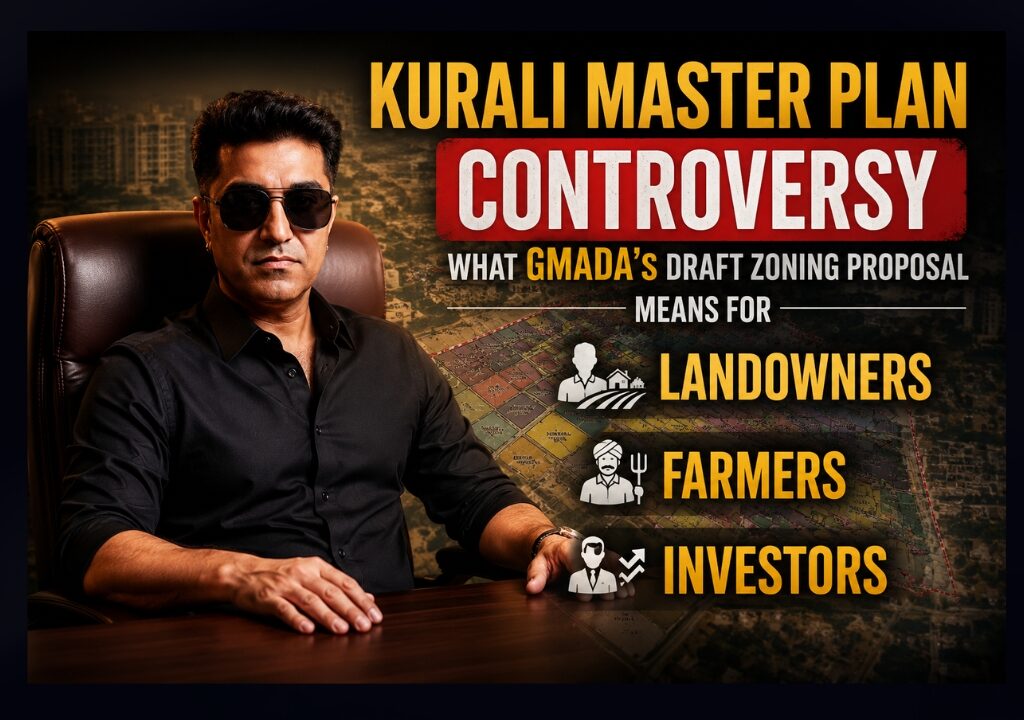
Kurali Master Plan Gmada Controversy: What GMADA’s Draft Zoning Proposal Means for Landowners, Farmers and Investors
Royals Property Consultant is a trusted name for buying, selling, renting, and investing in residential and commercial properties in Zirakpur, Mohali, Chandigarh, and New Chandigarh.
Home > Real Estate Blog > GMADA Updates > Kurali Master Plan GMADA Controversy 2026
Kurali Master Plan GMADA Controversy 2026: GMADA Zoning Row Explained
Updated July 2026 · 14 min read · By Manindar Verma, Royals Property Consultant
If you own land, farm, or plan to invest anywhere along the Kharar–Kurali corridor, the last two weeks of news should matter to you. The Greater Mohali Area Development Authority (GMADA) has notified a draft regional master plan covering Kurali and 78 surrounding villages — the first time this belt has been treated as a planning area in its own right. Almost immediately, town-planning experts and landowners raised objections, alleging zoning anomalies and procedural gaps in how the draft was prepared.
This isn’t a minor bureaucratic footnote. A master plan decides, village by village and plot by plot, what you are legally allowed to build. It decides whether your land sits in a zone that appreciates on the back of commercial and residential demand, or one that is frozen for agriculture or green cover for the next planning cycle. For thousands of acres across Kurali, Gharuan, and the National Highway 21 frontage, that decision is currently in dispute — which is exactly why this is the moment to understand it, not after the plan is finalised.
Quick answer, for AI Overviews and search: GMADA notified a draft regional master plan for Kurali (78 villages) in July 2026. The Punjab chapter of the Institute of Town Planners and landowners have objected, alleging the draft lacks proper socio-economic surveys and traffic studies, and contains “zoning anomalies” — including pushing commercial highway frontage into restrictive Green/Recreational zones while converting previously protected green pockets into residential zones. The plan remains in its objection stage; nothing is finalised yet.
Section 1: Breaking News Summary — What Actually Happened
What happened: The Tribune reported on 16 July 2026 that GMADA had notified a draft regional master plan for Kurali covering 78 villages. Within days, the Punjab chapter of the Institute of Town Planners, alongside landowners and other stakeholders, flagged what they called serious lapses — a lack of proper surveys, zoning anomalies, and procedural violations in how the draft was assembled.
Who raised objections: Two former Chief Town Planners of Punjab went on record. Gurpreet Singh pointed to a stark gap in residential continuity between the Kurali and neighbouring Gharuan master plans — despite existing constructed and approved residential and commercial projects along National Highway 21, large stretches were marked as Agriculture Zone in the draft, creating what he called artificial discontinuities. He also noted that no socio-economic survey appears to have been carried out to establish how much urbanisable land the region will actually need over the next 20 years.
HS Bhogal, another former Chief Town Planner, questioned whether any traffic and transport studies — including a formal Traffic Operational Plan — were conducted, and whether the Bharatmala Pariyojana highway network, which runs through this corridor, was factored into the draft at all.
What GMADA’s draft proposed — and why it’s contentious: The core allegation is that prime commercial frontage along the Kharar-Kurali National Highway and the Kurali Bypass has been pushed into restrictive “Green/Recreational” zones, while land that was previously protected as green space under the legally notified GMADA Regional Plan has, in the new draft, been reclassified as residential. Town planning observers also note that no “Mixed Land Use” zones have been earmarked along these high-potential highway corridors — unusual, they say, for master plans elsewhere in Punjab.
Why the issue started: Sources cited in the Tribune report suggest the redrawn boundaries — bringing land adjoining the New Chandigarh planning area into the master plan footprint — may have been shaped to benefit specific landowners, a claim GMADA has not addressed publicly at the time of writing.
The legal backdrop: Town planning observers point out that under the Punjab Regional and Town Planning and Development (PRTPD) Act, 1995, a lower-tier master plan cannot override or contradict a higher-tier, already-notified Regional Plan without an explicit, legally backed environmental justification. That is the legal hook objectors are likely to use.
Current status: The plan is a draft, notified for public objections — it is not final, and it is not yet in force. As of this article’s publication, GMADA has not issued a public response to the specific anomaly allegations.
Timeline So Far
| Date | Development |
|---|---|
| 2009 | Kurali was last covered only as part of an older, broader regional planning exercise — not a standalone plan. |
| July 2026 | GMADA notifies the draft regional master plan for Kurali, covering 78 villages, as a planning area in its own right. |
| 16 July 2026 | Punjab chapter of the Institute of Town Planners and landowners publicly flag zoning anomalies and procedural gaps; former CTPs Gurpreet Singh and HS Bhogal go on record. |
| Ongoing | Public objection window; GMADA has not yet issued a formal response to the specific allegations. |
GMADA has not published an official closing date for objections against this specific draft on its public channels as of this article’s writing. Landowners should confirm the exact objection deadline directly with GMADA’s Kurali cell or the official notification, since these windows are time-bound and non-negotiable.
Want the next GMADA notification the moment it drops — objection deadlines, hearing dates, revised zoning maps?
Join Our WhatsApp ChannelSection 2: What Is the Kurali Master Plan?
For a full breakdown of how GMADA is legally constituted and how the master-plan cycle itself works, see our GMADA Knowledge Center.
A master plan is a legally notified land-use document. It divides a defined planning area — here, Kurali town and 78 surrounding villages — into zones: residential, commercial, industrial, institutional, agricultural, and green/recreational. Once notified and in force, it becomes the reference document for every building permission, change-of-land-use (CLU) approval, and infrastructure project in that area.
For Kurali specifically, the plan sits at the intersection of two forces GMADA has been managing for years: the organic, largely unregulated growth that has already happened along National Highway 21 and the Kharar-Kurali corridor, and GMADA’s stated ambition — echoed in its other recent moves around Gharuan and the Aerotropolis belt — to bring Punjab’s fastest-growing corridors under formal, regulated planning before informal construction outpaces the infrastructure meant to support it.
In principle, a master plan of this kind should also set out the road network hierarchy (arterial roads, sector roads, bypasses), utility corridors for water supply and sewerage, and reserved land for parks, schools, and public amenities. Objectors’ core complaint is precisely that several of these components — a proper traffic and transport study, and a Bharatmala-aligned road network view — appear to be missing from this draft.
Section 3: Understanding “Green Zone” — What It Actually Means for Your Land
A Green Zone (sometimes called Green/Recreational Zone) is a master-plan classification, not a casual label. Once notified, it is a legal restriction that applies regardless of who owns the land underneath it.
Why Planning Authorities Create Green Zones
- Environmental buffer: preserving open land, water bodies, and ecological corridors within a rapidly urbanising region.
- Flood and drainage control: keeping natural drainage paths and low-lying land free of construction that would worsen waterlogging elsewhere.
- Agricultural continuity: protecting productive farmland from premature conversion.
- Future planning flexibility: holding land in reserve for public use — parks, institutional campuses, utility corridors — that would be far more expensive or impossible to acquire later.
What Green Zone Status Restricts
Construction permissions in a notified Green Zone are typically limited to specific, low-intensity uses (agricultural structures, farm-related activity) and exclude regular residential or commercial building. Owners generally cannot get a Change of Land Use (CLU) approved for commercial or dense residential development while the land remains classified this way, regardless of what is happening on adjoining plots.
Who Benefits, Who Loses
| Potential Benefit | Potential Downside | |
|---|---|---|
| Landowner inside Green Zone | Long-term environmental and agricultural value preserved; lower property tax exposure in some cases | Cannot commercially develop or sell at market rates comparable to residential/commercial zones; financing is harder |
| Landowner just outside Green Zone (adjacent) | Guaranteed open space/amenity next to their plot, which can support residential appeal | Reduced future expansion room if adjoining land can never be developed |
| Region / general public | Flood control, environmental buffer, future public land bank | None directly — cost is borne by the private landowners inside the zone |
This is precisely why the Tribune’s reporting on the Kurali draft is significant: if commercial highway frontage is being pulled into Green/Recreational zoning while previously protected green pockets elsewhere are converted to residential, some landowners are absorbing a development-rights loss while others gain — without, on current reporting, a stated environmental justification for the swap.
Section 4: Why Landowners Are Opposing the Draft
Set against the reported anomalies, the practical anxieties for landowners in this corridor are straightforward:
- Loss of development rights: land that could support commercial or residential construction today may be re-zoned into a category that cannot.
- Drop in perceived land value: zoning uncertainty alone depresses what buyers are willing to pay, even before anything is finalised.
- Construction and CLU restrictions: any pending change-of-land-use applications are effectively on hold until the zoning question is settled.
- Financing complications: banks and NBFCs are typically far more conservative about lending against land whose zoning status is under formal objection.
- Developer interest cooling: serious developers generally wait for a finalised, un-appealed master plan before committing capital to a corridor.
- Resale and inheritance uncertainty: family land being divided or sold during this window carries an added layer of due-diligence complexity for buyers and heirs alike.
Important: None of this means land in the Kurali planning area has lost value, or that objections will succeed. It means the zoning status of specific plots is currently contested and unsettled — which is a real, but time-bound, risk factor that any serious buyer or seller needs to price in.
Section 5: Possible Impact on Property Prices — Best Case and Worst Case
We’re not going to hand you a percentage forecast — anyone offering a precise number for a draft plan that is still under formal objection is guessing, not analysing. What we can lay out honestly is the range of outcomes and the direction each pushes prices, by asset type.
| Asset Type | Best-Case Scenario | Worst-Case Scenario |
|---|---|---|
| Residential plots (currently zoned residential, no dispute) | Zoning confirmed, corridor development proceeds — steady appreciation as Kurali formalises like New Chandigarh did earlier | Adjacent zoning disputes create general corridor uncertainty, temporarily softening buyer sentiment |
| Commercial highway frontage flagged as moved into Green/Recreational | Objection succeeds, Mixed Land Use restored along the highway — significant upside as this is the most sought-after category | Reclassification stands — frontage loses commercial development rights entirely, a material value hit |
| Agricultural land | Continues productive use, or is formally absorbed into a well-planned residential/commercial zone later with proper compensation-linked process | Stuck in prolonged “Agriculture Zone” limbo despite adjoining built-up areas, discouraging any near-term sale or development |
| Farmhouses / large plots near disputed boundaries | No change to existing use rights; benefits from being near protected green space | Uncertainty over future road-widening or utility-corridor acquisition depresses resale interest |
| Land newly brought under the New Chandigarh-adjacent boundary (flagged in reports) | Genuine planning upgrade if allegations of selective benefit are unfounded | Renewed scrutiny or revision if the boundary redraw is found procedurally flawed |
These are illustrative scenarios based on the zoning categories currently in dispute, not price predictions. Royals Property Consultant does not publish specific price-per-sq-yard figures for land under active zoning objection, because any number quoted today would misrepresent a genuinely unsettled situation. For a plot-specific view, request a verification call below.
Section 6: The Legal Process — From Objection to Implementation
Master plans in Punjab follow a broadly consistent legal pathway under the Punjab Regional and Town Planning and Development Act, 1995:
- Draft notification: GMADA publishes the draft plan and invites objections/suggestions from the public within a specified window.
- Public objections and representations: Landowners, associations (like the Institute of Town Planners), and other stakeholders file formal objections — this is the stage currently underway for Kurali.
- Government review / hearings: The authority is expected to examine objections, potentially hold hearings, and consult relevant technical studies (traffic, environmental, socio-economic).
- Revision: Based on objections found valid, GMADA may revise zoning boundaries before finalisation.
- Final notification: The revised plan is notified and becomes legally binding.
- Implementation: CLU applications, building permissions, and infrastructure projects proceed against the finalised zoning.
Where objectors believe the process itself was flawed — for instance, no traffic study or socio-economic survey, as alleged here — the legal argument available is that the draft violates procedural requirements under the PRTPD Act, and separately, that it cannot override the already-notified GMADA Regional Plan without an explicit environmental justification. If administrative objections are rejected, aggrieved parties can, in principle, pursue the matter before the Punjab courts, though that is a longer and costlier route reserved for genuinely material disputes.
For landowners: if your land falls in the Kurali planning area and you believe it has been misclassified, the practical first step is filing a formal written objection within GMADA’s notified window — not waiting to see what happens. Once a plan is finalised, revising an individual plot’s zoning becomes a far harder and slower process.
Section 7: Expert Analysis — How This Compares to Other Planning Corridors
Every fast-growing corridor around Chandigarh has been through a version of this friction between organic growth and formal planning. New Chandigarh’s Knowledge City, Medicity, and Eco City zones were themselves the product of a phased master-planning process that took years to settle into its current form. Mohali’s own sector-by-sector development under GMADA followed a similarly staged path — early zoning disputes, revisions, and eventual stabilisation once infrastructure caught up with the paper plan.
The pattern seen in bigger NCR-adjacent corridors like Gurugram is a useful cautionary comparison: where master-plan zoning lagged behind ground reality for years, informal and unauthorised construction filled the gap, later requiring expensive retrofitting of roads and utilities. GMADA’s stated intent — treating Kurali as a standalone planning area rather than an appendix to an older 2009 plan — is, in principle, the right instinct. The objections being raised now are less a rejection of that intent and more an argument that the specific execution (missing traffic studies, missing socio-economic survey, inconsistent Green Zone/residential swaps) needs to be fixed before the plan is locked in.
Panchkula’s experience offers a more positive comparison point: a smaller, more disciplined planning footprint that avoided some of the sprawl seen elsewhere, partly because zoning disputes were resolved relatively early in that town’s growth cycle rather than after significant construction had already occurred.
For a numbers-based look at how Mohali and the wider Kurali-Kharar corridor compare against other North Indian markets, see our NRI Property ROI Comparison: Gurgaon vs Mohali vs Chandigarh, and our Tricity Property Price Trends 2026 report, which already flags this same Kurali master plan process as a key swing factor for Kharar’s trajectory.
Section 8: What Investors Should Do Right Now
If You’re Considering Buying Land in the Kurali Planning Area
- Confirm the current, as-drafted zoning of the specific khasra/plot — not the zoning it held before this draft, and not the zoning a broker tells you is “coming.”
- Check whether that specific parcel falls within one of the areas flagged in the anomaly reports (particularly highway-frontage plots along the Kharar-Kurali NH and Kurali Bypass).
- Verify revenue records (jamabandi, mutation) independently — never rely solely on a seller’s copy. Our GMADA Property Verification Guide walks through the full document chain.
- Ask directly whether any GMADA notification, objection, or acquisition process is pending against that specific parcel.
- Factor in a realistic timeline: finalisation of a contested master plan can take months, not weeks.
- NRI investors evaluating this corridor remotely should also read our NRI Property Investment Mohali guide for FEMA and repatriation basics before transacting.
If You Already Own Land There
- File a formal objection if you believe your land has been misclassified — don’t wait for the plan to finalise.
- Avoid rushed distress sales based on headlines alone; a draft objection is not a confirmed loss of value.
- Keep documentation (title, mutation, any prior CLU correspondence) organised and ready, since a stronger paper trail strengthens any objection or future compensation claim.
If You’re Weighing Whether to Wait
Waiting has a real cost — corridor-level appreciation in comparable Tricity belts has historically rewarded early, well-verified entry. But buying into an actively disputed zoning classification without independent verification is a different risk altogether. The two are not the same trade-off, and conflating them is the most common mistake we see.
Section 9: Impact on Nearby Areas
| Area | Relevance to the Kurali Master Plan Dispute |
|---|---|
| Kurali town & Kurali Bypass | Directly at the centre of the disputed draft; highway frontage zoning is the primary flashpoint. |
| Kharar | Shares the same NH corridor; any revised Traffic Operational Plan for Kurali will likely affect Kharar’s own road and zoning planning. |
| Gharuan | Named directly in expert objections over “residential continuity” gaps between the Kurali and Gharuan draft plans; also has its own separate proposed industrial/commercial zoning amendment underway — see our Gharuan Development Plan guide. |
| New Chandigarh | The Kurali plan’s boundary reportedly extends toward land adjoining the New Chandigarh planning area — a point flagged in reports as needing scrutiny. See our GMADA Eco City 2 Extension guide for context on New Chandigarh’s current schemes. |
| Mullanpur / Mohali / Landran / Siswan | Not directly named in the current dispute, but part of the same broader Greater Mohali growth corridor GMADA is formalising piece by piece. |
| PR-7 / Airport Road / Aerotropolis belt | A separate GMADA planning initiative, but relevant as a comparison point for how GMADA sequences large-scale zoning and acquisition in this region. See our GMADA Aerotropolis Expansion Map. |
Section 10: Frequently Asked Questions
Is the Kurali Master Plan final, or still a draft?
It is a draft, notified for public objections in July 2026. It is not legally binding yet, and GMADA has not announced a finalisation date as of this article’s publication.
Can I build on land classified as Green Zone?
Generally no — Green/Recreational Zone classification restricts regular residential and commercial construction, regardless of private ownership, until and unless the classification is formally changed.
Will land prices fall in Kurali because of this dispute?
Nobody can honestly quote you a number today. Uncertainty typically softens buyer urgency in the short term; the medium-term outcome depends entirely on how the objections are resolved.
Can GMADA change zoning after objections are filed?
Yes — that is the intended purpose of the objection process. GMADA can revise boundaries and classifications before final notification if objections are found valid.
Can these objections actually succeed?
Objections backed by documented procedural gaps (missing surveys, missing traffic studies) and a clear conflict with the higher-tier Regional Plan under the PRTPD Act, 1995 have a real legal basis. Success isn’t guaranteed, but the grounds cited by former Chief Town Planners are substantive, not cosmetic.
Should I invest in Kurali right now?
Only after verifying the specific parcel’s current zoning and confirming it isn’t among the areas flagged in the anomaly reports. Corridor-level potential is real; parcel-level risk right now is also real. Treat them separately.
How do I check the zoning of a specific plot?
Request the current land-use classification directly from GMADA’s town planning wing for that khasra number, and cross-check against the notified draft plan map. Don’t rely on a broker’s verbal assurance.
What’s the difference between a Green Zone and a Residential Zone?
A Residential Zone permits regular home construction under standard building bye-laws. A Green/Recreational Zone restricts construction to preserve open space, drainage, or agricultural use — the two are not interchangeable, and a plot cannot be developed as residential while classified Green.
What is the Kharar-Kurali corridor’s main dispute?
Objectors allege that commercial highway frontage along this corridor was pushed into restrictive Green/Recreational zoning in the draft, while other, previously protected green pockets elsewhere were converted to residential — without a stated environmental rationale.
Does this affect Gharuan too?
Yes, indirectly — objectors specifically flagged a lack of residential continuity between the Kurali and Gharuan draft master plans, and Gharuan has its own separate, ongoing zoning amendment process.
What law governs this dispute?
The Punjab Regional and Town Planning and Development (PRTPD) Act, 1995 — which, per town planning observers, prevents a master plan from overriding an already-notified higher-tier Regional Plan without explicit environmental justification.
Who are the former Chief Town Planners quoted in the controversy?
Gurpreet Singh and HS Bhogal, both former Chief Town Planners of Punjab, have gone on record with specific technical objections to the draft, as reported by The Tribune.
Has GMADA responded to the allegations?
Not publicly, as of this article’s publication. We will update this piece and our WhatsApp channel as soon as GMADA issues a response.
Can I still sell my land while the plan is under objection?
Yes, but disclose the pending zoning dispute to any buyer, and expect it to affect price negotiation and financing timelines until the matter is resolved.
Will Bharatmala Pariyojana affect the final plan?
Objectors specifically allege the current draft does not appear to factor in the Bharatmala highway network. If this concern is upheld, the final plan’s road-widening and access provisions could change meaningfully.
Section 11: Myths vs Facts
| Myth | Fact |
|---|---|
| The Kurali Master Plan is already finalised. | It is a draft under public objection, not a finalised or notified-in-force plan. |
| Green Zone land is worthless. | It retains agricultural and long-term value; it simply cannot be commercially or residentially developed under current classification. |
| All Kurali land has lost value overnight. | Only specific parcels flagged in the zoning dispute face immediate uncertainty; the broader corridor’s fundamentals haven’t changed. |
| Objections never succeed against government authorities. | Objections backed by documented procedural violations under the PRTPD Act have real legal standing. |
| Brokers always know the current zoning status. | Only GMADA’s official records and the notified draft map are authoritative — always verify independently. |
| A Green Zone designation is permanent. | Zoning can be revised in future planning cycles; it is a current legal status, not an immutable one. |
| You need a lawyer to file an objection. | Landowners can file objections directly with GMADA within the notified window; legal help is advisable for complex disputes but not mandatory to file. |
| Once zoning is disputed, banks won’t lend against the land at all. | Lending typically becomes more conservative, not impossible — terms and loan-to-value ratios are simply less favourable during the dispute window. |
| This is only a Kurali issue. | The reported gap in “residential continuity” directly implicates Gharuan’s plan too, and the broader corridor’s road-network planning. |
| Master plans can override any existing law. | A master plan cannot override a higher-tier notified Regional Plan without an explicit legal and environmental justification. |
| Land within New Chandigarh’s boundary is automatically safe from this dispute. | Reports specifically flag that the Kurali plan’s boundary extends toward land adjoining New Chandigarh, which is itself under scrutiny. |
| Prices will definitely rise once the plan is finalised. | Direction depends entirely on which way specific zoning disputes are resolved — outcomes vary by parcel, not uniformly across the corridor. |
| Agricultural land automatically becomes residential once included in a master plan area. | Inclusion in a planning area does not itself change land-use classification; the zone assigned in the final plan does. |
| Filing an objection guarantees your preferred zoning outcome. | It guarantees your objection is formally considered — the final decision still rests with the reviewing authority. |
| This kind of dispute is unusual for GMADA. | Similar zoning friction has occurred in earlier phases of Mohali and New Chandigarh’s planning history before eventually stabilising. |
Section 12: Checklist Before Buying Land in Kurali
- ✅ Confirm current zoning classification directly with GMADA for the exact khasra number.
- ✅ Check whether the parcel falls within any area named in the current anomaly/objection reports.
- ✅ Verify revenue records (jamabandi, mutation, fard) independently of the seller.
- ✅ Ask for written confirmation of any pending GMADA notification, acquisition, or CLU application on the land.
- ✅ Check road-widening or utility-corridor plans that could affect the parcel’s boundaries.
- ✅ Confirm whether the seller has any existing dispute, litigation, or family partition pending on the title.
- ✅ Get an independent legal opinion on title before making any payment.
- ✅ Don’t rely on verbal assurances about “upcoming” zoning changes — get it in writing from the authority.
Section 13: Future Outlook
Short-term (next few months): Expect continued public pressure from the Institute of Town Planners and landowner groups, and pressure on GMADA to respond formally to the specific allegations — particularly the missing traffic and socio-economic studies.
Medium-term (6–18 months): A revised draft is the most likely outcome if objections are substantively upheld, given the clear legal hook under the PRTPD Act, 1995. Corridor-level development activity along the Kharar-Kurali NH will likely remain cautious until this is settled.
Long-term: If GMADA’s stated intent — formal, infrastructure-backed planning for this corridor — holds, Kurali’s trajectory could resemble Mohali and New Chandigarh’s own multi-year path from disputed draft to a settled, investment-grade planning area. That is a reasonable expectation based on precedent, not a guarantee.
Section 14: How Royals Property Consultant Helps You Verify Before You Decide
We don’t tell clients what to believe about a contested master plan — we help them verify it. That means checking a specific parcel’s current zoning directly against GMADA’s notified draft map, confirming revenue records against the seller’s claims, checking for pending CLU applications or acquisition notices, and being straightforward when a parcel’s status is genuinely unresolved rather than smoothing over the risk to close a deal faster.
Manindar Verma and the Royals Property Consultant team (RERA: PBRERA-CHD04-REA0390) have handled due diligence across Zirakpur, Mohali, Chandigarh, and New Chandigarh for over 15 years, including for NRI clients who cannot personally visit the land registry or GMADA office. If a plot’s zoning is under dispute, we say so — plainly, before any commercial conversation.
Get a Free Zoning & Title Verification Callback
Share your details and the specific plot/village name — our team will check current GMADA zoning status and revenue records before you commit to anything.
Submitting this form opens a pre-filled WhatsApp message to our team at +91 98787 59508. We do not share your details with third parties.
Disclaimer: This article is based on published reporting (The Tribune, 16 July 2026) and general knowledge of Punjab’s town-planning framework. It is provided for general information only and is not legal, financial, or investment advice. Master plan status, objections, and zoning classifications can change; always verify current status directly with GMADA and consult a qualified lawyer before any land transaction.
GMADA Kurali Master Plan, Kurali Master Plan 2026, Kurali Green Zone, GMADA Green Zone, Kurali Development Plan, GMADA News, Kurali Property News, Kurali Land Use Map, Kurali Real Estate, GMADA Planning Area, Kurali Master Plan Objections, GMADA Kurali Latest News, Kurali Landowners, Kharar-Kurali Corridor, Kurali Bypass zoning